Word of the Day: BLASPHEMATORY

ETYMOLOGY
from Latin blasphematorius, from blasphemator (from blasphemat-, past participial stem of blasphemare (to blaspheme)) + -ius

EXAMPLE
“… But againe I renounce and abiure now and for euer, both her and all her doctrine; in so much as that it is against the expresse word of God, blasphematory, Apostatique, superstitious, and as farre from the meaning of Christe our true maister, as darkenesse from light, as falshood from trueth, & vice from vertue: most humbly beseeching almighty GOD (thorough the entralls of his mercy, and through the most precious bloude which his sonne Iesus Christ hath shed for me) that he will not lay to my charge the faults of my youth nor iudge me according to the sinnes of my ignorance; but rather pursuing his mercy begunne in me, he will pardon all my offences committed by me either in works, words or thoughts, and in others, through examples and wicked superstitious doctrines: …”

From: The Confession and Publike Recantation of Thirteene Learned Personages,
Translated out of the French and Dutch printed copies, by I.M., 1602
Word of the Day: SPEECHFUL

ETYMOLOGY
from speech + -ful

EXAMPLE (for adj. 2.)
“… John Mauropus, of Euchaita, Euchania, Theodoropolis — one living man among many dead, as the Arabian tale goes of the city of enchantment — one speechful voice among the silent, sole survivor of the breath which maketh words effluence of the soul replacing the bittern’s cry — speak to us! …”

From: Some Account of the Greek Christian Poets
By Elizabeth Barrett Browning, 1842 (1863)

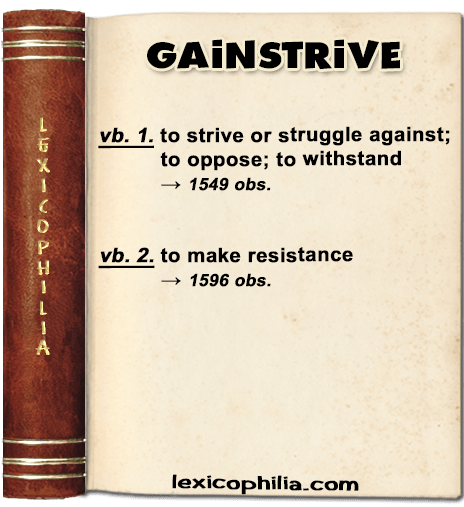
Word of the Day: GAINSTRIVE

ETYMOLOGY
from gain- (against, in opposition to) + strive (to endeavour vigorously)

EXAMPLE (for vb. 1.)
“… Giue vs that peace, which we doo lacke,
Through misbelief and ill lyfe:
Thy Word to offer thou dost not slacke,
Which we unkindly
gainstriue.
With fire and swoord,
This healthfull woord:
Some persecute and oppres:
Some with the mouth,
Confess the truth,
Wythout sincere godlynes.
…”

From: The Whole book of Psalms: collected into English metre, by Thomas Sternhold, John Hopkins, and others, 1569
Da Pacem, Domine

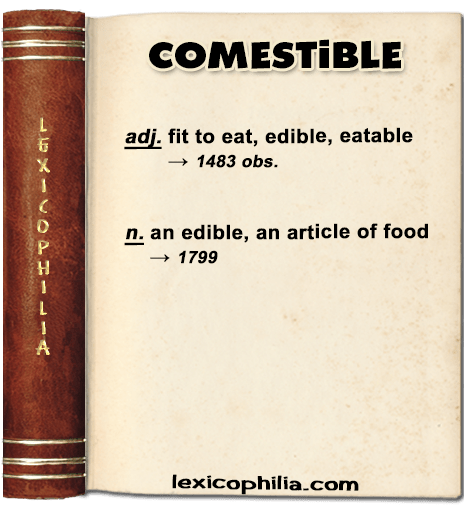
Word of the Day: COMESTIBLE

ETYMOLOGY
from French comestible (edible), or from Latin comestibilis (fit to eat, edible);
from comest- variant of comes- past participial stem of comedere (to eat up, devour);
from com- (altogether) + edere (to eat)

EXAMPLE (for adj.)
“… And they mocked hym and said that he raued and was a foole and gaf no faith to his sayeng, and contynued in theyr synnne and wickednes. Thenne whan the Arcke was parfyghtly maad god bad hym to take in to it of all the beestis of therthe, and also of the fowles of thayer of eche two male and female, that they may lyue and also of all the metes of therthe that ben comestible, that they may serue and fede the and them. And Noe dyde all that our lord commanded hym. Thenne said our lord to Noe entre thou and all thy houshold in to the Arke, that is to saye thou and thy wyf and thy thre sones & theyr thre wiuys I haue seen that thou art rightful in this generacion. …”

From: Legenda aurea sanctorum, sive, Lombardica historia/The Golden Legend
By Jacobus de Voragine
Translated by William Caxton, 1483

Word of the Day: PEACIFY

ETYMOLOGY
from peace (n.) + -ify, influenced by pacify (vb.)

EXAMPLE
“… yet she wolde not but rather suffre dethe she was so stedfaste in the feythe relygyous and chaste, and thus he beynge in great perplexyte and doutfull peryll, the foresayde Blessyd vyrgyne his Donghter was warnyd by an Aungell that she shulde goo to her Fader and bydde hym agree to the other Kynys requeste and desyre, and that she shulde assent therto, / and so shulde she comforte and assure her Fader and peacyfye and make glad the other parte.

From: Here Begynneth the Kalendre of the Newe Legende of Englande, 1516

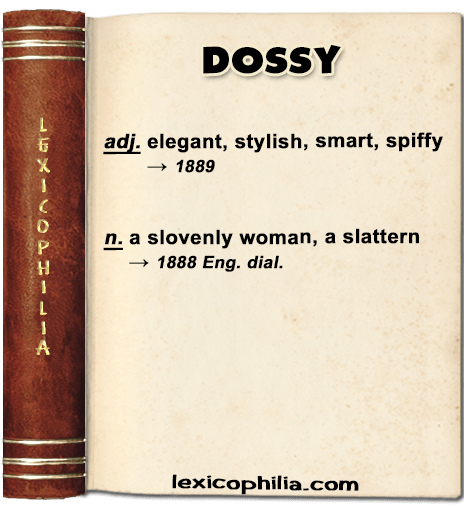
Word of the Day: DOSSY

ETYMOLOGY
of uncertain origin;
Scots has doss (neat, spruce) and dossie (a sprucely dressed person)

EXAMPLE (for adj.)
“… I’ll tell you where they’ll get the pull of us,” (this very confidentially and in my ear.)
“There ain’t no weather down there,” (pointing to asphalt with this whip), “and what with the ladies’ bonnets and blokes’
dossy hats, that’s a big matter. …”

From: The Daily Colonist
Victoria, BC, Sunday September 2 1900

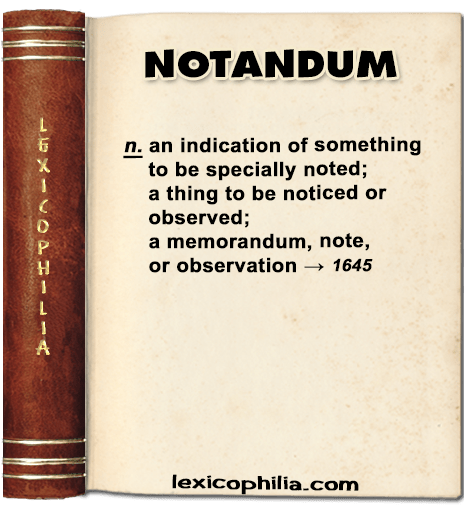
Word of the Day: NOTANDUM

ETYMOLOGY
from Latin notandum, (neuter singular of notandus, gerundive of notare (to note)

EXAMPLE
“… These former notandums having beene premised, we need not dwell long upon answering of objection, for by them the way is opened already, and that which before hath beene delivered will not need any more then application. …”

From: The Prerogative of Man, or, His soules immortality, and high perfection defended, 1645

PRONUNCIATION
noh-TAN-duhm

Word of the Day: OENOPHILIST

ETYMOLOGY
from oeno- (relating to or resembling wine) + -philist (loving the person or thing denoted)

EXAMPLE
“… Are the Temperance men to be allowed to shout in the public places? are the Vegetarians to bellow ” Cabbage for ever?” and may we modest Œnophilists not sing the praises of our favourite plant? After the drinking of good Bordeaux wine, there is a point (I do not say a pint) at which men arrive, when all the generous faculties of the soul are awakened and in full vigour; when the wit brightens and breaks out in sudden flashes; when the intellects are keenest; when the pent up words and confined thoughts get a night-rule, and rush abroad and disport themselves; when the kindest affections come out and shake hands with mankind, and the timid Truth jumps up naked out of his well and proclaims himself to all the world. …”

From: Title: The Virginians
By William Makepeace Thackeray, 1859

PRONUNCIATION
ee-NOFF-uh-list

Word of the Day: CESSIVE

ETYMOLOGY
from Latin cess- participial stem of cedere (to yield) + -ive

EXAMPLE
“… Yet there is a Diversity in Softness by Argentrive, and in Softness by Sulphur: because Softness by Sulphur is Cessive, but Softness by Argentrive is Extensive. And this must necessarily be proved by Sight; seeing We see Bodies of much Argentrive, to be of much Extension; but Bodies of little, of little. …”

From: The Works of Geber
By Jabir ibn Haiyan
Translated by Richard Russell, 1678