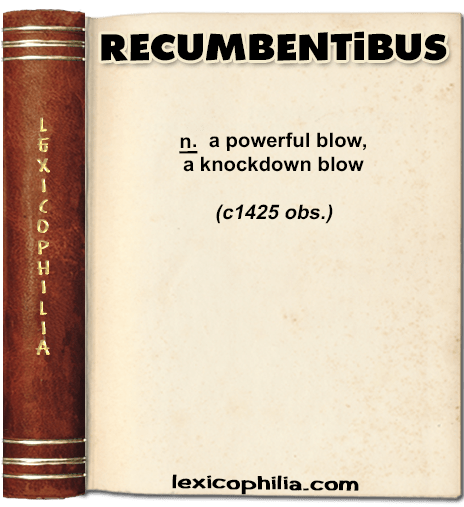
Word of the Day: RECUMBENTIBUS


ETYMOLOGY
a humorous use of Latin recumbentibus, ablative plural of recumbens, present participle of recumbere (recumb – to lean, recline, rest)


EXAMPLE
“…Ector sone to him gan take,
He thoght him venge of that wrake;
Ector bare his sword on hye,—
For he hadde no spere him bye,—
He ȝaff the kyng Episcropus
Suche a recumbentibus,
He smot In-two bothe helme & mayle,
Coleret and the ventayle…”

From: The Laud Troy Book;
an anonymous Middle English poem dealing with the background and events of the Trojan War, dating from around 1400
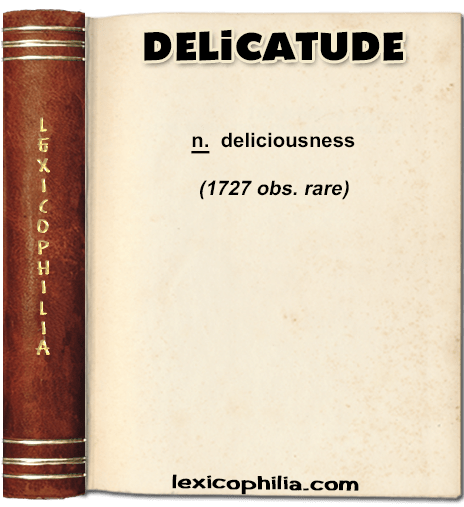
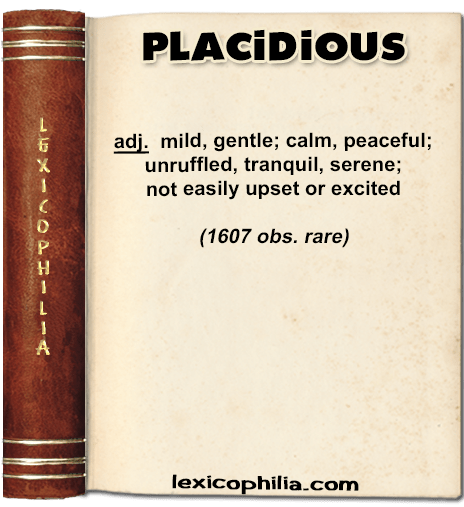
Word of the Day: PLACIDIOUS


ETYMOLOGY
from Latin placidus (pleasing, favourable, gentle, mild, calm),
from root of placēre (to please)


EXAMPLE
“…There was never any thing more strange in the nature of Dogs, then that which happened at *Rhodes besieged by the Turk, for the Dogs did there discern betwixt Christians and Turks; for towards the Turks they were most eager, furious, and unappeaseable but towards Christians, although unknown, most easie, peaceable and placidious, which thing caused a certain Poet to write thus…”

From: The History of Four-footed Beasts, and Serpents
By Edward Topsell, 1607

Word of the Day: HONEY-DROP


ETYMOLOGY
from honey + drop


EXAMPLE
“…The younges brother he stepped in,
            Took’s sister by the hand;
            Said, Here she is, my sister Maisry,
            Wi the hinny-draps on her chin.
             ‘O if I were in some bonny ship,
            And in some strange countrie,
            For to find out some conjurer,
            To gar Maisry speak to me!’…”

From: Bondsey and Maisry
in English and Scottish Popular Ballads
By Francis Child, 1886

Word of the Day: RECRAYED


ETYMOLOGY
from recray (to tire or wear out), from Anglo-Norman recreirerecreere and Middle French recroire (to desist, give up, to acknowledge oneself defeated, to yield in battle, to fail to go back on what one has said, to tire (something) out, to become tired out (especially of a horse), to confess (something), to go back on one’s sentiments or beliefs)


EXAMPLE
“…The toke[n]s ar not good
To be true Englysh blood
For if they vnderstood
  His traytourly dispyght
He was a recrayed knyght
A subtyll sysmatyke
Ryght nere an heretyke
Of grace out of the state
And dyed excomunycate…”

From: Agaynst the Scottes
By John Skelton, a1529

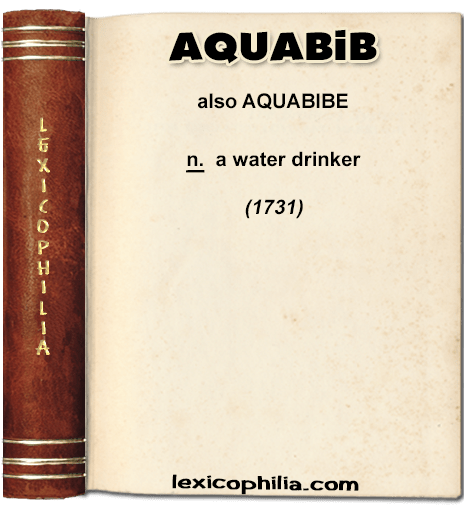
Word of the Day: AQUABIB


ETYMOLOGY
from Latin aqua (water) + bibere (to drink)


EXAMPLE
“…To call a man a total abstainer would imply that he abstained from everything; to call him a temperance man is absurd, because from time immemorial men have drunk, as they still drink, wine temperately. Aquabib and hydropot may mean one who drinks water, but most men do that. I drink it always to quench thirst, but then I drink also a moderate quantity of wine…”

From: The Medical Times and Gazette,
A Journal of Medical Science, Literature, Criticism, and News
Volume I for 1883
“Temperance Appellations”

Word of the Day: INCOLIST


ETYMOLOGY
from Latin incolere (to inhabit) + -ist


EXAMPLE
“…which maladyes much molest the Germanes, and Septentrionall incolists; the like whereof hapned upon Caesars Souldiers when they came beyond Rhene, who there finding a River, drunk of the water, which within two dayes caused their teeth to fall out, and resolved the joynts of their knees, but the herb Britannica will help such as are thus infested…”

From: A Medicinal Dispensatory
Composed by the Illustrious Renodaeus,
Englished and Revised by Richard Tomlinson, 1657
Section 6. Of Fruits. Chapter XVII.

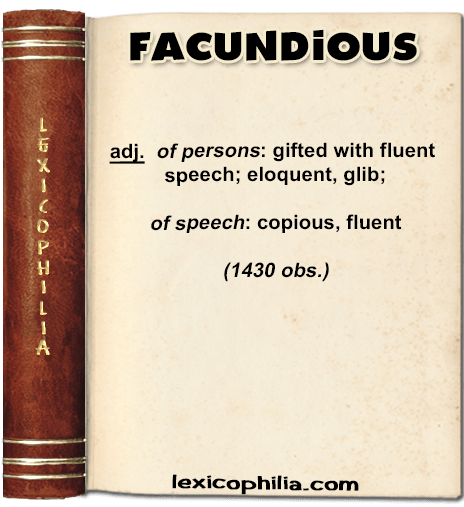
Word of the Day: FACUNDIOUS


ETYMOLOGY
from Latin fācundia (eloquence) + -ous


EXAMPLE
“…Discrete and hardy and wonder vertuous,
And of speche ryght facundious.
And coud him wel in euery thinge demene,
But Menelay of stature was but meane…”

From: The Auncient Historie and Onely Trewe and Syncere Cronicle of the Warres Betwixte the Grecians and the Troyans 
By John Lydgate, 1430