ETYMOLOGY
from oil + berry
EXAMPLE
“…And þer ſhal ben laft in it as þe braunche of a cluſter, and as þe ſhaking out of þe oile berie, as of two or of þre olyues in þe cop of þe braunch…”
From: Bible (Wycliffe, early version), a1382
ETYMOLOGY
from oil + berry
EXAMPLE
“…And þer ſhal ben laft in it as þe braunche of a cluſter, and as þe ſhaking out of þe oile berie, as of two or of þre olyues in þe cop of þe braunch…”
From: Bible (Wycliffe, early version), a1382
ETYMOLOGY
from spatter (to scatter or disperse in fragments)
EXAMPLE
“...Or when the court removes, or what’s a clock,
Or where’s the wind (or some such windy mock)
With such fine scimble, scemble, spitter-spatter,
As puts me clean besides the money-matter?
Thus with poor mongrel shifts, with what, where when?…”
From: A Kicksey Winsey: Or, A Lerry Come-Twang
By John Taylor, 1619

ETYMOLOGY
possibly from maum (mellow, soft, esp. over-ripe) + –ish
EXAMPLE
“…but she fed more vpon fancie, than glutted hir selfe with any cates there presente: more vpon daintie deuices, than any parcell of repast: for this meate forsooth was mawmish, & this melancholie: this dish would driue hir to drincke, and this cause hir to drie…”
From: Narbonus The Laberynth of Libertie
By Austin Saker, 1580
ETYMOLOGY
from high + stomached
EXAMPLE
“…For the which in those dayes, they had moche a do with these hygh stomaked Romanes…”
From: The Actes of Englysh Votaryes
By Iohan Bale, 1546
ETYMOLOGY
from Latin fracidus, from frac-, frax (lees of oil)
EXAMPLE
“…Natures recreation, which she out of the fracid ferment of putrifying Bodies doth form…”
From: The Reformed Common-wealth of Bees,
presented in several letters and observations to Samuel Hartlib, 1655
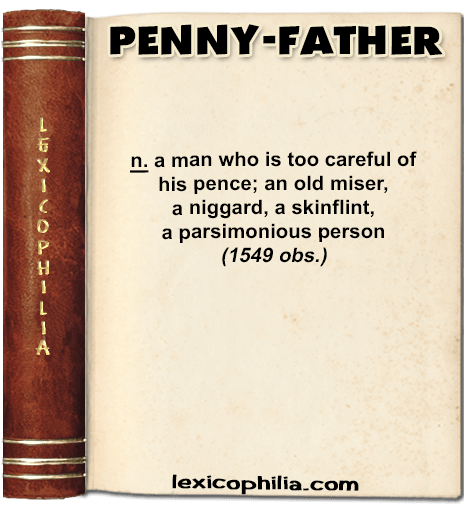
ETYMOLOGY
from penny + father
EXAMPLE
“…This skapethrifte, throweth his good{is} against the walles. That pennie father, skrapeth it togethers, bothe by God, and by the diuell…”
From: The Praise of Folie
Moriæ encomium a booke made in Latine by that great clerke Erasmus Roterodame,
Translated by Thomas Chaloner Knight, 1549

ETYMOLOGY
from Latin derogatorius derogatory + -ous
EXAMPLE
“…if the said archbishop intermeddled after the said provocation, his doings were derogatorious not only to the dignity of the patriarche but to the supremacy of the Pope and to the authority also of the general Counsell…”
From: A Treatise on The Pretended Divorce Between Henry VIII and Catharine of Aragon
By Nicholas Harpsfield, a1575
Modernized Text By Nicholas Pocock, 1878

ETYMOLOGY
from Latin insipientem, from in- + sapientem (wise, sapient)
EXAMPLE
“…Where the Chylde or Insypient drynkyth the swete and delycious wordis unauysydly…”
From: The New Cronycles of Englande & Fraunce
By Robert Fabyan, a1513
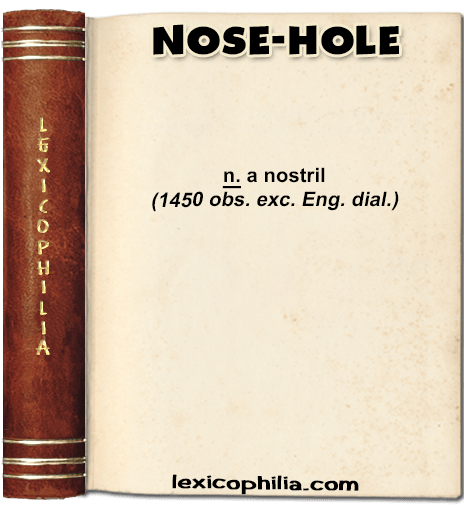
ETYMOLOGY
from nose + hole
EXAMPLE
“…Whan a bodi is stinged of an Adder than shall the woūde be wasshed ther with and clowtes wet layd ther vpō I Cotton wet in the same water & put in the nose holes is good agaynst Polippus that is stynkinge flesshe in the nose…”
From: The vertuose boke of distyllacyon of the waters of all maner of herbes
By Hieronymus Brunschwig
Translated by Laurence Andrewe, 1527
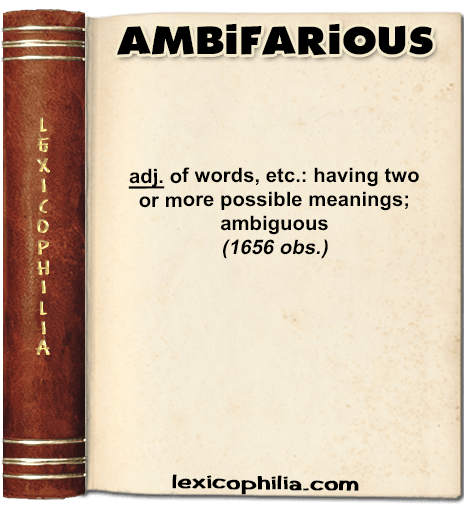
ETYMOLOGY
from Latin ambifarius two-sided, of double meaning + -ous
EXAMPLE
“…The Bridegroom, with his Bride is brought,
To Bed with various Turn of Thought;
By Ruth, with ambifarious Jest:
To please them both, she thinks it best…”
From: Poems on Various Subjects,
By Thomas Sadler, 1766
The Unfortunate Batchelor, Or Wife’s Resentment
 Lexicophilia