Word of the Day

Word of the Day: RHONCHISONANT


ETYMOLOGY
from Latin rhonchus (a snoring) + sonans, p. pr. of sonare (to sound)


EXAMPLE
“…Out marches the paleontologist Collett,
And with his little hammer
And scientific grammar
First knocks a mammoth tooth,
To put into his grip-sack;
Then constructs an awful name
By means of which to skip back
With a great rhonchisonant fury, on
The epochs carboniferous and Silurian…”

From: Biographical and Historical Record of Vermillion County, Indiana, 1888

Word of the Day: TOBACCONALIAN


ETYMOLOGY
from tobacco, after bacchanalian


EXAMPLE
“…As we passed on, the number of promenaders increased, but scarcely a lady was now to be seen. Every other gentleman we met was enveloped in a cloud, not of bacchanalian, but tobacconalian incense, which gave a peculiar atmosphere to the Levee…”

From: The South-West
By Joseph Holt Ingraham, 1835

Word of the Day: SPLENDICANT


ETYMOLOGY
from present pple. of Latin splendicare to shine


EXAMPLE
“…and yet cast into a curious desire to vnderstand and knowe what should be the reason and cause that the purple humiditie in the touch of hir bodie, in the smoothnes of hir hand should be as white as pure milke: and by what meanes that nature had bestowed in hir faire bodie the fragrant sweetnes of Arabia. And by what industrie in hir starrie forehead pampynulated with threds of gold aptly disposed, she had infixed the fairest part of the heauens, or the splendycant Heraclea…”

From: Hypnerotomachia: The Strife of Loue in a Dreame
By Francesco Colonna
Translated by Robert Dallington, 1592

Word of the Day: CLAPPER-TONGUE


ETYMOLOGY
from clapper (the tongue of a bell; a talkative person’s tongue) + tongue


EXAMPLE
“…She has an e’e, she has but ane,
The cat has twa the very colour;
Five rusty teeth, forbye a stump,
A clapper tongue wad deave a miller:
A whiskin beard about her mou’,
Her nose and chin they threaten ither;
Sic a wife as Willie had,
I wadna gie a button for her!…”

From: The Scots Musical Museum
By James Johnson, 1792
Sic A Wife as Willie had – Robert Burns

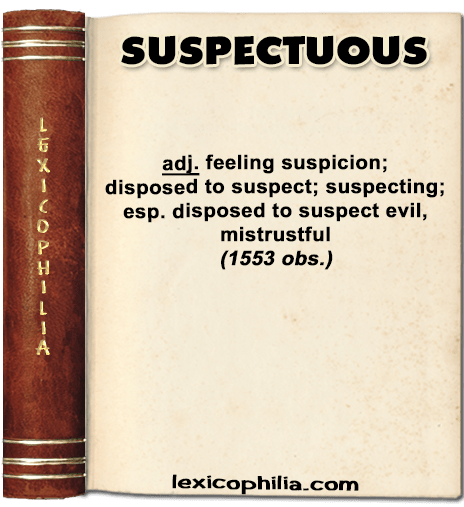
Word of the Day: SUSPECTUOUS


ETYMOLOGY
from Latin suspectus (u-stem) (suspect n.) + -ous


EXAMPLE
“…I thynke as our Cytezens be suspectuous and full of coniectoures; so dyd hee feare the comodyte of the place, and woulde eschewe the occasyon …”

From: The goodli history of the moste noble and beautyfull Ladye Lucres of Scene in Tuskane, and of her louer Eurialus verye pleasaunt and delectablevnto ye reder
By Pope Pius II, 1553

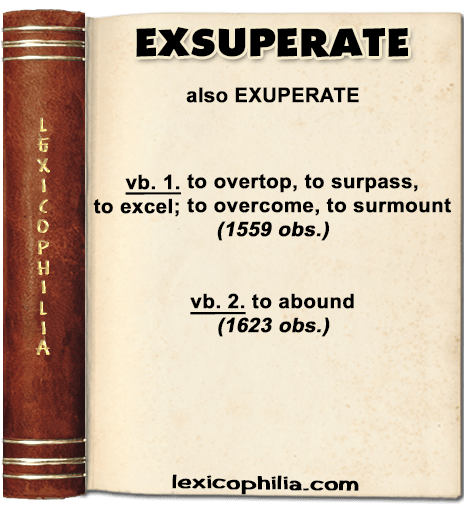
Word of the Day: EXSUPERATE


ETYMOLOGY
from Latin ex(s)uperat- ppl. stem of ex(s)uperare
from ex- + superare (to rise above), from super (above)


EXAMPLE
“…And if bewtie breed such blisfulnesse
Euamouring both God and man
Good Lady let no wilfulnesse
 Exuperate  your bewtye then
To slaye the hertes that yeld & craue
ladye ladye
The graunt of your goodwil to haue
My deare ladye…”

From: The Panges of Loue and Louers Fittes
By William Elderton, 1559

Word of the Day: DECURTATE


ETYMOLOGY
adjective: from Latin decurtatus, pa. pple. of decurtare (to cut off, curtail)
verb: from participial stem of Latin decurtare + -ate


EXAMPLE
“…hee sendes for his Barber to depure, decurtate, and spunge him, whome hauing not paide a twelmonth before, he now raines downe eight quarter angels into his hande…”

From: Lenten Stuffe
By Thomas Nashe, 1599

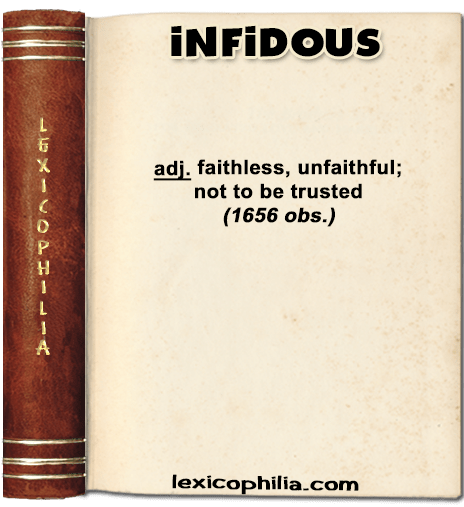
Word of the Day: INFIDOUS


ETYMOLOGY
from Latin infīdus (untrue, disloyal) + -ous


EXAMPLE
“…The Arabian Interpreters are also miserably out, in rendring Tabaxir Spodium, and Spodium Burnt Ivory: for Tabaxir is the succe or concreted liquor of certain Trees, or very crass and tall Reeds, which by the agitation of the wind, and their mutual collision, sometimes conflagrate; from which burning, Avicenna mendicated his Spodium, or rather Tabaxir, which his infidous Interpreter Clusius calls his Spodium. But we get not this Tabaxir from India, nor the ashes of these burnt Canes from Arabia…”

From: A Medicinal Dispensatory, containing the whole body of physick discovering the natures, properties, and vertues of vegetables, minerals, & animals
By Jean de Renou
Translated by Richard Tomlinson, 1657