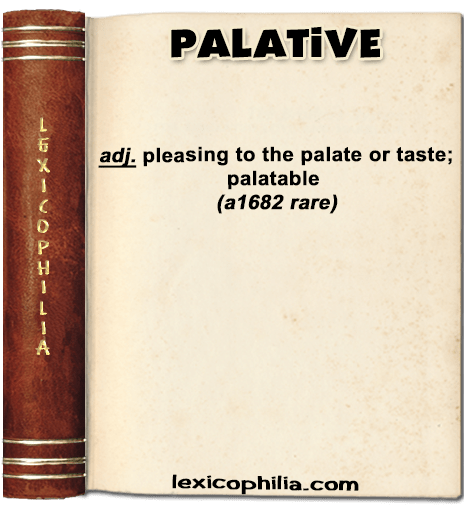
ETYMOLOGY
from Latin palātum palate + -ive
EXAMPLE
“…Punish not thy self with Pleasure; Glut not thy sense with palative Delights; nor revenge the contempt of Temperance by the penalty of Satiety…”
From: Christian Morals
By Sir Thomas Browne, a1682
ETYMOLOGY
from Latin palātum palate + -ive
EXAMPLE
“…Punish not thy self with Pleasure; Glut not thy sense with palative Delights; nor revenge the contempt of Temperance by the penalty of Satiety…”
From: Christian Morals
By Sir Thomas Browne, a1682
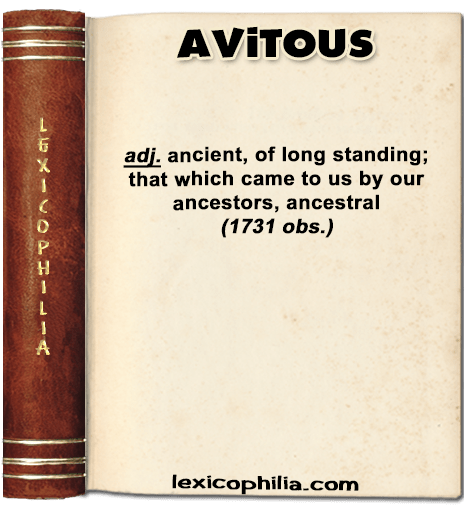
ETYMOLOGY
from Latin avītus of or pertaining to the avus (grandfather) + -ous
EXAMPLE
“…Being a leucothiop, he was not even a mediocrist, but a mere polypragmatical hafter or barrator. His inscience of avitous justicements, and of lexicology, his perissology and battology, imparted to his tractation of his cause, an imperspecuity which rendered it immomentous to the juratory audients…”
From: Letters to Squire Pedant in the East
Letter No. IX, 1843
By Lorenzo Altisonant (pseudonym Samuel Klinefelter Hoshour),
an Emigrant to the West, 1856
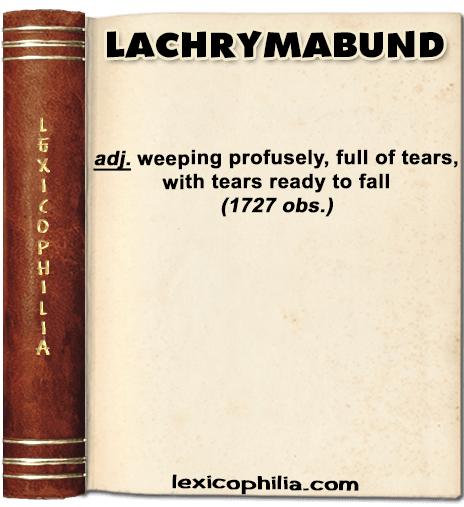
ETYMOLOGY
from Latin lacrimābundus (weeping, in tears),
from lacrimāre (to shed tears) + -bundus
EXAMPLE
“…that I must soon inevitably succumb, unless you most charitably applicate the balsamic lenitives of complyance to your most agonized,
and lachrymabund slave,
TIMOTHY BLUNDERBUSS…”
From: The Adventures of Jerry Buck
By John Slade, 1754

ETYMOLOGY
from Latin fluctisonus; fluctus (wave) + sonus (sound)
EXAMPLE
“…Flash! White raw human waves make a fluctisonous roar!…”
From: G Day, Please God, Get Me Off the Hook
By Neil Baker, 2010

ETYMOLOGY
from Greek λόγος (logos) (word)
EXAMPLE
“…by the various ravishments of the excellencies whereof, in the frolickness of a jocound straine beyond expectation, the logofascinated spirits of the beholding hearers and auricularie spectators, were so on a sudden seazed upon in their risible faculties of the soul…”
From: Εκσκυβαλαυρον (Ekskybalauron);
Or, The Discovery of a Most Exquisite Jewel, More Precious Then Diamonds Inchased in Gold
By Thomas Urquhart, 1652
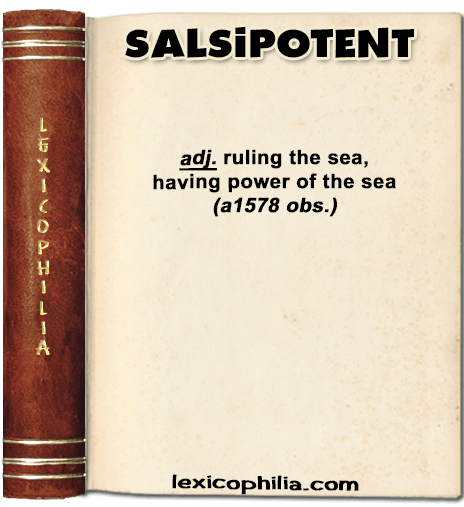
ETYMOLOGY
from Latin salsipotentem, a false reading for salipotentem,
from salum (salt water) + potentem (having great authority or influence)
EXAMPLE
“…whearunto he made hiz fish to swim the swifter, and hy then declared: how the supream salsipotent Monarch Neptune, the great God of the swelling Seaz, Prins of profunditees, and Soouerain Segnior of all Lakez, freshwaterz, Riuerz, Créekes, and Goolphs…”
From: A Letter whearin part of the Entertainment vntoo the Queenz Maiesty at Killingwoorth Castl in Warwik Sheer
By William Patten, a1578

ETYMOLOGY
from Latin pacificat-, past ppl. stem of pacificare (to make peace, to pacify)
EXAMPLE
“…It mitigateth anger, letificateth those that bee sad, pacificateth such as are at discord. It temperateth choler, and (to conclude all in a word) it expelleth all vagrant, wandring, and imaginary cogitations whatsoeuer…”
From: The Secrets of Nvmbers.
According to Theologicall, Arithmeticall, Geometricall and Harmonicall Computation
By William Ingpen, 1624
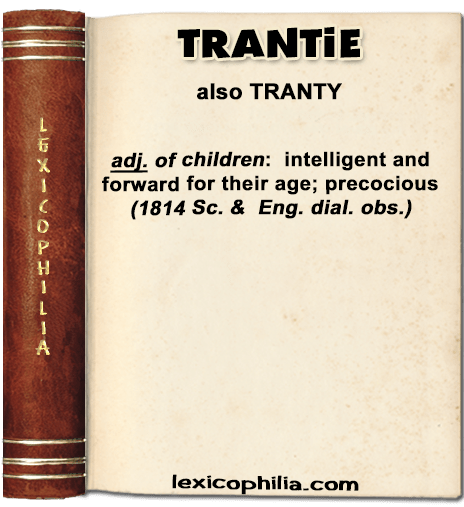
ETYMOLOGY
? from Middle English trant (cunning action, trickery)
EXAMPLE
“…About this period died at Hawick two lone sisters, named Marjory and Isobel Hume, designated the Tranties, rather more intelligent than their neighbours in a similar humble condition of life…”
From: Hawick and its Old Memories
By James Wilson, 1858
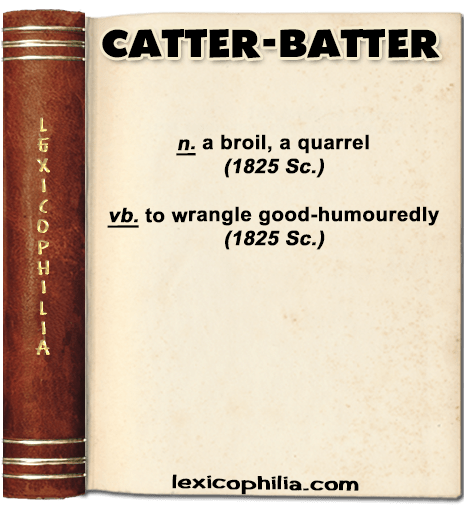
ETYMOLOGY
? for the first element ‘catter’ perhaps from Dutch kater (tomcat) + batter (to fight)
EXAMPLE
“…By Gemini ! you never heard such a catter- batter! The whole court-room stamping and laughing fit to split, and the ushers calling order, and the tipstaffs running, and his worship gobbling like a cailzie-cock…”
From: Blackwood’s Magazine
Volume 225, 1929
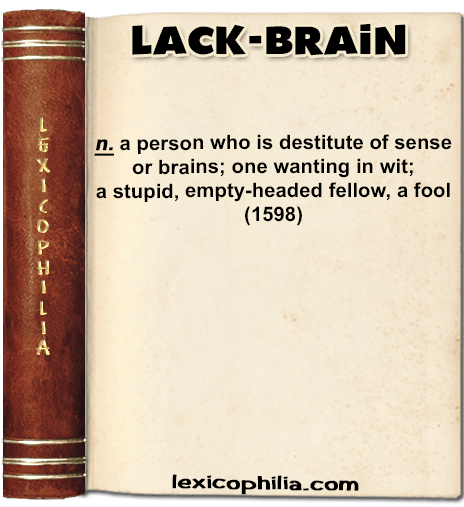
ETYMOLOGY
from lack + brain
EXAMPLE
“…Say you so, say you so, I say vnto you againe, you are a shallow cowardly hind, and you lie: what a lacke braine is this? by the Lord our plot is a good plot, as euer was laid, our friends true and constant: a good plot, good friends, and ful of expectation: an excellent plot, verie good friends; what a frosty spirited rogue is this?…”
From: Henry IV, Part I
By William Shakespeare, 1598
 Lexicophilia