Word of the Day

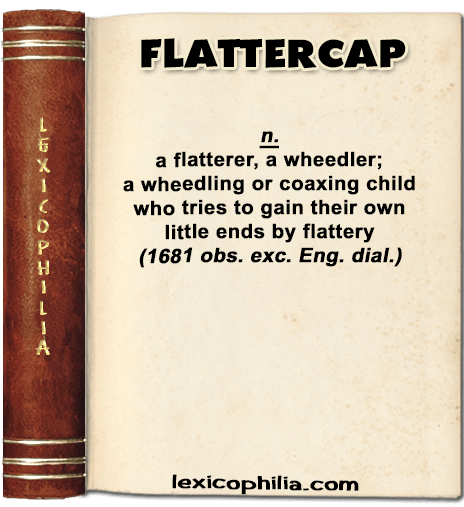
Word of the Day: FLATTERCAP

ETYMOLOGY
from flatter (vb.) + cap

EXAMPLE
“… He’s struggling to learn a lot of new things, but I also think he’s trying to do whatever he can to get on with the men.
I’ve seen him behaving like a 
flattercap, all yes sir, no sir, with a seaman named Brian Blount. …”

From: Trouble on the Voyage : The Strange and Dangerous Voyage of the Henrietta Maria
By Bob Barton, 2010
Word of the Day: THESMOPHILIST

ETYMOLOGY
from Greek θεσµός (thesmos – law); (from root θε– (to lay down)) + –ϕιλ-ος (-phil )-ist

EXAMPLE
“… To shut out any light that may be usefull in Gods house, is with the Jews to make it a denne: as they would do, that would shut out the Ceremonies out of the Church: for, take away Ceremonies out of the Church, and take away the light that is in it. Surely this is spoken in Ceremony, by way of complement to his Bishop, that great Thesmophilist: Have we no other candle in our candlestick but ceremony? …”

From: A Discourse of Proper Sacrifice
By Edward Dering, 1644

Word of the Day: QUINOMBROM

ETYMOLOGY
of unknown origin

EXAMPLE
“… When you have cast an eye upon this Letter which goeth stuff’d with all Proverbs, old Motts, and Adages, whereof some were used in the time of high bonnets, when men used to wipe their noses on their sleeves, for want of a napkin, you will judge perhaps, that the Author hath some strange freaks, or quinombroms in his noddle, that he hath quicksands, or Mercury, or rather one quarter of the Moon in his pericranium; But you Sir, that have a head so well timbred, will, I presume, passe another judgement. …”

From: Paroimiographia Proverbs, or, Old sayed savves & adages in English (or the Saxon toung), Italian, French, and Spanish
By James Howell, 1659

Word of the Day: BEAUPERE

ETYMOLOGY
from Old French beau (fine, good_ + pre (father), or, in sense 2, per, peer (equal, peer):

From OED: In Old French, beau père was politely used in addressing every one whom one called ‘father’; i.e. one’s own father, a ‘father’ in the church, a god-father, a step-father, a father-in-law, an elderly man occupying a fatherly position in one’s regard; about the 16th or 17th century, this use of beau became obsolete, and beau-père was retained as a distinctive term for ‘father-in-law’ and ‘step-father’ as distinct from a real father. In English the use appears to have been much more limited.

EXAMPLE
“… Tho he hadde his tale itold and ymaked al his wise,
He sat adoun and the Bischop of Cicestre gan arise. “
Beau pere,” he seide to the Pope: “me thinȝth hit
faith to the,
“To desturbi thing that falleth: to harm of communeaute;
…”

From: The Life and Martyrdom of Thomas Beket, c1300
Edited by J.H. Black, 1848

Word of the Day: MALADIOUS

ETYMOLOGY
from malady (ill health, sickness, disease) + -ous;
or from French maladieux

EXAMPLE
“… Fro that tyme forth my sone began
To werke myracle gloriouse
He kyst oute feendis of many a man
Dume defe blynd lame all maladiouse
He made hem hole that to hym wan
And taught hem to be vertuouse
Vnto the temple went he than
Droue oute marchaunts of godds house …”

From: De Arte Lacrimandi (Harley MS.), a1450
Edited by Robert Max Garrett, 1909

Word of the Day: BEDOOZLE

ETYMOLOGY
perhaps from  bedazzle + bamboozle 

EXAMPLE
“… O Shadrack, my Shadrack! Prissilla did speak,
While the rosy red blushes surmantled her cheek,
And the tears of affection
bedoozled her eye,
Shadrack, my Shadrack! I ‘m yourn till I die!
…”

From: The Gazette of the Union, Golden Rule, and Odd-Fellow’s Family Companion
A Saturday Family Journal of General Literature, Odd-Fellowship and Amusement.
Volume X – From January to June Inclusive, 1849
From the Scrabble Hill Luminary