Word of the Day

Word of the Day: AILUROPHOBIA

ETYMOLOGY
from Greek αἴλουρος [ailouros] (cat) + –phobos (fear)

EXAMPLE
“… Of Ailurophobia and the Power to be Conscious of the Cat as Near, when Unseen and Unheard. …” (Title)

From: Transactions of the Association of American Physicians.
Twentieth Session held at Washington, D.C., May 16 and 17. 1905
By S. Weir Mitchell

PRONUNCIATION
ay-lyoor-oh-FOH-bee-uh

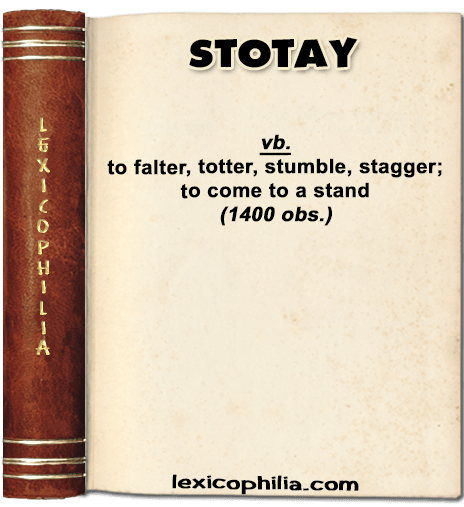
Word of the Day: STOTAY

ETYMOLOGY
possibly from Old French estoutoierestoteier (to fall into disorder)

EXAMPLE
“… Þo cried þat freoly foode:
“Whi spille ȝe innocens bloode?”
And alle þei stoteyd and stoode,
Þis ferlys to frayne. …”

From: The Pistill of Susan – a Middle English adaptation of the Old Testament Apocryphal book The History of Susanna, a1400

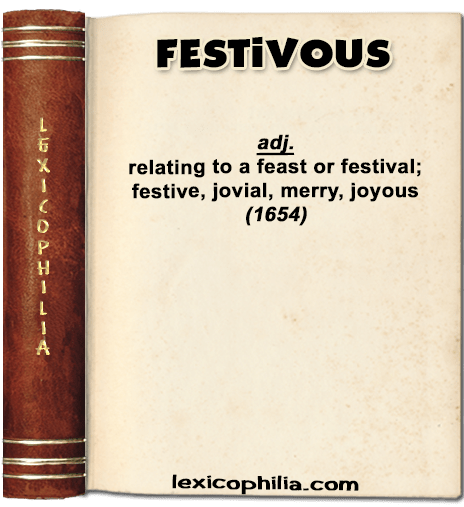
Word of the Day: FESTIVOUS

ETYMOLOGY
from Latin festivus (festive), from festum (a feast) + -ous

EXAMPLE
“… But goe on boldly, Frestons charmes must end,
See here, a Disinchanter is thy friend;
Who innocent black Art, hath round thee writ
A magick circle of Festivous Wit;
Which will secure thy Fame against that Prime,
And lasting monster, all devouring Time. …”

From: John Speed in Edmund Gayton’s Pleasant Notes Upon Don Quixot, 1654

Word of the Day: SMICKER

ETYMOLOGY
from Old English smicer (possessing charm and attractive; beautiful)

EXAMPLE 1 (for adj. 1)
“… Þatt wollde ben effninng wiþþ Godd
Abufenn alle shaffte,
Þurrh whatt he fell off heffne dun
Inntill niþ hellepine,
& warrþ till atell defell þær
Off shene & smikerr enngell. …”

From: The Ormulum (Burchfield transcript), c1175


EXAMPLE 2 (for vb. 1)
“…Humph. This will not pass; for, though I’m stuft in the head, yet I can blow my Nose as well as another to smell things out. No, no, I see I may make love long enough before you smicker at me. You may e’en keep your Portion, I shall find my Land in the old Place. …”

From: The Man’s the Master, a comedy
By Sir William D’Avenant, 1668

Word of the Day: MORBULENT

ETYMOLOGY
from Latin morbus (disease) + -ulent

EXAMPLE
“… they should apply such medicines as are suitable, and in such a Proportion as is most proper to assist Nature in the Discharging of the Malignant and Morbulent Matter; but never to clog and hinder its Motions by too many and useless doses. …”

From: The History of the Works of the Learned,
Or, An Impartial Account of Books Lately Printed in all parts of Europe.
Done by Several Hands, Volume VI
The Works of the Learned, for February 1704

Word of the Day: RIGENT

ETYMOLOGY
from Latin rigent-rigens (stiff, rigid), present participle of rigere (to be stiff)

EXAMPLE
“… An hous [y]maad of aller is but shent; 
Yet ther the ground is myre, weet, vnsure,
Pile in aller as for the fundament.
Ek elm & asshe ydried beth rigent,
And while they beth vndried, so curuable,
ffor shippis that they beth right profitable. …”

From: Middle-English translation of Palladius De Re Rustica. ?1440
Edited by Mark Liddell, 1896

Word of the Day: PIGRITIOUS

ETYMOLOGY
from Latin pigritia (laziness, sluggishness, sloth) + -ous

EXAMPLE
“… Now if Stercus and Ʋrina can bee pickt out of the vanities of Cornelius Agrippa, it shal be thrown upon the purple robes of the Physician, by the ignorant or impudent. For Science hath no enemy but ignorance, nor is vilified among any except pigritious and impudent persons. Then let the ignorant prattle, still the Physitian shall be the instrument of all common good in a Republique, and if no valetudinarie man of any condition bee able to effect any solid good, either to his King, Countrie, or selfe, as he is not, and the power of restoring and healing him, bee given principally to the Phisician …”

From: The Tree of Humane Life, or, The Bloud of the Grape
By Tobias Whitaker, 1638

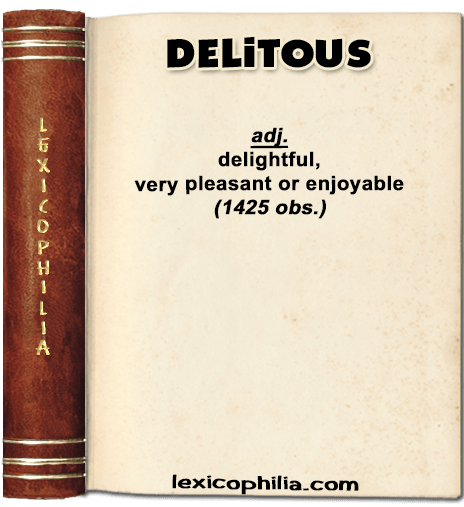
Word of the Day: DELITOUS

ETYMOLOGY
from Anglo-Norman delitous, Middle French deliteux;
from delit (delight) + ‑ous 

EXAMPLE
“… For sich solace sich ioie and play
I trowe that neuere man ne say 
As was in that place delytous
The gardeyn was not daungerous
To herberwe briddes many oon
So riche a yeer was neuer noon …”

From: The Romaunt of the Rose
By Guillaume de Lorris and Jean de Meun
Translated by Geoffrey Chaucer, a1425