Word of the Day

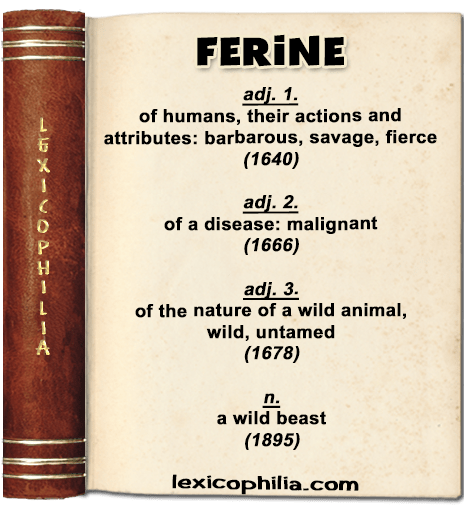
Word of the Day: FERINE

ETYMOLOGY
from Latin ferinus, from fera (wild beast)

EXAMPLE (for adj. 1)
“… Secondly there are brutish and unnaturall Desires, which the Philosopher calleth 
ferine and inhumane, instancing in those barbarous Countries, where they use to eat mens flesh and raw meat; and in the Woman who ripped up Women with childe that shee might eat their young ones: …”

From: A Treatise of the Passions and Faculties of the Soule of Man
By Edward Reynolds, 1640

Word of the Day: COVER-SLUT

ETYMOLOGY
from cover (to put or something over an object, with the effect of hiding from view or protecting) + slut (an untidy, dirty, or slovenly woman; a woman who is habitually careless, lazy, or negligent with regard to appearance, household cleanliness, etc.)

EXAMPLE
“… But as it is a sad thing that the grace of God pretended, should be used as a pander unto wantonness, so it is no less hateful, that the providence of God should be misapplied as a cover-slut of idleness, ignorance, and unconscionableness: for who knowes not that our life is so in Gods hand, as it is ordinarily preserved ro lost by the use or want of things proper thereto? even hunger if self would be certainly mortal, if not appeased by meat appropriated thereto by the appointment of God. …”

From: Natures explication and Helmont’s vindication.
Or A short and sure way to a long and sound life.
By George Starkey, 1658

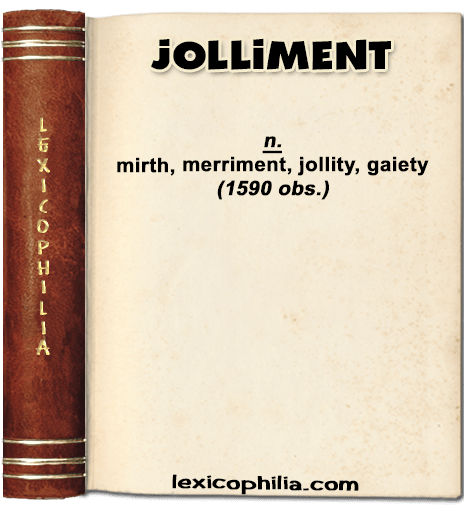
Word of the Day: JOLLIMENT

ETYMOLOGY
irregular from jolly (adj.) + -ment

EXAMPLE
“… And therein sate a Ladie fresh and faire,
  Making sweet solace to her selfe alone;
  Sometimes she sung, as loud as larke in aire,
  Sometimes she laught, that nigh her breth was gone,
  Yet was there not with her else any one,
  That might to her moue cause of meriment:
  Matter of merth enough, though there were none
  She could deuise, and thousand waies inuent,
To feede her foolish humour, and vaine
iolliment. …”

From: The Faerie Queene
By Edmund Spenser, 1590

Word of the Day: AMPUTE

ETYMOLOGY
from French amputer, from Latin amputare (to remove by cutting off)

EXAMPLE
“… The Blood of Christ, as purging away the guilt of sin, was represented in Circumsion as to be shed; but it is represented in Baptism as already shed, and applyed to the party baptized. The body of sin was represented in Circumcision under the notion of a superfluity to be amputed and cut off: ‘Tis represented in Baptism under the notion of a defilement or pollution, which is removed by washing. But the use of the one and the other in general was and is the same, namely to represent to the mind that way, and those means, by and through which the soul hath remission of sin, peace which God, and is brought to future Salvation. …”

From: An essay to revive the primitive doctrine and practice of Infant-Baptism
By Joseph Whiston, 1676

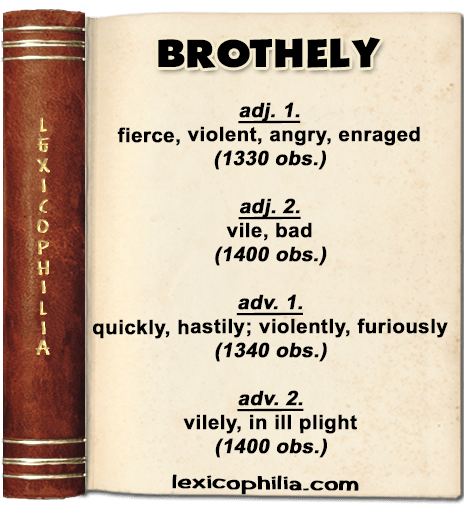
Word of the Day: BROTHELY

ETYMOLOGY
Middle English: in sense adj. 1, from broth (impetuous, violent, wrathful) + -ly;
sense adj. 2, possibly a derivative of brothel

EXAMPLE (for adj. 1)
“… þan said Isaac tille him, “ert þou his mayntenour?
Fulle
broþely & brim he kept vp a trencheour,
& kast it at Statin, did him a schamfulle schoure.
His nese & his ine he carfe at misauentoure.
…”

From: Peter Langtoft’s Chronicle, (as illustrated and improv’d by Robert of Brunne), 1330

Word of the Day: MANQUELL

ETYMOLOGY
back formation from manqueller (a murderer), from man + queller (a person or thing who subdues someone or something)

EXAMPLE
“… At which wordes kyng Edward sayd nothyng, but with his hād thrust hym from hym (or as some say, stroke him with his gauntlet) whom incontinent, they that stode about, whiche were George duke of Clarence Rychard duke of Gloucester, Thomas Marques Dorset, and Williā lord Hastynges, sodaynly murthered, & pitiously manquelled. The bit ternesse of which murder, some of the actors, after in their latter dayes tested and assayed by the very rod of Iustice and punishment of God. …”

From: The vnion of the two Noble and Illustre Famelies of Lancastre [and] Yorke
By Edward Hall, 1548

Word of the Day: NOCTIVAGANT

ETYMOLOGY
from Latin noctivagant-noctivagans, present participle of noctivagare (to wander or roam about at night)

EXAMPLE
“…How should this make vs mourne like Doues, and groane like Turtles? The wilde Swallowes, our vnbridled Youngsters sing in the warme Chimneyes: the lusfull Sparrowes, noctiuagant Adulterers, sit cherping about our houses; the filching Iayes, Secret theeues, rob our Orchards; the Kite and the Cormorant, deuoure and hoord our fruits: and shall not among all these, the voyce of the Turtle be heard on our land, mourning for these sinfull rapines? …”

From: The Diuells Banket
By Thomas Adams, 1614

PRONUNCIATION
nock-TIV-uh-guhnt

Word of the Day: VERSIPELLOUS

ETYMOLOGY
from Latin versipellis, from vers-vertere (to turn) + pellis (skin)

EXAMPLE
“… The power, indeed, is in the witch, and not conferred by him; but this versipellous or Protean impostor – these are his words – will not suffer her to know that it is of her own natural endowment, though for the present charmed into somnolent inactivity by the narcotic of primitive sin. …”

From: The House By The Churchyard
By Joseph Sheridan Le Fanu, 1863
Chapter V. How the Royal Irish Artillery Entertained some of the Neighbours at Dinner

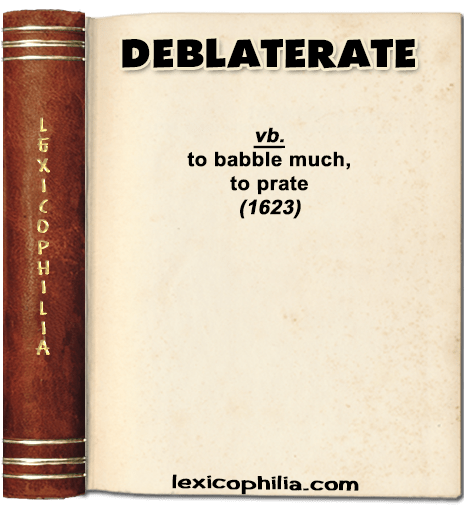
Word of the Day: DEBLATERATE

ETYMOLOGY
from Latin deblaterare transitive (to prate of, blab out), from de- blaterare (to prate)

EXAMPLE
“… Robert Louis Stevenson, the traveler and author, writes: I conceived a great prejudice against missions in the South Seas, and I had no sooner come there than that prejudice was first reduced and then annihilated. Those who deblaterate against missions have only one thing to do, to come and see them on the spot. They will see a great deal of good done, and I believe, if they be honest persons, they will cease to complain of mission work and its effect. …”

From: What is a Christian and A Talk on Books,
By Henry Drummond, 1891
Thomas E. Watson “exposed”; an examination of his “Foreign missions exposed”.

Word of the Day: PERCULSIVE

ETYMOLOGY
from Latin perculs-, past participial sterm of percellere (to upset, strike with consternation) + -ive

EXAMPLE
“… But grant that ONELY bee an alleuiating particle, yet it is so by comparison: and so is an OATH, a tryall of more ease, both to body and minde then are those other meanes by Rackes and tortures (vsuall in the Inquisition:) for as the peines are vnsufferable to flesh and blood, so haue they a very perculsiue force euen vpon the Soule, Nam & innocentes cogit mentiri door, saith the Stoicke, because in so many streights, of terrour, payne, hope, feare, nihil veritati loci relinquitur, as the Orator well obserued, (let Aelian speake of the Egyptians courage or insensiblenes what he will): men will say any thing (though most vnture) for ease and release from such pangs. …”

From: An Answer to a Catholike English-man
By William Barlow, 1609