Word of the Day

Word of the Day: NOCIVOUS

ETYMOLOGY
from Latin nocivus (harmful, injurious), (from nocere (to hurt)) + -ous

EXAMPLE
“…Phisitions which prescribe a remedy
To each disease & bodies maladie;
That know what is
nocivous & what good,”
When it is fit to bath, to purge, let bloode;
Although they know the nature & the power
Of every simple, every hearbe, & flower,
With Solomon, which from the cedar tall
Vnto the hisope spreading on the wall,
Knew every growing plant, flower, hearbe, or tree,
With their true vse & proper qualitie;
…”

From: The Times’ Whistle: Or, A New Daunce of Seven Satires, and Other Poems
Compiled by R.C., c1616
Published for the Early English Text Society, 1871
Word of the Day: SICCICATE

ETYMOLOGY
irregularly from Latin siccus or siccare

EXAMPLE
“… Thirdly, when you put forth your horses to run at grasse all, or the most part of Summer, during which time the scorching heats wil so siccicate and dry the planks, which will cause them to warp, and the pinnes which holdeth them down to the joyces will rot, and so the planks give way, especially when horses (who not being handled in some moneths before) becomming wild, rammage, and unruly, are newly brought into the Stable, who feeling the planks to move, yeeld, and give way under them, will fall from starting thereat, to slinging, leaping, bounding and plunging, till they have dislocated the planks, and thereby have endangered both themselves, the residue of their fellowes, and those who might come to their help and succour, which is a thing very frequent in a flore of this nature: …”

From: The Compleat Horseman and Expert Ferrier In two bookes. The first, shewing the best manner of breeding good horses, with their choyce, nature, riding and dyeting … The second, directing the most exact and approved manner how to know and cure all maladies and diseases in horses;
By Thomas de Grey, 1639

Word of the Day: IMPERDIBLE

ETYMOLOGY
from Latin imperdibilis; from im- + perdere (to lose) + -ibilis (-ible)

EXAMPLE
“… Most men are erroneous in the apprehension of their Felicity, Honour, Glory and Riches being their ordinary objects, are but smoaky substances to make it solid and imperdible; all these are daily subject to casualties: for what with difficulty we have acquired in a year, may by an unexpected accident of fortune be lost in a day, and often times by the same means, we projected to mount the throne of our felicity, we inevitably fall into the abiss of disgrace. …”

From: The Idea of the Lavv Charactered from Moses to King Charles.: Whereunto is added the Idea of Government and Tyranny
By John Heydon, 1660

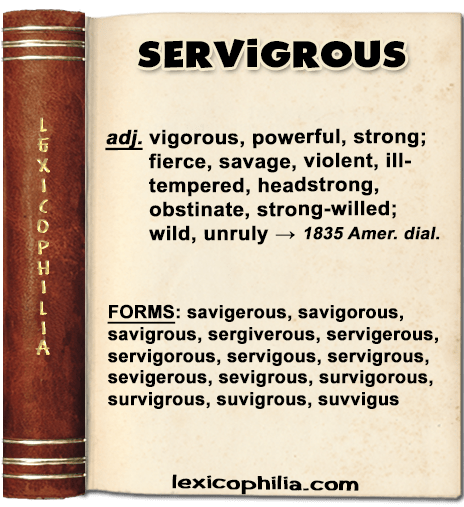
Word of the Day: SERVIGROUS

ETYMOLOGY
of uncertain origin;
possibly an alteration of savagerous (barbarously savage); perhaps influenced by vigorous

EXAMPLE
“… It now came to Spivey’s turn. There was nothing remarkable in his person or manner. He took his place, lowered his rifle slowly from a perpendicular, until it came on a line with the mark — held it there like a vise for a moment, and fired.
” Pretty
sevigrous, but nothing killing yet,” said Billy Curlew, as he learned the place of Spivey’s ball. …”

From: Georgia Scenes, Characters, Incidents, &c. : in the first half century of the republic,
By Augustus Baldwin Longstreet, 1835
“The Shooting Match”

PRONUNCIATION
suhr-VIGH-gruhss

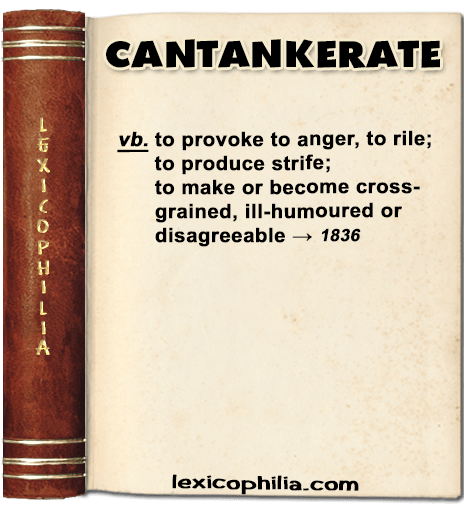
Word of the Day: CANTANKERATE

ETYMOLOGY
from cantankerous

EXAMPLE
“… I never see’d a convart made by that way yet; but I’ll tell you what I have see’d, a man set his own flock a doubtin by his own writin. You may happify your enemies, cantankerate your opponents, and injure your own cause by it, but I defy you to sarve it. …”

From: The Clockmaker,
Or, Sayings and Doings of Sam Slick, of Slickville,
By Thomas Chandler Haliburton, 1836

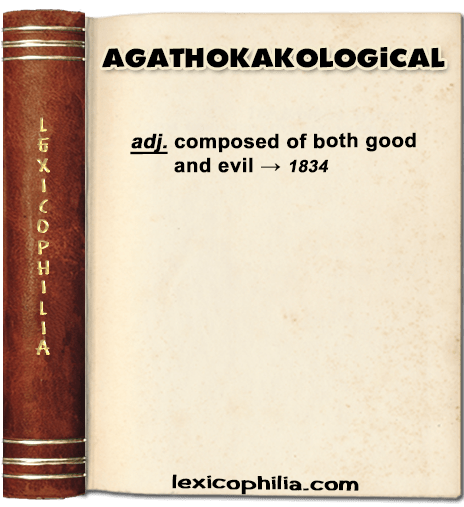
Word of the Day: AGATHOKAKOLOGICAL

ETYMOLOGY
from. Greek ἀγαθός (agathos – good) + κακός (kakos – bad) + -logical

EXAMPLE
“… There may be an opposite fault; for indeed upon the agathokakological globe there are opposite qualities always to be found in parallel degrees, north and south of the equator. …”

From: The Doctor &c.
By Robert Southey

PRONUNCIATION
ag-uh-thoh-kack-uh-LOJ-uh-kuhl

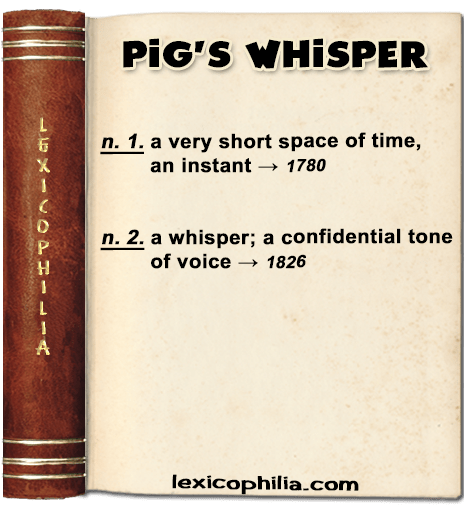
Word of the Day: PIG’S WHISPER

ETYMOLOGY
from pig + whisper

EXAMPLE (for n. 1.)
“… Frank.
Yes, sir; there are tailors, shoemakers, milliners, perfumers, dancing-masters, music masters and boxing masters.

Tickle.
I’ll be with them in a
pig’s whisper.

Frank.
Pig’s whisper! what a fellow for a gentleman’s tutor! O! he’s a shocking dog!
…”

From: Tony Lumpkin in town: A Farce
By John O’Keeffe, 1780

Word of the Day: THUMPATORY

ETYMOLOGY
from thump + –atory (a thing relating to)

EXAMPLE
“… Then scrubbing and swindging a little with his left Hand alongst, and upon the uppermost in the very bought of the Elbow of the said dexter Arm, the whole Cubit thereof by leisure fair, and softly, at these thumpatory warnings, did raise and elevate it self even to the Elbow, and above it, on a suddain did he then let it fall down as low as before: and after that, at certain intervals and such spaces of time, raising and abasing it, he made a shew thereof to Panurge …”

From: The Third Book of the Works of Mr. Francis Rabelais, Containing the Heroick Deeds of Pantagruel the Son of Gargantua,
By François Rabelais
Translated by Thomas Urquhart and Peter Anthony Motteux, 1693

Word of the Day: FRANTLING

ETYMOLOGY
of unknown origin

EXAMPLE
“… croaking of Ravens, screeching of Owls, whicking of Pigs, gushing of Hogs, curring of Pigeons, grumbling of Cushet-doves, howling of Panthers, curkling of Quails, chirping of Sparrows, crackling of Crows, nuzzing of Camels, wheening of Whelps, buzzing of Dromedaries, mumbling of Rabets, cricking of Ferrets, humming of Wasps, mioling of Tygers, bruzzing of Bears, sussing of Kitnings, clamring of Scarfes, whimpring of Fullmarts, boing of Buffalos, warbling of Nightingales, quavering of Meavises, drintling of Turkies, coniating of Storks, frantling of Peacocks, clattering of Mag-pyes, murmuring of Stock-doves, crouting of Cormorants, cigling of Locusts, charming of Beagles, guarring of Puppies, snarling of Messens, rantling of Rats, guerieting of Apes, snuttering of Monkies …”

From: The Third Book of the Works of Mr. Francis Rabelais, Containing the Heroick Deeds of Pantagruel the Son of Gargantua,
By François Rabelais
Translated by Thomas Urquhart & Peter Anthony Motteux, 1693

Word of the Day: MELLISONANT

ETYMOLOGY
from Latin mell-, mel (honey) + sonant-, sonans, present participle of sonare (to sound)

EXAMPLE
“… And rise up Sir Iocastus, our deare Knight.
Now hang the hallowed bell about his neck,
We call it a
mellisonant Tingle Tangle,
(Indeed a sheep-bell stolne from’s own fat wether.)
The ensigne of his knighthood. Sir Iocastus,
Wee call to mind we promis’d you long since
The President of our Dances place; we are now
Pleas’d to confirme it on you: give him there
His Staffe of Dignity.
…”

From: Poems with the Muses Looking-Glasse: and Amyntas
By Thomas Randolph, 1638