ETYMOLOGY
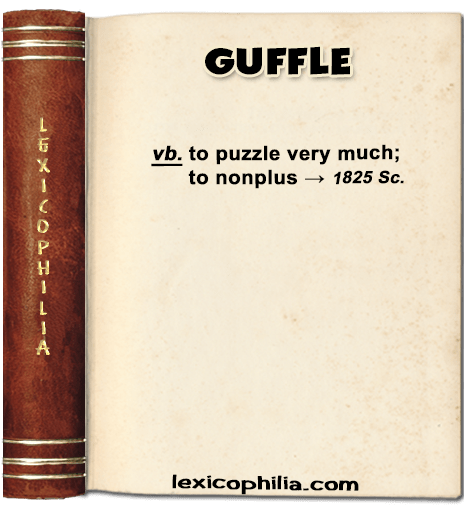
probably formed from guff (a fool, ” to make one appear as a fool “)
EXAMPLE
The complex riddle completely guffled her, even after she had thought about it for hours.
ETYMOLOGY
probably formed from guff (a fool, ” to make one appear as a fool “)
EXAMPLE
The complex riddle completely guffled her, even after she had thought about it for hours.
ETYMOLOGY
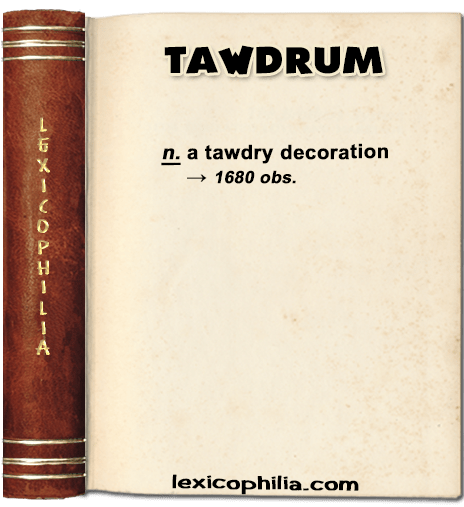
from tawdry, with Latin ending -um
EXAMPLE
“… Young Woman, young Woman, this is no time to think of Trifles, and gew gaws; the best dress is that of Repentance, let your Conscience be clean and neat within, and no matter for Lace and Tawdrums; dress up your Soul I say. …”
From: The Revenge, or, A Match in Newgate a Comedy
Usually attributed to writer, Aphra Behn, 1680
ETYMOLOGY
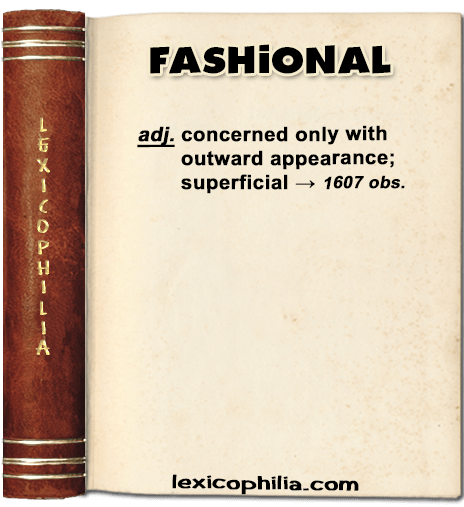
from fashion (n.) + -al
EXAMPLE
“… I ought you a letter in verse before by mine owne promise, & now that you thinke you have hedged in that debt by a greater by your letter in verse I thinke it now most seasonable and fashionall for mee to break. At least, to write presently were to accuse my selfe of not having read yours so often as such a letter deserves from you to mee. …”
From: Poems
By John Donne, 1633
‘Letters‘, a1607
ETYMOLOGY
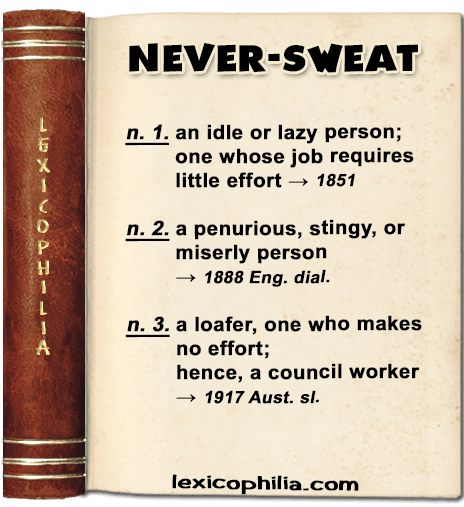
from never + sweat
EXAMPLE
“… This would be received with peals of laughter, and followed by a general repetition of the same cry. Next, a hundred and fifty cat-calls of the shrillest possible description would almost split the ears. These would be succeeded by cries of ” Strike up, you catgut scrapers,” ” Go on with your barrow,” ” Flare up, my never-sweats,” and a variety of other street sayings. Indeed, the uproar which went on before the meeting began will be best understood if we compare it to the scene presented by a public menagerie at feeding time. …”
From: London Labour and the London Poor;
A cyclopaedia of the condition and earnings of those that will work, those that cannot work, and those that will not work,
By Henry Mayhew, 1851
ETYMOLOGY
from bum + bags (trousers, sl.)
EXAMPLE
“… Hodgson in a bit of pink!
Shade of Stultz, shade of Brummell,
Who of such a sight could think,
Having seen him in the pommel?
Hodgson in white leathers, tights,
Braces, bumbags, brogues, or breeches
Made to fit like very Flight’s,
Till the pressure starts the stitches. …”
From: The Annals of the Warwickshire Hunt, 1896
Costume of the New Master of the Quorn (Mr. Hodgson)
By Lord Rosslyn in Blackwood’s Magazine, February Ist, 1840
ETYMOLOGY
from Latin morientem, present participle of mori (to die), cognate with mors (death) and mortuus (dead)
EXAMPLE
“… we see him (saith he) in our Day, by Luther, Calvin, Perkins, &c. who unmask’d him; and he adds a 6th Period, to wit, Morient, saying, If we do not, yet our Posterity shall see him die, for God saith, that his day is coming, …”
From: A Distinct Discourse and Discovery of the Person and Period of Antichrist
By Christopher Ness, 1679
ETYMOLOGY
from trub (a little, squat woman)
EXAMPLE
“… 1st Peasant. Husband, did’st hear he called me woman! called Me whore! Me! me, thy wife!
2nd Peasant: Keep quiet, shrew! I’ll teach thee, trub-tail, what this meddling means! …”
From: The Trinity: A Nineteenth Century Passion-Play
By Karl Pearson, 1882
ETYMOLOGY
from French negatoire or Latin negatorius negative; from negāt-, past participial stem of negare (to negate, to render invalid) + –orius (‑ory)
EXAMPLE
“… Only one thing grieved me by anticipation; the sorrow of my Berga, for whom, dear tired wayfarer, I on the morrow must overcloud her arrival, and her shortened market – spectacle, by my negatory intelligence. She would so gladly (and who can take it ill of a rich farmer’s daughter?) have made herself somebody in Neusattel, and overshone many a female dignitary! …”
From: Translations From The German
Schmelzle’s Journey to Flaetz
By Jean Paul Feiedrigh Richter
Translated by Thomas Carlyle, 1827
ETYMOLOGY
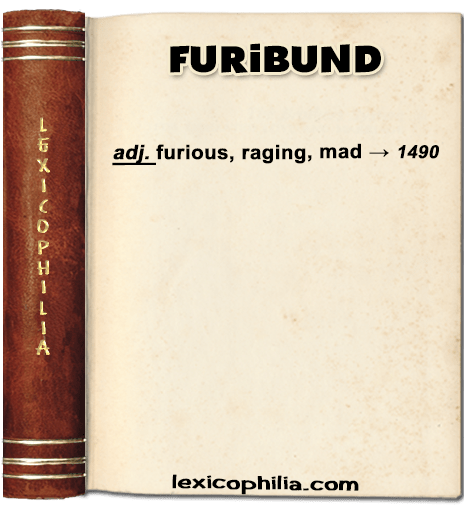
from Latin furibundus (from furere = to rage); the earlier forms through French furibond
EXAMPLE
“… In sayeng the whiche wordes by eneas / dydo lokyng at one side torned hir eyen sodaynli wythout to speke neuer a worde / as a persone furybounde & furyous: and or euer that she coude saye ony thyng. …”
From: “The Boke yf Eneydos, compyled by Vyrgyle, which hathe be translated oute of latyne in to frenshe, and oute of frenshe reduced in to Englysshe by me Wyllm Caxton“
By William Caxton, 1490
ETYMOLOGY
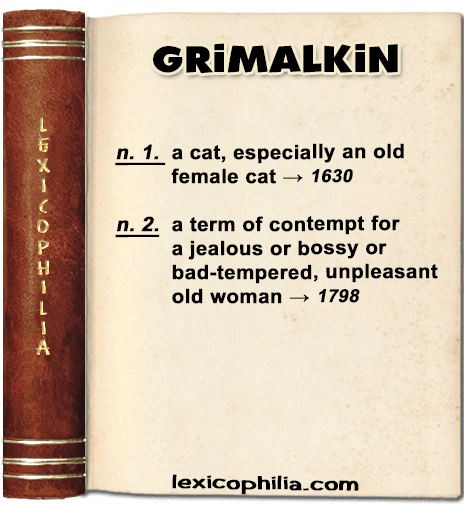
? Shakespeare’s Gray-Malkin, in “Macbeth,” 1605 = Gray cat
EXAMPLE
“… Your Muses, th’one a Youth, and one an Infant,
Gaue me two Panegericks at one Instant:
The first Pen, the first line it pleas’d to walke in,
Did make my Art a Rat, and like Grimalkin,
Or a kinde needfull Vermin-coursing Cat.
By Art I play, but will not care your Rat.
I thanke you that you did so soone determine,
To Anagram my Art into a Vermine,
For which I vow, if e’re you keeps a Dayrie,
Of (now and then) a Cheese I will impaire yee. …”
From: All the vvorkes of Iohn Taylor the water-poet
By John Taylor, 1630
PRONUNCIATION
grim-AL-kin
 Lexicophilia