Word of the Day

Word of the Day: EPICHORIAL

ETYMOLOGY
from Greek ἐπιχώριος (in or of the country) (from ἐπί- (epi-) + χώρα (country) + ‑ιος) + -al

EXAMPLE
“…this double suffering will shortly be succeeded by a very peculiar, perfectly epichorial, and most distracting method of separating dust from carpets (of which more anon); while you must, at all times, be prepared for the infernal bagpipe, modulated by the blind for the benefit of the deaf, to say nothing of the stridulous flute, which it hath pleased Pan, Apollo, or Nemesis, hitherto to restrain to the classical region of the college. …”

From: The New Monthly Magazine and Literary Journal
Volume 3, 1833
“The City of the Clyde”
Letter from Henry d’Arcy, Esq., to Charles Vernon, Esq.
Word of the Day: CLOTH-MARKET

ETYMOLOGY
from cloth + market

EXAMPLE
“…Neverout. Miss, your Slave: I hope your early Rising will do you no Harm. I hear you are but just come out of the Cloth-Market.
Miss. I always rise at Eleven, whether it be Day or no.
Col. Miss, I hope you are up for all Day?
Miss. Yes, if I don’t get a Fall before Night
…”

From: A complete collection of genteel and ingenious conversation, according to the most polite mode and method now used at court, and in the best companies of England,
By Jonathan Swift, 1738

Word of the Day: EAR-DROPPER

ETYMOLOGY
from ear + dropper

EXAMPLE
“… But, that he was a Creature of the Duke’s, and commended to him by Bishop Williams, the Historian is strangely out again. It is possible an Ear-dropper might hear such things talk’d at Cock-pits and Dancing-schools, miserable Intelligence to thrust into an History …”

From: Scrinia Reserata a Memorial Offer’d to the Great Deservings of John Williams, D. D.
By John Hacket, a1670

Word of the Day: THRUMBLE

ETYMOLOGY
vb. 1: of uncertain origin
vb. 2, 3, 4: apparently from thrum (to press, to condense) + -le
vb. 5: apparently from thrum (to play on a stringed instrument) + -le

EXAMPLE (for vb.3)
“…PETER, quho was ever maist sudden, answers, and sayis: Thou art thrumbled and thrusted be the multitude, and ʒit thou speeris quha hes twitched thee, hee answers againe and he sayis, it is not that twitching that I speak of: It is ane vther kinde of twitching …”

From: Sermons vpon the Sacrament of the Lords Supper
By Robert Bruce, ?1591

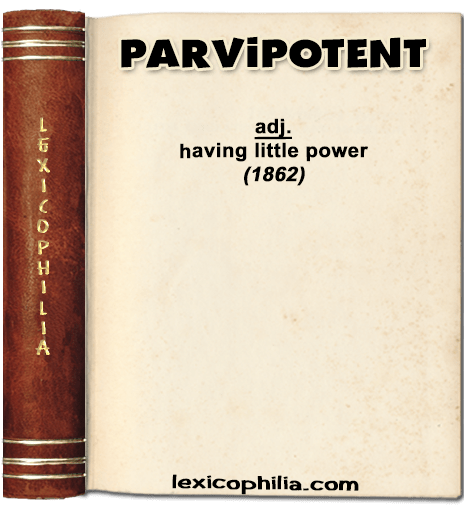
Word of the Day: PARVIPOTENT

ETYMOLOGY
from parvi- comb. form + potent (powerful, having great authority or influence)

EXAMPLE
“…It is called his causal body. Neither can do anything without one. The aggregate of the causal bodies of all souls, that is to say, distributive ignorances, make up I’s’wara’s causal body, which is illusion. Strange to say, the ignorance of a single soul renders that soul subject to misapprehension, and keeps it parviscient, parvipotent, &c; but the aggregation of these individual ignorances, or illusion, allows I’s’wara to be exempt from misapprehension, and communicate to him such attributes as omniscience and omnipotence …”

From: A Rational Refutation of the Hindu Philosophical Systems
By Nehemiah Nilakantha S’Astri’ Gore
Translation by Fitz-Edward Hall, 1862

Word of the Day: PAINTRIX

ETYMOLOGY
from paint + -trix 

EXAMPLE
“…
Quarters wages for Midsomer, anno Regni Regis Edwardi sexti Primo. [a.d. 1457.]…

On leaf 27, back, are
per Cade Item, to Anthony Totto, Painter … … … vj li v s
Item, to Barthilmewe Penne, Painter … … … vj li v s
Item, to Misteris levyn Terling, Paintrix … … xli
…”

In Thomas Vicary’s ‘The Anatomie of the Bodie of Man‘, 1547
Published by Early English Text Society, 1888

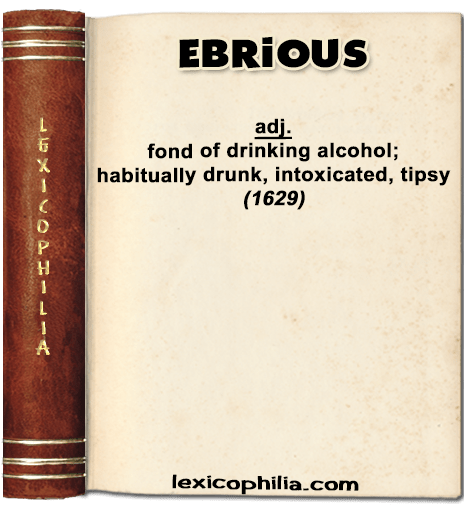
Word of the Day: EBRIOUS

ETYMOLOGY
from Latin ebrius (drunk intoxicated_ + -ous

EXAMPLE
“…This branded and illegall witnesse then, being at the very best a forraigner, doth only marre, not helpe their cause: The second was but an Anglo-Belgicus, a dissolute, ebrious and luxurious English-Dutchman…”

From: The Church of Englands Old Antithesis to New Arminianisme 
By William Prynne, 1629

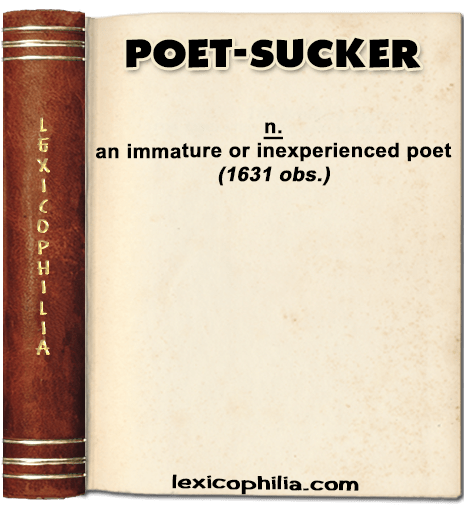
Word of the Day: POET-SUCKER

ETYMOLOGY
from poet + sucker (a greenhorn, a simpleton)

EXAMPLE
“…But gi’ me the man can start up a Justice of Wit out of six-shillings beer, and give the law to all the poets and poet-suckers i’ town. Because they are the players’ gossips? ‘Slid, other men have wives as fine as the players’, and as well dressed. Come hither, Win. …”

From: Bartholmew Fayre, A Comedie
By Ben Jonson, 1631