Word of the Day

Word of the Day: LENNO

ETYMOLOGY
from Gaelic leanabh (baby, infant, child)

EXAMPLE
“…Ye’s neir pe pidden work a turn
At ony kind o’ spin, mattam,
But shug your
lenno in a scull,
And tidel highland sing, mattam;
Had awa’, had awa’,
Had awa’ frae me, Donald;
Your jogging sculls and highland sang
Will sound but harsh wi’ me, Donald.
…”

From: Scotish Song
By Joseph Ritson, 1714
Song XI.  Had Awa’ Frae Me, Donald

Word of the Day: QUADRAGENARIOUS

ETYMOLOGY
from Latin quadragenarius (forty years old) + -ous

EXAMPLE
“…Tis my fancy that, having won for himself a fortune, he went on in the same resistless way and won for himself a wife: “taking the biggest,” as usual, by cutting out valiantly from under the guns of a dozen rivals some stout buxom widow suited to his estate and to his medium years – one of those plumply mellow quadrigenarious bodies who especially appeal to the vigorous and well-salted emotion which with sailor-men stands for love …”

From: Harper’s New Monthly Magazine, February, 1895
New York Colonial Privateers’, By Thomas A. Janvier

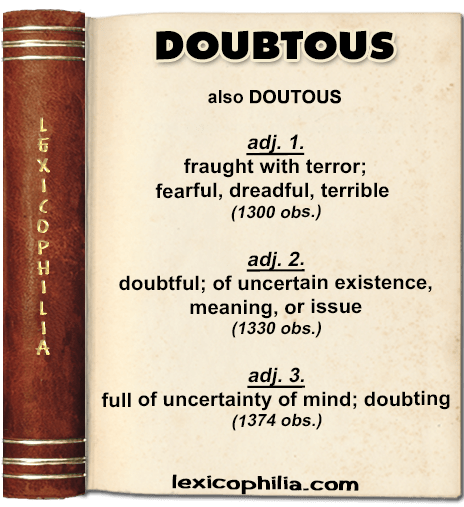
Word of the Day: DOUBTOUS

ETYMOLOGY
Middle English from Old French dutusdotusdoutous;
from modern French douteux, from doute (doubt n.)

EXAMPLE 1 ( for adj. 1)
“…no for al is moch honoure
þat he ne worþ wel sone dede
Þe eiȝt dai so is
dotus 
and þat ful wel þou salt se
ful of tene and angus
…”

From: Early English Poems and Lives of Saints with those of the wicked birds Pilate and Judas
Edited by Frederick James Furnivall, 1862
Fifteen Signs before Judgment‘, a1300

EXAMPLE 2 (for adj. 1)
“… And she said to hym: ‘My swete frend̛, yf it were possyble, soo wold I fayne doo, but it may not be. And wete it wel, that my departyng fro you is more gryeuous & doubtous a thousand tymes to me than to you, but it is the wyƚƚ & playsire of hym that can do & vndoo al thinges.’ and, with these wordes, she embraced & kyssed hym fuƚƚ tenderly, sayeng: ‘Farwel, myn owne lord & husbond̛; Adieu, myn herte, & al my joye; Farwel, my loue, & al myn wele …”

From: Melusine
By Jean d’Arras, c1500
(Published by Early English Text Society, 1895)

Word of the Day: EXPLORATE

ETYMOLOGY
adj.: from Latin exploratus past participle of explorare (to explore)
vb.: from Latin explōrāt- past participial stem of explorare (to explore)

EXAMPLE
“…The consideration whereof (most iudicious Men) though I looke not to be of that weigh with you, as to moue you ac­tually to implant your selfs in our Catholicke Church; yet since you are wyse, learned, and loth (no dowbt) to commit any such explorate errours, as the force of Naturall Reason and your owne Consciences may freely check; I am in good hope, that the serious perusall of the poynts aboue disputed, will at least preuayle thus far with diuers of you; …”

From: The Converted Jew
By John Clare, a1628

Word of the Day: DEROGANT

ETYMOLOGY
from Latin derogantem, present participle of derogare (to derogate)

EXAMPLE
“…If they could foresee future things, they would bragge themselues equall to God: But Secret things belong to GOD, reuealed to vs. The other is both arrogant in man, and derogant to God. And Greg. sayes well: If such a Starre be a Mans Destenie, then is Man made for the Starres, not the Starres for Man. The Diuels know not future euents: and will these boast it? …”

From: The Sacrifice of Thankefulnesse
A sermon preached at Pauls Crosse
By Thomas Adams, 1616

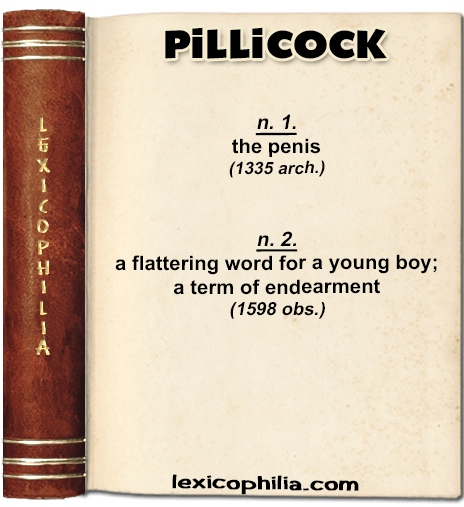
Word of the Day: PILLICOCK

ETYMOLOGY
from a first element of uncertain origin (see note below) + cock (mature male of the domestic chicken)

EXAMPLE (for n. 1.)
“…Lear.
Death traytor, nothing could haue subdued nature
To such a lownes, but his vnkind daughters,
Is it the fashion that discarded fathers,
Should haue thus little mercy on their flesh,
Iudicious punishment twas this flesh
Begot those Pelicane daughters.

Edg.
Pilicock sate on pelicocks hill, a lo lo lo.

Foole.
This cold night will turne vs all to fooles & madme
n. …”

From: True Chronicle Historie of the Life and Death of King Lear and his three daughters
By William Shakespeare, 1608

Word of the Day: SWASIVIOUS

ETYMOLOGY
from Italian suasivo (suasive, having the power of persuading or urging) + -ious

EXAMPLE
“…Who is most merciful, bountiful, and liberal, and willing to helpe and further you, in your intended loues, burning desires, and high conceites. Plucke vp a good heart, man, come let vs goe on.
With pleasurable actions, maydenly iestures,
swasiuious behauiours, girlish sportes, wanton regardes, and with sweet vvords they ledde mee on thither, beeing vvel content vvith euerie present action, but that my Polia vvas not there to the suppliment of my felicitie, and to haue been the sixt person in the making vp of a perfect number. …”

From: Hypnerotomachia: The Strife of Loue in a Dreame
By Francesco Colonna
Translated by Robert Dallington, 1592

Word of the Day: QUISQUILIOUS

ETYMOLOGY
from Latin quisquiliae (waste matter, refuse, rubbish) + ous

EXAMPLE
“…He knows not what to say against them; and yet something must be said. They publish too much; more than used to be published: the science is overloaded by the quisquilious matter they rake together and preserve. They publish too soon; before they have taken the requisite time for digestion …”

From: Rationale of Judicial Evidence
By Jeremy Bentham, 1827

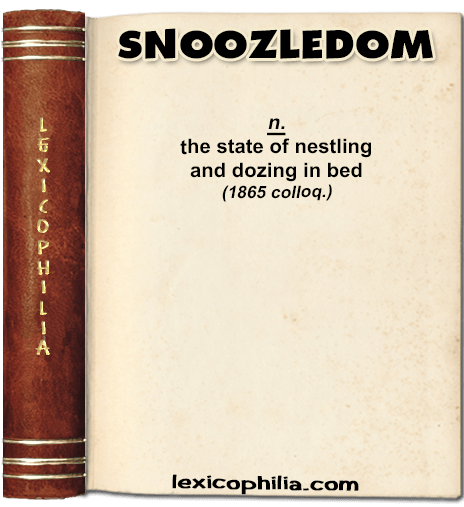
Word of the Day: SNOOZLEDOM

ETYMOLOGY
from snoozle (to nestle and sleep or doze) + -dom

EXAMPLE
“…There are times with us all, when in a concave mirror we see a minute distorted into long hours; and, again, in the convex glass the long hours dwindle to a point. When summoned by peremptory duty from a warm bed upon a keen, frosty morning, how precious are the last five minutes of snoozledom! You live introspectively all through them; you chew the cud of your own cosiness. …”

From: The Casquet of Literature, a Selection in Poetry and Prose
Edited by C. Gibbon, 1873
‘The Philosophy of Sorrow’
By D’Arcy Wentworth Thompson