Word of the Day

Word of the Day: MALEFICIOUS

ETYMOLOGY
from Latin maleficium (malefice, a wicked enchantment, sorcery)  + -ious

EXAMPLE
“…Or again, the foresaid change of a sound into a morbid body proceeds from the breath, or from the depraved spirit and aspect of the eyes, permeating, dissipating or infecting, or any other way changing the very tender substance of the Child. At which time, if any thing superstitious or maleficious come from the wickedness of the Devil, the Assistence of Holy Church being first desired, we must proceed to such Remedies as may dissipate, dissolve and weaken the breath, wind, or foul and contagious spirit …”

From: A Guide to the Practical Physician shewing, from the most approved authors, both ancient and modern, the truest and safest way of curing all diseases, internal and external, whether by medicine, surgery, or diet
By Theophile Bonet, Translated from Latin, 1684
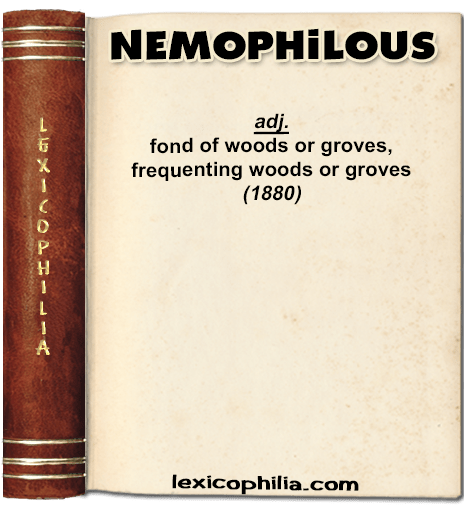
Word of the Day: NEMOPHILOUS

ETYMOLOGY
from Greek νέμος [némos] (wooded pasture, glade) + ‑philous

EXAMPLE
“…The remainder may be classed with regard to requisite moisture as Hygrophilous, Xerophilous, or Noterophilous, the former division including most shade-loving or Nemophilous plants, the Dryads of Martius, and the Xerophiles most but not all Calcophiles or lime-loving plants…”

From: Journal of Botany, British and Foreign
Edited by James Britten, Vol. IX, 1880
‘Proceedings of Societies. Geologists’ Association’

Word of the Day: GROUT-HEAD

ETYMOLOGY
from grout (sediment, dregs, lees), taken as the type of something big and coarse; 
for definition 2: there is confusion with great; perhaps the sound recalled the Dutch groot

EXAMPLE
“…professed her self a nonne in the yeare of our lord a. M. and. lxxv. to serue the deuyll in the monkes hypocresy, & in ye burnynge heates of Sodome. So daynty mowthed wer these greasy grouteheades, and so crafty in their generacyon, that they could fynde out kynges doughters to serue their lustes, and yet apere chast ghostly fathers to the world. Thurstinus a monke of Cane in Normandy…”

From: The First Two Partes of the Actes or vnchast examples of the Englysh Votaryes gathered out of their owne legenades and chronycles
By John Bale, 1551

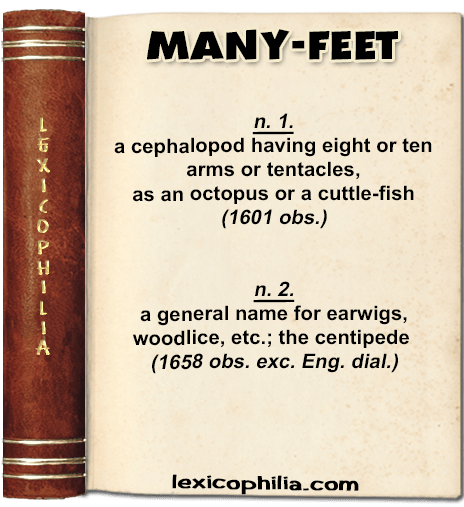
Word of the Day: MANY-FEET

ETYMOLOGY
from many + foot

EXAMPLE
“…As for some sea-fishes, wee have said before that they have eight legs: namely, Manyfeet, Pourcuttles, Cuttles, Calamaries, and Crabfishes; and those moove their fore-clees like armes a contrary way, but their feet either they turne round or else fetch them crooked atone-side: and a man shall not see any living creature again, all round, but they …”

From: The Historie Of The World: Commonly called, The Naturall Historie Of C. Plinius Secundus.
By Pliny the Elder
Translated into English by Philemon Holland, 1601

Word of the Day: TRAGEMATOPOLIST

ETYMOLOGY
from Latin tragematopola (sweet seller) or its etymon, Greek τραγηματοπώλης (seller of sweetmeats),
from τραγήματ-τραγήμα (dried fruits or sweetmeats eaten as dessert) + ‑ο‑ ‑πώλης (-pole) + ‑ist 

EXAMPLE
Abby promised her children a trip to the tragematopolist’s after they’d done their chores and homework.

Word of the Day: DRY-FIST

ETYMOLOGY
from dry (miserly, stingy) + fist

EXAMPLE
“…Ferentes. Yet again ? nay, an if you be in that mood, shut up your fore-shop, I’ll be your journeyman no longer. Why, wise Madam Dryfist, could your mouldy brain be so addle to imagine I would marry a stale widow at six-and-forty? Marry gip! are there not varieties enough of thirteen? come, stop your clap-dish, or I’ll purchase a carting for you. By this light, I have toiled more with this tough carrion hen than with ten quails scarce grown into their first feathers …”

From: Loves Sacrifice
By John Ford, 1633

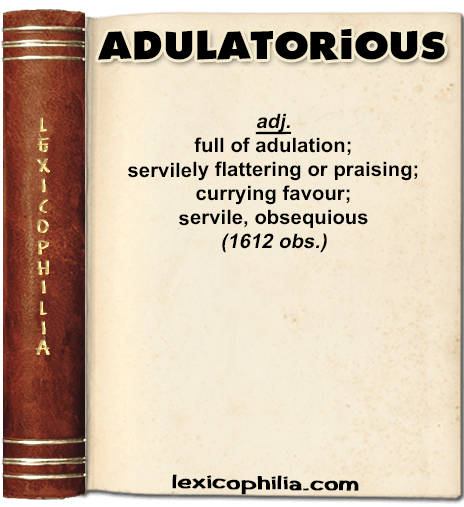
Word of the Day: ADULATORIOUS

ETYMOLOGY
from Latin adulatorius (adulatory) + -ous

EXAMPLE
“…Histories are full fraught with such relations of adorations, and most adulatorious Epithites giuen to his Holinesse, the proper name and calling now of the Pope, amongst his adorers and followers: and doe you think the Pope knoweth not, or affecteth not this his greatnes: obserue his pride (excuse me Pontifician reader) when he saith not priuate Masse himselfe, but is in his publike Chappel, …”

From: The Motiues of Richard Sheldon pr. for his Lust, Voluntary, and Free Renouncing of Communion with the Bishop of Rome, Paul the 5. and his Church
By Richard Sheldon, 1612