Word of the Day

Word of the Day: IMPLUVIOUS


ETYMOLOGY
from im- + pluvious (characterized by rain, rainy) [from French pluvieux, or from Latin pluviosus (rain)]


EXAMPLE
“…Though (by the way) how that Expression should countenance an Impluvious state before the Flood, as the Latin Theory would make it, is not so clear and easie to be understood. For, if we consider, there was no Water upon that Earth, but what fell in Rain…”

From: Geologia: Or, A Discourse Concerning the Earth before the Deluge
By Erasmus Warren, 1690
Word of the Day: ADMINUTIVE


ETYMOLOGY
from Latin adminut-, past participial stem of adminuere (to lessen, to diminish),
from ad- (to) + minuere (to lessen)


EXAMPLE
“…Bellarmine bewails the business, that ever since we began to count and call the Pope Antichrist, his kingdom hath greatly decreased. And Cotton the Jesuite confesses, that the authority of the Pope is incomparably less then it was; and that now the Christian Church is but adminutive …”

From: A Commentary or Exposition Upon all the Books of the New Testament.
By John Trapp, 1656
‘A Commentary Upon the Revelation’

Word of the Day: REFRACTARIOUS


ETYMOLOGY
from Latin refractarius (obstinate, stubborn) + -ous


EXAMPLE
“…Thirdly, if we do well obserue the preposterous & disastrous studies of many schismaticall and refractarious spirits, their heate, their violence, description and vncharitablenes, how vnnaturally they do reiect & reuile their Mother, how passionately they doe blaspheme the Church, which God hath planted with his owne hand, and with what morosity they haue ab-alienated themselues from their Bretheren; they can by no pretext acquit themselues of great vndutifulnes vnto God, being so turbulent in his House, so disobedient to their Mother, & so farre exorbitant in all their courses; not much vnlike to mothes, that fret the cloth, wherein they breed; to water-boughes, which hurt the tree,…”

From: The Picture of a True Protestant:
or, Gods house and husbandry wherein is declared the duty and dignitie of all Gods children, both minister and people.
By Thomas Tuke, 1609

Word of the Day: PEEPY


ETYMOLOGY
from peep + -y


EXAMPLE (for adj. 1)
“…An individual of the latter kind is distinguished in his earliest petticoats – even before he has well left the nursery. He is then a poor, peepy wretch, with blear eyes, and one everlasting dingy night-cap. constantly sitting by the fire, to the great annoyance of the nurse, who frequently declares him to be more of an infant than even his younger brother the baby…”

From: Chambers Edinburgh Journal
Conducted by William Chambers, and Robert Chambers,
Volume I No. 49, Saturday, January 5, 1833,
‘The Domestic Man’

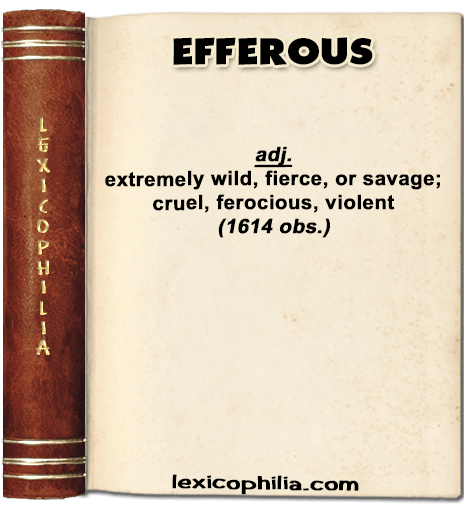
Word of the Day: EFFEROUS


ETYMOLOGY
from Latin efferus [from ex– out + ferus (fierce)] + -ous


EXAMPLE
“…But whatsoeuer be done with the foxes, yet from the teeth of that efferous beast, from the tuske of the wild bore, from the sucking and drawing of Romish horse-leaches, from the bloud-thirsty dropsie of Antichrist and his adherents, from the cursed Assasinates of Iesuites and their darke disciples, from the peremptory knife of Popish, worse then paganish, pruners, ô thou that art the root & generation of Dauid preserue our root and all his generation, together with his most glorious stemme…”

From: Vitis Palatina
A sermon appointed to be preached at VVhitehall vpon the Tuesday after the mariage of the Ladie Elizabeth her Grace.
By Bishop John King, 1614

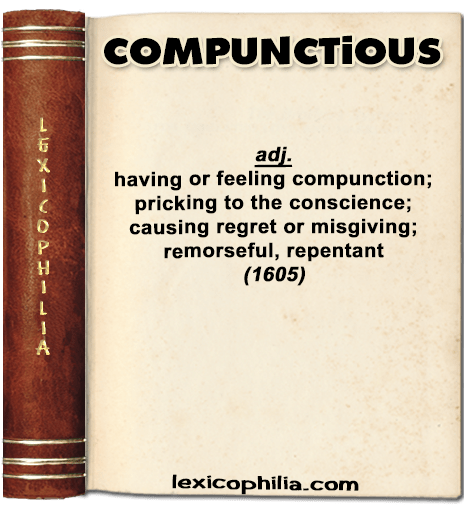
Word of the Day: COMPUNCTIOUS


ETYMOLOGY
from stem of compunction (pricking of the conscience, remorse) + -ous


EXAMPLE
“…The Rauen himselfe is hoarse,
That croakes the fatall entrance of Duncan
Vnder my Battlements. Come you Spirits,
That tend on mortall thoughts, vnsex me here,
And fill me from the Crowne to the Toe, top-full
Of direst Crueltie: make thick my blood,
Stop vp th’ accesse, and passage to Remorse,
That no compunctious visitings of Nature
Shake my fell purpose, nor keepe peace betweene
Th’ effect, and hit. Come to my Womans Brests,
And take my Milke for Gall, you murth’ring Ministers,
Where-euer, in your sightlesse substances,
You wait on Natures Mischiefe. Come thick Night,
And pall thee in the dunnest smoake of Hell,
That my keene Knife see not the Wound it makes,
Nor Heauen peepe through the Blanket of the darke,
To cry, hold, hold
….”

From: Macbeth
By William Shakespeare, a1616

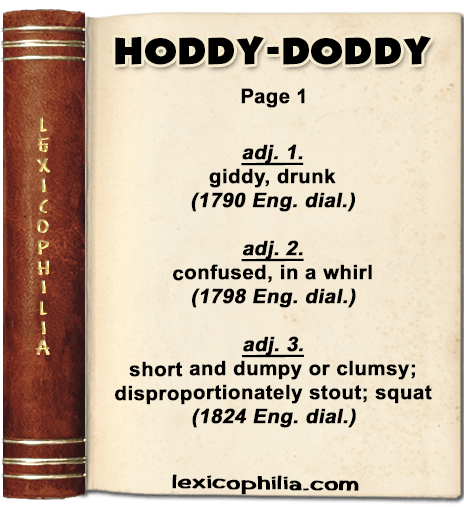
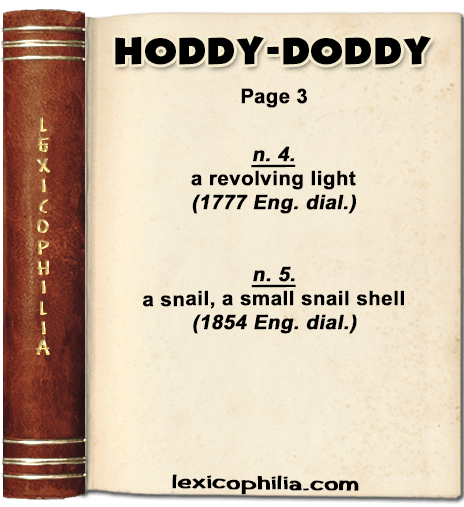
Word of the Day: HODDY-DODDY


ETYMOLOGY
the element dod is evidently the same as in dodman (a shell-snail);
hoddy-dodhoddy-doddy, & hodman-dod, are perhaps from nursery reduplications;
but the element hoddy- appears itself to have come to be associated to mean ‘snail’ (or ? horned);
for n. 2. (a cuckold) – with reference to the ‘horns’ of a cuckold


EXAMPLE (for n. 1.)
“…My living lieth here and there, of God’s grace,
Sometime with this good man, sometime in that place;
Sometime Lewis Loiterer biddeth me come near;
Somewhiles Watkin Waster maketh us good cheer;
Sometime Davy Diceplayer, when he hath well cast,
Keepeth revel-rout, as long as it will last;
Sometime Tom Titivile keepeth us a feast;
Sometime with Sir Hugh Pie I am a bidden guest;
Sometime at Nichol Neverthrive’s I get a sop;
Sometime I am feasted with Bryan Blinkinsop;
Sometime I hang on Hankyn Hoddydoddy’s sleeve;
But this day on Ralph Roister Doister’s, by his leave
…”

From: Ralph Roister Doister,
By Nicholas Udall, a1556

Word of the Day: INSTIGATRIX


ETYMOLOGY
from Latin instigatrix, female agent-n. from instigare (to instigate, bring about by incitement or persuasion)


EXAMPLE
“…She was (saies Salme∣ron, a main Supporter of the Roman Church among the Tridentine Fathers) cooperatrix, that is, Christs Fellow-laborer in the very Passion to the end, that as a Man and a Woman did work out the utter ruine of Man-kind, so a Man and a Woman might perfect their Salvation; and as well here as there, the Woman should be the Instigatrix, or the first Sollicitress, Eve to temt, and Mary to set the Man to work. Thus she is, saies another, the Mother of Redemtion, by shedding her Soul into compassion under, as Christ did his in Passion upon the Cross…”

From: Saul and Samuel at Endor,
or The new waies of salvation and service, which usually temt men to Rome, and detain them there Truly represented, and refuted,
By Daniel Brevint, 1674

Word of the Day: GRIMTHORPE


ETYMOLOGY
from the name of Sir Edmund Beckett, first Lord Grimthorpe (1816–1905), whose restoration of St. Albans Cathedral, completed in 1904, aroused fierce criticism and controversy


EXAMPLE
“…Talking of Lord Grimthorpe reminds us of an honour that has recently been done unto his name. It shall not be the Antiquary’s fault if this honour is not perpetuated; so that, perchance, the dictionaries of the future may immortalize his titular name in the same way as they have already treated the family appellation of Boycott. Last November, a group of appreciative visitors were standing in the nave of the abbey church of Selby, discussing its probable reparation. “Ah!” remarked one, “if only the wealthy and generous man could be found, what a fine field for his labours!” To this a keen and well-known Yorkshire ecclesiologist replied: “Heaven forbid! the building might be grimthorped!…”

From: The Antiquary,
A Magazine Devoted to the Study of the Past, Vol. XXI, January – June, 1890
‘Notes of the Month’