Word of the Day

Word of the Day: WOOL-BIRD

ETYMOLOGY
from wool + bird (the offspring or young of animals, obs.)

EXAMPLE
“… With all the natural timidity of the hare whom he thus particularised, I was proceeding to help him, when Echo inquired if he should send me the breast of a swiss; and the facetious Eglantine, to increase my confusion, requested to be allowed to cut me a slice off the wing of a wool bird. …”

(Note: swiss = a pheasant)

From: The English Spy: an original work, characteristic, satirical and humorous, comprising scenes and sketches in every rank of society
By Charles Molloy Westmacott, 1825
Word of the Day: COCTURE

ETYMOLOGY
from Latin coctura (a cooking)

EXAMPLE
“… For truly, whatsoever is cast into the stomack, digestion being at length finished, is transchanged, and far separated from boyling and other
coctures, after whatsoever degree prepared. …”

From: Oriatrike or, Physike Refined
By Jean Baptiste van Helmont
Translated by John Chandler, 1662

Word of the Day: VILIPENDIOUS

ETYMOLOGY
from vilipend (vb.) + -ious;
from French vilipender, or from Latin vilipendere, from vilis (vile, worthless) + pendere (to consider, esteem)

EXAMPLE
“… And thou ignoble horse-rubbing peasant, that by the borrowed title of a Lord (being but a vilipendious mechanicall Hostler, hast laid this insulting insupportable command on me: the time shall come, when thou shalt cast thy anticke authority, as a snake casts her skin; and then thou for an example to future posterities shalt make an vnsauory period of thy maleuolent dayes in litter and horse-dongue …”

From: All the vvorkes of Iohn Taylor the water-poet Beeing sixty and three in number
By John Taylor, 1630

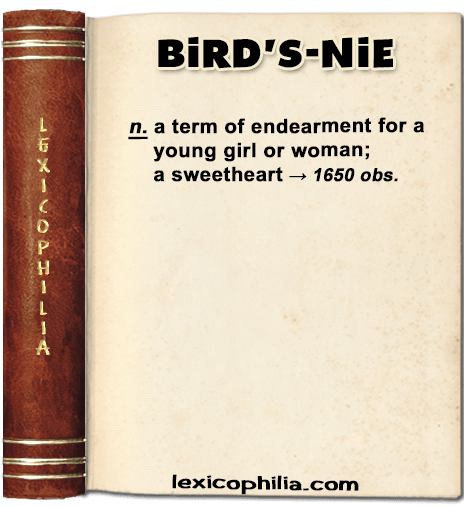
Word of the Day: BIRD’S-NIE

ETYMOLOGY
from the genitive of bird + nye for eye, as in my nye = myn eye;
possibly an alteration of pigsney (a sweetheart, a term of endearment)

EXAMPLE
“… Oh Mistris May, come to bed Sweet-heart come, my Duck, my Birds-nye; Zblood, I must goe to Salisbury to morrow, bring me my Boots quickly; Zounds, will not the Rogues bring me more Money; Zblood, that Cock’s worth a Kings Ransome, a runs, a runs, a thousand pound to a Hobby-horse; Rub, Rub, Rub, a pox Rub a whole hundred Rubs; …”

From: The last vvill and testament of Philip Herbert, burgesse for Bark-shire, 1650

Word of the Day: SWONG

ETYMOLOGY
from Old Norse svangr, related to svangi (swange,  groin), from swaŋgw-, perhaps identical with swaŋgw-, grade-variant of swiŋgw- (to swing – to scourge, whip, flog, beat)

EXAMPLE
“… Þe hungri in god he made stronge,
And þe riche he lette al
swonge.
Þe folk of Israel haþ vndurfonge
Þe child þat heo abide longe; …”

From: The minor poems of the Vernon MS
Published for the Early English Text Society, 1892-1901
La estorie del Euangelie, a1300

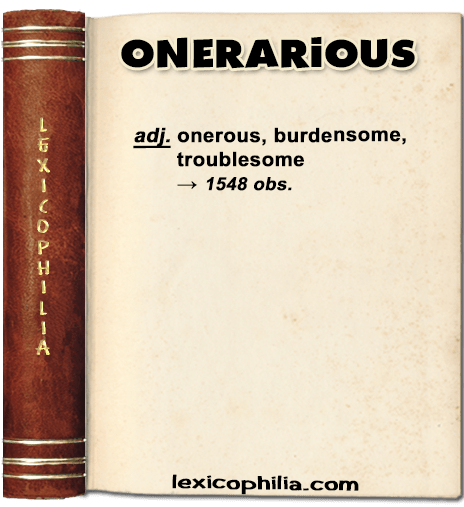
Word of the Day: ONERARIOUS

ETYMOLOGY
from Latin onerarius (suitable for carrying a burden or cargo) + -ous

EXAMPLE
“… For that he emongest all gouernors, chiefly did remembre that a kyng ought to bee a ruler with wit, grauitie, circumspeccion, diligence and constancie, and for that cause to haue a rule to hym comitted, not for an honor, but for an onorarious charge and daily burden, and not to looke so muche on other mennes liuynges, as to consider and remembre his owne doynges and propre actes. …”

From: The vnion of the two noble and illustrate famelies of Lancastre [and] Yorke 
By: Edward Hall, 1548

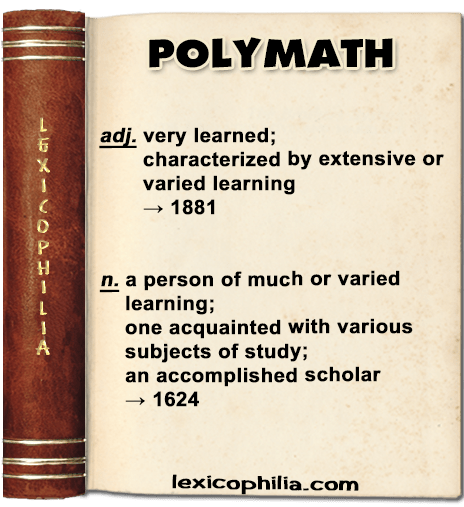
Word of the Day: POLYMATH

ETYMOLOGY
from Greek πολυµαθής (having learnt much), from πολυ- (poly-, much) + μάθη (learning) from the base of µανθάνειν (to learn)

EXAMPLE (for n.)
“… To be counted writers, scriptores ut Salutentur, to be thought and held Polumathes and Polyhistors, apud imperitum vulgus ob ventosæ nomem artis, to get a paper-kingdom: nulla spe quæstus sed ampla famæ, in this precipitate, ambitious age, nunc ut est sæculum, inter immaturam eruditionem, ambitiosum et præceps (’tis Scaliger’s censure); and they that are scarce auditors, vix auditores, must be masters and teachers, before they be capable and fit hearers. …”

From: The Anatomy of Melancholy 
By Robert Burton, 1624

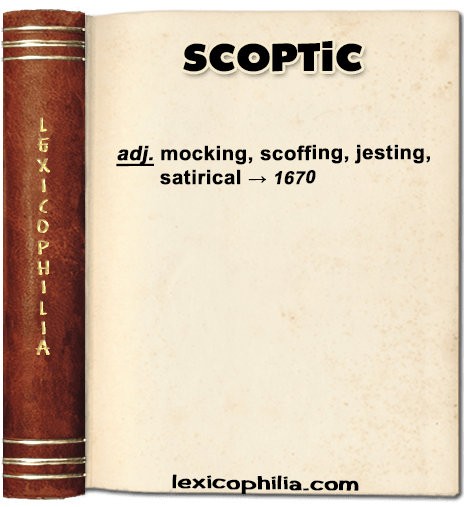
Word of the Day: SCOPTIC

ETYMOLOGY
from Greek σκωπτικός, from σκώπτειν (to mock, jeer)

EXAMPLE
“… Againft these Books, the ‘Learned employed their Learning, and the Witty employed their Wit. Celsus, Porpbyrius, Jamblichus, Hierocles, and other Philosophers, endeavoured to dispute them out of the world, Symmachus and Libanius, and other Rhetors to declaim them away. Julian and Lucian and other Scoptick wits, endeavoured to jeer and droll away the credit of them. …”

From: Sermon Against the Anti-scripturists
By Seth Ward, 1670

Word of the Day: HICKSCORNER

ETYMOLOGY
see definition above

EXAMPLE
“… but Plato moe tymes than one auised hym, with sacrifice to purchace the fauour of the Graces, that is, so to applye hymself, yt his saiynges and dooynges might haue more grace and bee better accepted & taken of the worlde. zeno beeyng outright alltogether a Stoique vsed to call Socrates the scoffer, or the Hicke scorner of the citee of Athenes: because of his merie conceiptes and tauntyng, that he neuer ceassed to vse: but yet is there no manne, but he will saie that Socrates was a more godly feloe then either of those twoo whiche I named last afore. …”

From: Apophthegmes that is to saie, prompte, quicke, wittie and sentencious saiynges, of certain emperours, kynges, capitaines, philosophiers and oratours,
By Desiderius Erasmus
Translated by Nicholas Udall. 1542

Word of the Day: OBLIGATORIOUS

ETYMOLOGY
from Latin obligatorius (imposing obligation) + -ous

EXAMPLE
“… quharethrow he culd nocht contract, trespas, or do ony sic deid as were obligatorious, quherbj he mycht be oblist to pvnisment of his persoune, likeas he mycht nocht oblise him in his gudis …”

From: Ancient Criminal Trials in Scotland
Compiled from the original records and manuscripts
By Robert Pitcairn, 1833
Slaughter committed by an alleged Madman or Furious person – A.D. 1554