Word of the Day

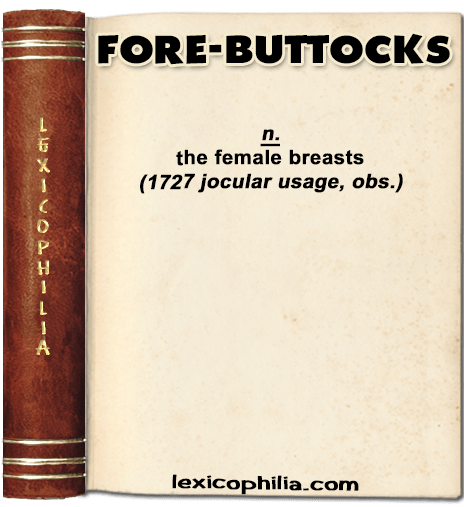
Word of the Day: FORE-BUTTOCKS


ETYMOLOGY
from fore- (prefix) + buttock (n.)


EXAMPLE
“…Nothing in Nature is so lewd as Peg,
Yet, for the World, she would not shew her Leg!
While bashful Jenny, ev’n at Morning-Prayer,
Spreads her Fore-Buttocks to the Navel bare.
But diff’rent Taste in diff’rent Men prevails,
And one is fired by Heads, and one by Tails;
Some feel no Flames but at the Court or Ball,
And others hunt white Aprons in the Mall
…”

From: Sober Advice from Horace: to the young gentlemen about town.
As deliver’d in his second sermon.
Imitated in the manner of Mr. Pope.
…as restored by the Rev’d. R. Bentley, 1734

Word of the Day: BILINGUOUS


ETYMOLOGY
from Latin bilinguis (speaking two languages)
from bi- (two) + lingua (tongue, language) + -ous


EXAMPLE
“…Besides this, we having a Greek translation of this history and that of Manetho, by Eusebius and others, this manuscript, like the Rosetta stone, affords a bilinguous inscription, and serves, by its considerable number of proper names, more than any other, to decide upon Champollion’s hieroglyphical system…”

From: The Literary Gazette,
and Journal of the Belles Lettres, Art, Sciences, Etc. for the year 1828.
Saturday, July 19, 1828.
Literary and Learned.
Remarks upon an Egyptian History, in Egyptian Characters, 
in the Royal Museum at Turin….
By Dr. G. Seyffarth

Word of the Day: NICELING


ETYMOLOGY
from nice (adj.) + -ling


EXAMPLES
(for n.1.)
“…Whether a man loue God purely, the pleasures of this worlde dooe trye, but muche more doeth the hurly burly of affliccions. And it is in vs, that being furnyshed with the helping ayde of God, we maye nether become tendre nycelynges through vayne pleasures, ne moued with terrible turmoylinges …”

From: The seconde tome or volume of the Paraphrase of Erasmus vpon the Newe Testament
Desiderius Erasmus
Translation by Miles Coverdale et al, 1549


(for n. 2.)
“…Why, I was showing you what nicelings and delicates my father was bringing, and what I had thought to say was this: that he may have this for one, and that for the other, and many a one proud to be remembered (as I shall be if he thinks of me), but this that I know he is bringing for little Bess Hall is something worth all of these, for it is nothing less than the whole love of his heart…”

From: Judith Shakespeare: Her love affairs and Other Adventures
By William Black, 1884

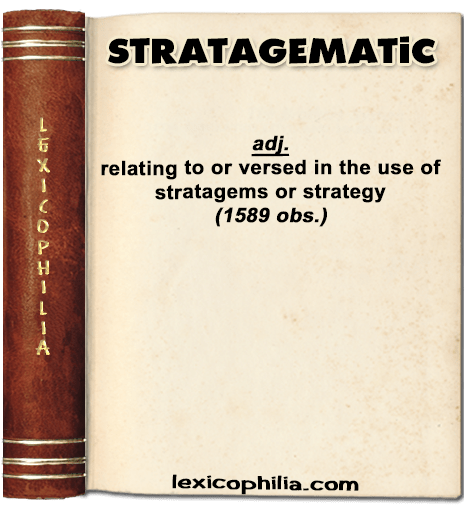
Word of the Day: STRATAGEMATIC


ETYMOLOGY
from obsolete French strategematique,
or from Latin strategematicus, from strategēmat-strategema (stratagem) + -icus (-ic)


EXAMPLE
“…Wherefore such persons as be illuminated with the brightest irradiations of knowledge and of the veritie and due proportion of things, they are called by the learned men not phantastici but euphantasioti, and of this sorte of phantasie are all good Poets, notable Captaines stratagematique, all cunning artificers and enginers, all Legislators, Polititiens, & Counsellours of estate, in whose exercises the inuentiue part is most employed, and is to the sound and true iudgement of man most needful…”

From: The Arte of English Poesie
By George Puttenham, 1589

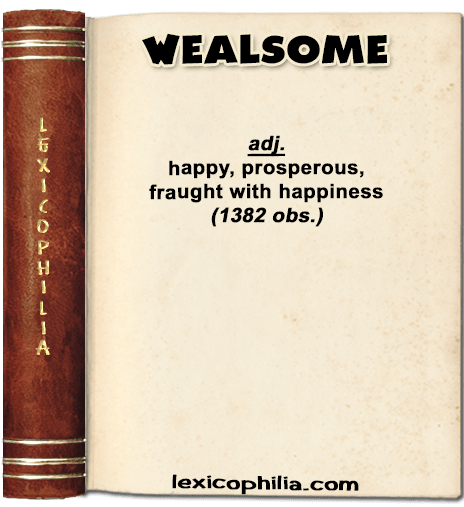
Word of the Day: WEALSOME


ETYMOLOGY
from weal (well-being, Old English wela [wealth], in late Old English also welfare, well-being), + –some


EXAMPLE
“…I preisede more the deade than the liuende; and I demede hym welsumere than either, that ȝit is not born …”

From: The Holy Bible, containing the Old and New Testaments, with the Apocryphal books
(Wycliffite, early version), a1382
Edited by Josiah Forshall and Frederic Madden. 1850

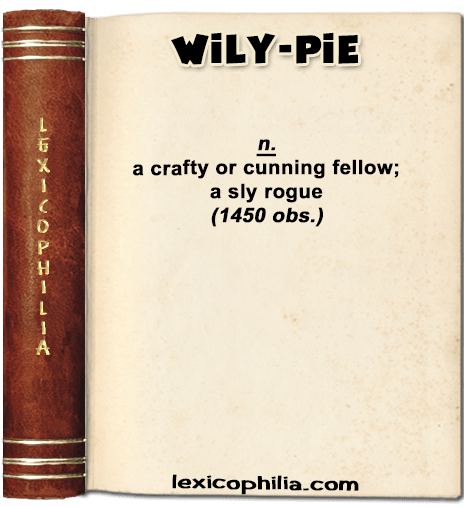
Word of the Day: WILY-PIE


ETYMOLOGY
from wily (crafty, cunning, sly) + pie (a cunning, sly, or wily person, obs.)


EXAMPLE
“…So fiercely he fighteth, his mind is so fell,
That he driveth them down with dints on their day-watch;
He bruiseth their brainpans and maketh them to swell,
Their brows all to-broken, such claps they catch;
Whose jealousy malicious maketh them to leap the hatch;
By their cognizance knowing how they serve a wily pie
Ask all your neighbours whether that I lie
…”

From: Divers Ballads and Ditties Solacious
The Ancient Acquaintance, Madam, Between us Twain
John Skelton, (1460? – 1529)

Word of the Day: AUTEXOUSIOUS


ETYMOLOGY
from Greek αὐτεξούσιος (free will) + -ous


EXAMPLE
“…For First, as to Moral Evils, (which are the Chiefest) there is a Necessity that there should be Higher and Lower Inclinations in all Rational Beings Vitally United to Bodies, and that as Autexousious or Free-willed, they should have a Power of determining themselves more or less, either way…”

From: The True Intellectual System of the Universe
By Ralph Cudworth, 1678