Word of the Day

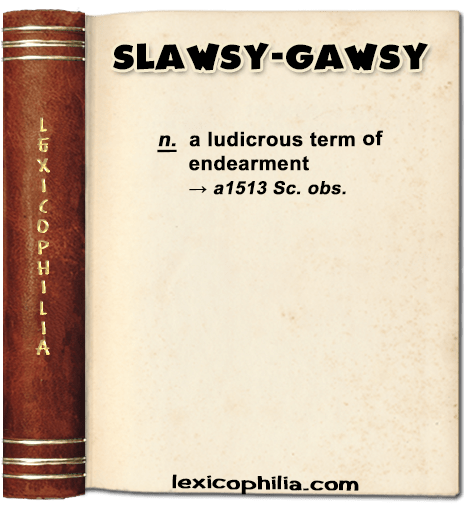
Word of the Day: SLAWSY-GAWSY

ETYMOLOGY
of uncertain origin;
possibly from slaw, Scots variant of slow

EXAMPLE
“… Quod scho, “My clype, my unspaynit gyane,
With moderis mylk yit in your mychane,
My belly huddrun, my swete hurle bawsy,
My huny gukkis, my
slawsy gawsy,
Your musing waild perse and harte of stane,
Tak gud confort, my grit heidit slawsy,
Fow leis me that graceless gane.
…”

From: The Poems of William Dunbar 
Edited by Priscilla Bawcutt, 1998 (Association for Scottish Literary Studies nos. 27 and 28)
Composed a1513

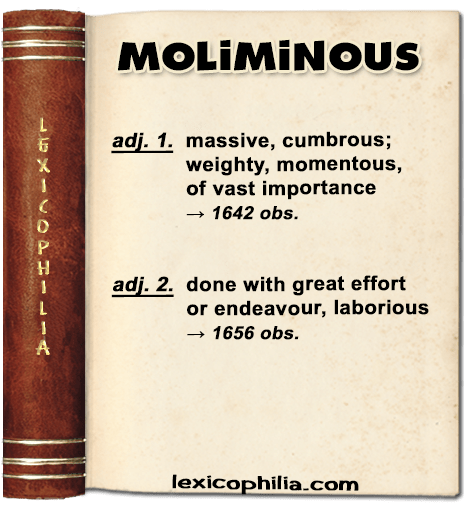
Word of the Day: MOLIMINOUS

ETYMOLOGY
from Latin molimin- molimen (effort); (from moliri (to make an effort, undertake, attempt)) + -ous

EXAMPLE (for adj. 1.)
“… In all great distresses the body of the people was ever constrained to rise, and by the force of a Major party to put an end to all intestine strifes, and make a redresse of all publique grievances, but many times calamities grew to a strange height, before so combersome a body could be raised; and when it was raised, the motions of it were so distracted and irregular, that after much spoile and effution of bloud, sometimes onely one Tyranny was exchanged for another: till some way was invented to regulate the motions of the peoples moliminous body, I think arbitrary rule was most safe for the world, but now since most Countries have found out an Art and peaceable Order for Publique Assemblies, whereby the people may assume its owne power to do itselfe right without disturbance to it selfe, or injury to Princes, he is very unjust that will oppose this Art and order. …”

From: Observations upon some of His Majesties late answers and expresses
By Henry Parker, 1642

PRONUNCIATION
moh-LIM-uh-nuhss

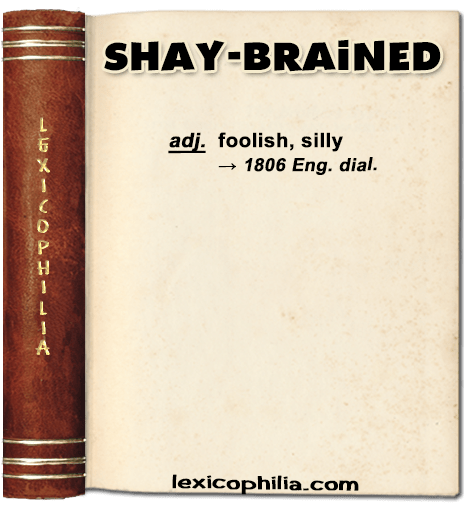
Word of the Day: SHAY-BRAINED

ETYMOLOGY
of unknown origin;
possibly a variant or alteration of shanny-brained;
from shanny (bashful, shy) + brained

EXAMPLE
“… But while I take this shay-brain’d course,
And like a fool run to and fro,
Master, perhaps, may sell the horse!
Therefore this instant home I’ll go.
…”

From: Wild Flowers; or, Pastoral and Local Poetry
By Robert Bloomfield, 1806

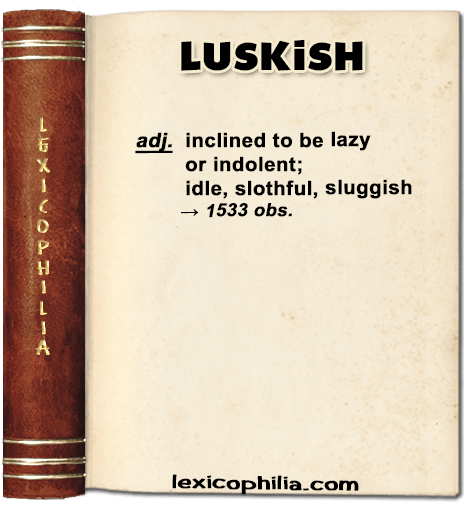
Word of the Day: LUSKISH

ETYMOLOGY
obsolete lusk (an idle or lazy fellow, a sluggard) + -ish

EXAMPLE
“… And as it fareth in the traunces and slepes that folke fall in by the bely – so fareth it lykewyse in the traunces and slepes that folke fall in by those partes that are benethe the bely. For whan the rage is thereof (as Tyndall sayeth) ouer passed, and that they haue in theyr traunce and theyr slepe played out all theyr luskysshe lustes … than they awake. …”

From: The Second Parte of the Confutacion of Tyndals answere in whyche is also confuted the chyrche that Tyndale deuyseth
By Thomas More, 1533

Word of the Day: LOSENGE

ETYMOLOGY
from Old French losenger = Provencal lauzengar, Spanish lisonjar, Portuguese lisonjear, Italian lusingare
from Old French losengelosange (flattery) = Provencal lauzengalauzenja, Spanish, 
Portuguese lisonja;
apparently adopted by the other Romance languages, from Provencal lauzenga = Old French loenge (French louange) (praise)
from medieval Latin laudemia, a derivative Latin laud-em (praise)

EXAMPLE
“… Thanne began Glaucus to call her and losenge her. …”

From: The Metamorphoses of Ovid 
Translated by William Caxton, 1480

Word of the Day: CAPERATE

ETYMOLOGY
from Latin caperat- participial stem of caperare (to frown)

EXAMPLE (for vb. 2.)
“… the first is called a Limmon which is turbinated with an oblong effigies, is colorated herbaceously, and turgid with a more acid acerb and frigid succe, corticated with a thinner pill, and not so amare as an Orenge: the second is the more vulgar Citron, very like the former, but its colour is more luteous, its pill more crasse, rugous and caperated, and it selfe more crasse, odorate, medicative and convenient for antidotes: the third is greatest called Pom-Citron, orbiculated like a melon, with a thick carnous pill, somtimes aequalling a mans nayle in crassitude, with a concolorated superficies, which we call Poncerium, Citroniatum, Assyrian Apple, and Adams Apple, all which names seem to be deflected from the Tree, and as they are alike in Idea, so also in facultyes. …”

From: A Medicinal Dispensatory, containing the whole body of physick discovering the natures, properties, and vertues of vegetables, minerals, & animals
By Jean de Renou
Translated by Richard Tomlinson, 1657
Of Limmons, Citrons.

Word of the Day: PLANILOQUENT

ETYMOLOGY
from Latin planiloquus (plain-speaking) (from planus [plain] + -loquus (from loqui [to speak])) + -ent

EXAMPLE
“… Dear Editor: Please continue your piperitious, planiloquent polemics against those omphaloskeptical, onychophagic, uxoravalent, philalethic, laodicean, opisthoporeiac, equivorous, kakorrhaphiophobiac, megalomaniacal, porlockian, contortuplicate, acritochromatic, and tragomaschaliac pseudoacademicians.
Cordially
Dr. Panos D. Bardis
Editor, Social Sciences …”

From: Maledicta (International Journal of Verbal Aggression, Volume 1 Number 2)
In Defense of Anticacademoidism
Edited by Reinhold Aman, 1978

Word of the Day: HIEFUL

ETYMOLOGY
from hie (haste, speed) + -ful

EXAMPLE
“… Schrift schal beo wreiful, bitter mid sorhe, ihal, naket, ofte imaket, hihful, eadmod, scheomeful, dredful ant hopeful …”

(Confession must be accusatory, bitter with regret, complete, naked, frequently made, prompt, humble, made with shame, fear, and hope…)

From: The English text of the Ancrene Riwle: Ancrene Wisse edited from MS. Corpus Christi College Cambridge 402, c1230
Edited by John Ronald Reuel Tolkien and Neil Ripley Ker
The Early English Text Society edition, 1962

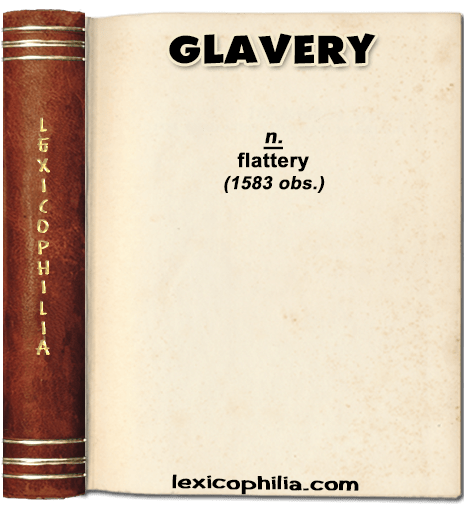
Word of the Day: GLAVERY

ETYMOLOGY
from glaver (to flatter, to deceive with flattery) + -y;
glaver is of obscure origin

EXAMPLE
“… But I staie my selfe and assure you of this, that in al crations and speeches, in all pleas, and actions, for and against any man amongst them, honest plainenesse was euer an argument of fauour and succour, and holowe smoothing glauerie a note of reprooch and an argument to perswade the contrarie. Nowe therefore let vs gather vppe all these againe together, and if heathens hate it, Christians loath it, and the God of life and death abhor it, what strength should anie cause in the earth haue to tempt you vnto it? …”

From: A Briefe Conference betwixt Mans Frailtie and Faith
By Gervase Babington, 1584