Word of the Day

Word of the Day: CARRIWITCHET


ETYMOLOGY
of unknown origin


EXAMPLE
“…That tells vs of Proiects beyond the Moone, of Golden Mines, of Deuices to make the Thames run on the North side of London (which may very easily be done, by remouing London to the Banke-side) of planting the Ile of Dogs with Whiblins, Corwhichets, Mushromes and Tobacco. Tut I like none of these, Let mee see, as I take it, it is an inuectiue against Coaches, or a proofe or tryall of the Antiquitie of Carts and Coaches…”

From: All the vvorkes of Iohn Taylor the Water-Poet 
By John Taylor, 1623
The VVorld runnes on VVheeles

Word of the Day: MELIORATE


ETYMOLOGY
from late Latin meliorat-, ppl. stem of meliorare, from Latin melior-, (melior better)


PRONUNCIATION
MEE-lee-uh-rayt


EXAMPLE
“…safe from all daungiers,beeyng proude therof not without cause, he would often saie: I found Roome made but of bricke, and I will leaue it of marble. Nothyng to a prince maye bee more magnificente or regall, then if the same dooe meliorate & bettre ye state of a dicion or royalme descended and come to his possession…”

From: Apophthegmes that is to saie, prompte, quicke, wittie and sentencious saiynges, of certain emperours, kynges, capitaines, philosophiers and oratours…
By Desiderius Erasmus
Translated by Nicholas Udall, 1542

Word of the Day: COCKLE-BRAINED


ETYMOLOGY
of uncertain origin;
perhaps from cockle (to move or rock unsteadily; to totter or wobble)


EXAMPLE
“…Their bind was just a Scots pint over-head, and a tappit-hen to the bill, and no man ever saw them the waur o’t. It was thae cockle-brained callants of the present day that would be mair owerta’en with a puir quart than douce folk were with a magnum…”

From: St. Ronan’s Well
By Sir Walter Scott, 1823

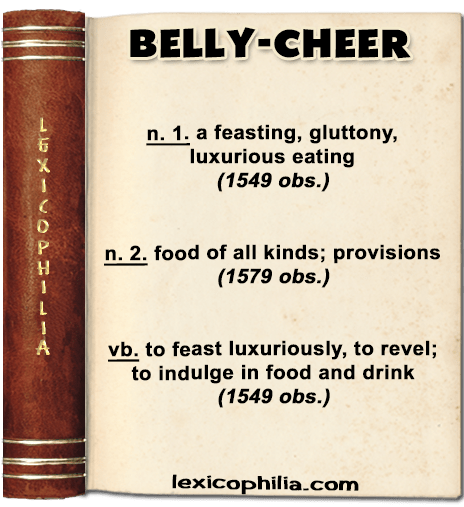
Word of the Day: BELLY-CHEER


ETYMOLOGY
from belly (n.) + cheer


EXAMPLE
“…so they would contynue, in case theyr ordinaries, Curates, & ministers were not trylers and hynderours therof, and if they were not seduced, and taught by sedicious earewhisperours contrary to the worde of God & the Kynges hyghnes mooste godly gracious procedinges, onely for pelfe , belycheare, ease and lucre. But take me not, that I meane all them to be triflers, hynderours, or sinistre resisters, that are ordinaries, curates or ministres…”

From: The Seconde Tome or Volume of the Paraphrase of Erasmus
By Desiderius Erasmus
Translated by John Olde, 1549

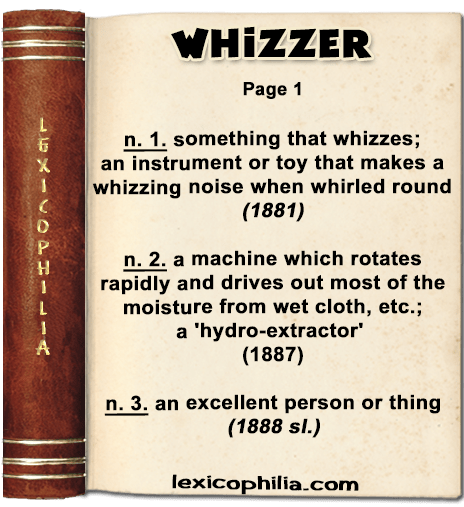
Word of the Day: WHIZZER


ETYMOLOGY
from whizz (to move swiftly or with such a sound) + -er


EXAMPLE
“…The washerwoman finds her occupation almost gone through the introduction of machinery. The larger part of the city of Troy is devoted to the manufacture of engines, whizzers, starchers, and other machines of the steam laundry. The most interesting machine is the whizzer, which dries clothes in 1,000 revolutions a minute…”

From: The Pall Mall Budget, July 1887
Volume 35

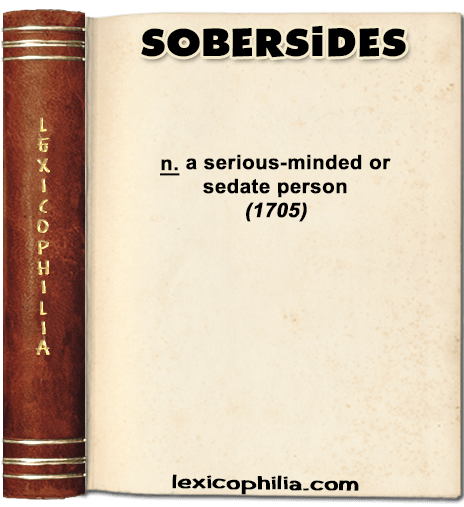
Word of the Day: SOBERSIDES


ETYMOLOGY
from sober + the plural of side


EXAMPLE
“…I am sorry you have been again out of luck with a horse; but do not despair. I have got a sober sides on trial for a week past, but really & truly cannot make time to put him to the proof, & he stands idle in my stable, but hope as I have often, very often hoped before that I shall have more time the next week…”

From: The Selected Letters of Josiah Wedgwood, Feb, 1779
Edited by Anne Finer and George Savage, 1965

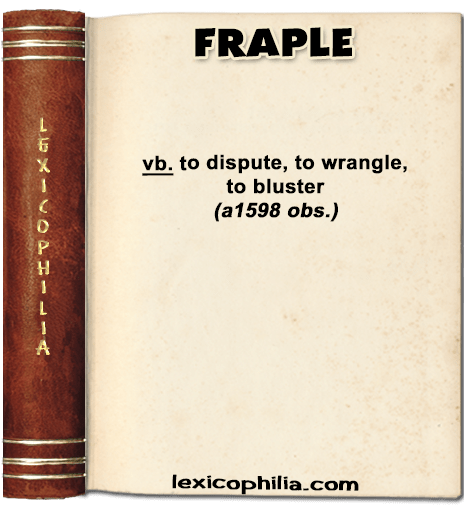
Word of the Day: FRAPLE


ETYMOLOGY
of uncertain origin;
perhaps from the Teutonic root flap and Old French frapillier (to be indignant, murmur)


EXAMPLE
“…Elixir vitae, and the precious Stone,
You know as well as how to make an Apple;
If’te come to the workinge then let you alone,
You know the coullers black brown bay and dapple,
Controwle you once then you begin to fraple.
Swearing and saying, what is fellow is this?
Yet still you worke but ever worke amisse
…”

From: Sir Edward Kelle’s Worke,
In Elias Ashmole’s Theatrum Chemicum Brittanicum, 1652

Word of the Day: WRIXLE


ETYMOLOGY
Old English wrixlian-an (to alter, change, exchange, etc.),
also ᵹewrixlian, altered form of ᵹewixlian, = Old Frisian wixlia, Old Saxon wehsalon, Old High German wehsalon (German wechseln)


EXAMPLE (for vb. 2)
“…Kynges, & knightes, & other kyde Dukes,
That the charge, & the chaunse hase of þis choise wer,
Thurgh oure might & oure monhod maintene to gedur!
What whylenes, or wanspede, wryxles our mynd?
Þat for meuyng of a man,—Menelay the kyng,—
And the wille of a woman, as ye weton all,
Oure londes haue leuyt, & oure lefe godys
…”

From: Destruction of Troy,
The gest hystoriale of the destruction of Troy,
An alliterative romance translated from Guido de Colonna’s Hystoria Troiana

Word of the Day: ACCUSANT


ETYMOLOGY
from French accusant (n. person who accuses), (adj. that accuses)


PRONUNCIATION
uh-KYOO-zuhnt


EXAMPLE
“…The whole Councell beeing afterward called together, they gaue them-selues to the vnderstanding of the matter. As for the crime and the punishment, was of the accusant called vpon in these wordes: The Iudgement of death is due to this man, because hee hath done this or that. But the Defendant repelled it, with these wordes. The Iudgement of death is not due this man, because hee hath not done it, or because hee hath doone it righteously …”

From: A Defence of the Government Established in the Church of Englande
By John Bridges, 1587

Word of the Day: MACROBIAN


ETYMOLOGY
formed on Greek.µακρόβιος (long-lived (from µακρός (long) + βίος (life)) + -an


PRONUNCIATION
muh-KROH-bee-uhn


EXAMPLE
“…Nor did we think it more reasonable to doubt of the Transmogrification of the Macrobian Children into Swans, or that of the Men of Pallene in Thrace into Birds, as soon as they have bath’d themselves in the Tritonie Lake. After this the Devil a word we could get out of him but of Birds and Cages…”

From: The Fifth Book of The Works of Francis Rabelais, M.D.
Translated by Peter Anthony Motteux, 1694