Word of the Day

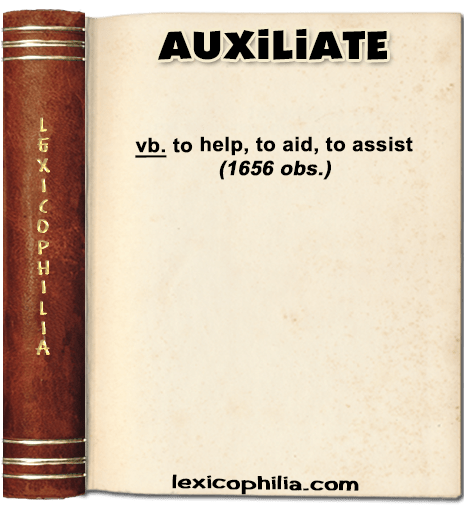
Word of the Day: AUXILIATE


ETYMOLOGY
from Latin auxiliat- ppl. stem of auxiliari (to help, to assist)


EXAMPLE
“…of which are some Plants, or parts thereof, and some Minerals, which being absolutely described, put the Apothecary upon doubts, who is ignorant of the genuine dilucidation: whose tenuity, that we may auxiliate, we will give him the names of the five opening roots; and they are the roots of Smallage, Sperage, Parsley, Fennel, and Butchers-broom. Besides which, other five are much celebrated, to wit, the roots of Grass, the greater Madder, Oenone, Ca∣pers, and Eryngium…”

From: A Medical Dispensatory
Containing the Whole Body of Physick
Composed by the Illustrious Renodaeus,
Englished and Revised by Richard Tomlinson, 1657
The Fourth Book Of Roots
Word of the Day: WIGHTLING


ETYMOLOGY
from wight (strong and courageous, esp. in warfare) + -ling (with the sense a person belonging to or concerned with)


EXAMPLE
“…Now, wiþ outen more dueling,
Galathin com swiþe flinge 
Wiþ þre þousand wiȝtling
& smot oȝain þat heþen king
…”

From: Arthour and Merlin;
an anonymous Middle English verse romance giving an account of the reigns of Vortigern and Uther Pendragon and the early years of King Arthur’s reign, c1330

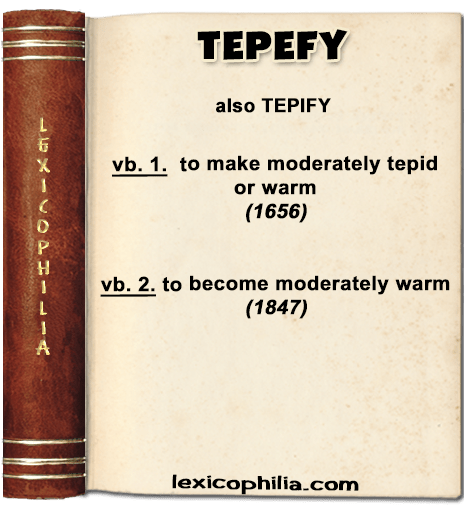
Word of the Day: TEPEFY


ETYMOLOGY
from Latin tepefacere (to make tepid),
from tepere (to be lukewarm)


EXAMPLE (for vb. 1)
“…Sonorous, thro’ the patient’s bosom pours
Its antidotal notes, the flood of life,
Loos’d at its source by tepefying strains,
Flows like some frozen silver stream unthaw’d
At a warm zephyr of the genial spring
…”

From: The Power of Harmony
By John Gilbert Cooper, 1745

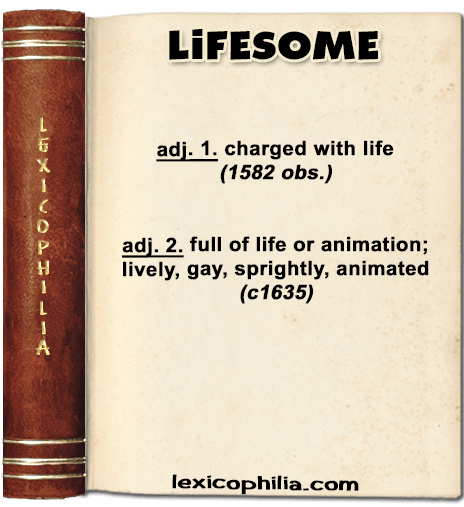
Word of the Day: LIFESOME


ETYMOLOGY
from life (n.) + -some


EXAMPLE (for adj. 1)
“…If badd, how happ’s that none his hurtes disproue?
If willingly I burne, how chance I waile?
If gainst my will, what sorrow will auaile?
liuesome death, O sweete and pleasant ill,
Against my minde how can thy might preuaile?
If I bend backe, and but refraine my will,
If I consent, I doe not well to waile
…”

From: ἐκατομπαθία: The Hekatompathia or Passionate Centurie of Loue
By Thomas Watson, 1582

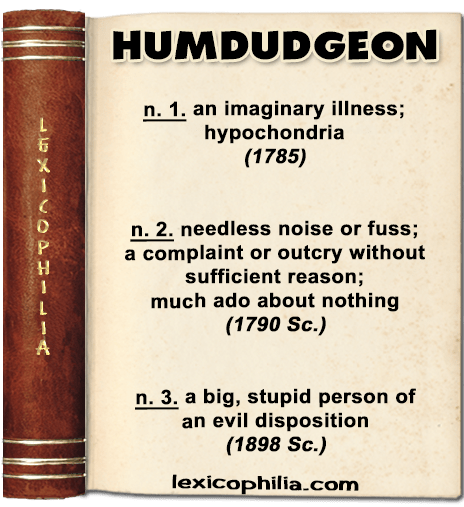
Word of the Day: HUMDUDGEON


ETYMOLOGY
from hum (a piece of humbug, an imposition, a hoax) + dudgeon (a feeling of anger, resentment, offense)


EXAMPLE (for n. 1)
“…”Hout tout, man – I would never be making a hum-dudgeon about a scart on the pow – but we’ll be in Scotland in five minutes now, and ye maun gang up to Charlies-hope wi’ me, that’s a clear case…”

From: Guy Mannering
By Walter Scott, 1815

Word of the Day: RURICOLIST


ETYMOLOGY
from Latin ruricola (a person who tills the land, husbandman, country dweller, rustic)
(from ruri-, combining form of rur-rus (country) + -cola) + -ist


EXAMPLE
“…His hood was half blue and half green, and, over his left ear, was set off with an artificial rose. His appearance did not bespeak the ruricolist, and Dick, who at once detected this, set him down for a burgess of London…”

From: The Life and Times of Dick Whittington
An Historical Romance.
By Richard Whittington, 1841

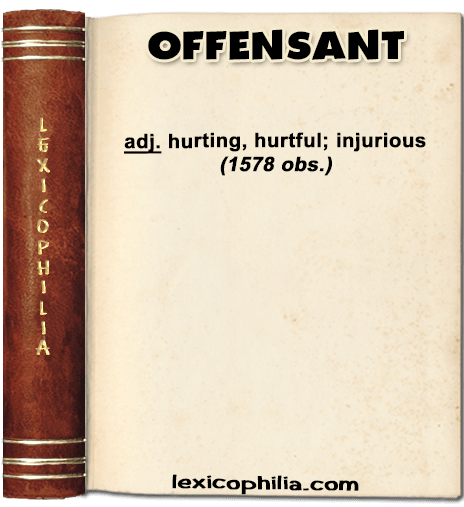
Word of the Day: OFFENSANT


ETYMOLOGY
from offence (to offend) + -ant


EXAMPLE
“…Now agayne because the ribbes, in their inner region or side, are succinged and clothed with a most sensible Membran called Pleura, and to the end that, the asperitie and roughnes of the ribbes, might not be at any time, to the sensibilitie of the same, offensaunt, it was therfore carefully prouided for, they beyng inwardly, wrought so smooth & easie for the same as may be deuised…”

From: The Historie of Man 
By John Banister, 1578

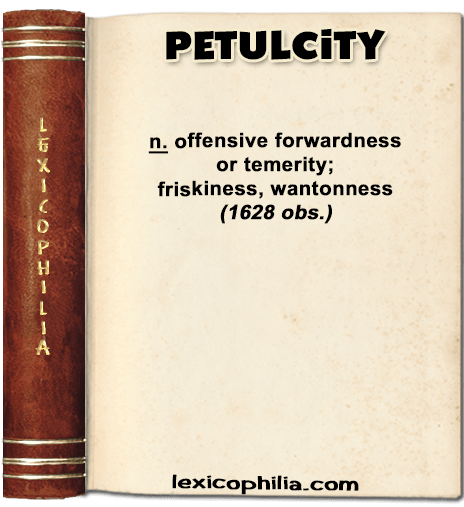
Word of the Day: PETULCITY


ETYMOLOGY
from Latin petulcus (butting, wanton, frisky)


EXAMPLE
“…I do therefore much blame the petulcity of whatsoever author that should dare to impute a popish affection to him, whom, besides his excellent writings and sermons, God’s visible, eminent, and resplendent graces of illumination, zeal, piety, and eloquence have made truly honourable and glorious in the Church of Christ…”

From: The Works of the Right Reverend Joseph Hall, 1837
Letter to Joseph Hall from Thomas Morton, 1628