Word of the Day

Word of the Day: POCULENT


ETYMOLOGY
from Latin poculentus (drinkable, suitable for drinking),
from poculum (a cup, a drinking vessel) + -lentus (-lent), after vinolentus (addicted to drinking wine)


EXAMPLE
“…As for radish and tarragon, and the like, they are for condiments, and not for nourishment. And even some of those herbs which are not esculent, are notwithstanding poculent; as hops, broom, &c…”

From: Sylva Sylvarum
By Francis Bacon, 1626
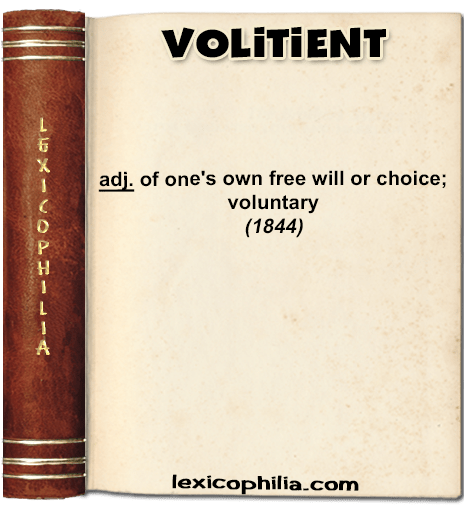
Word of the Day: VOLITIENT


ETYMOLOGY
irregularly from voliti-,
from French volition,
from medieval Latin volition-volitio (noun of action),
from Latin volo (I wish, will) + -ent 


EXAMPLE
“…I chose this ruin: I elected it
Of my will, not of service, What I do, I do volitient, not obedient,
And overtop thy crown with my despair
…”

From: A Drama of Exile
By Elizabeth Barrett Browning, 1844

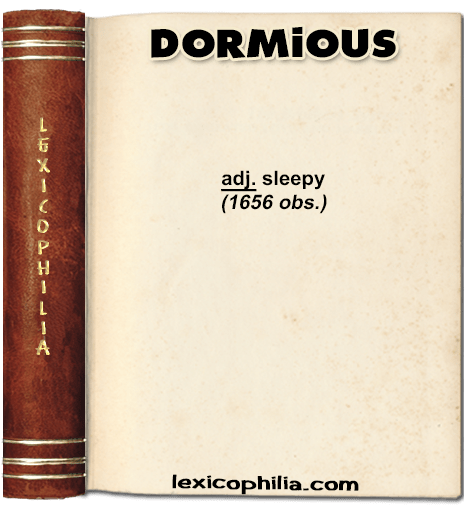
Word of the Day: DORMIOUS


ETYMOLOGY
from Latin dormire (to sleep) + -ous


EXAMPLE
“…and the busie Bell-man bounced twice at the door, and as well the Champion as Soto began to grow dormious, which occasioned the Host to petition their present departure to bed, which (with heavie heads heaven knows) they went to…”

From: Don Zara del Fogo: a Mock-Romance
By Samuel Holland, 1656

Word of the Day: HYPEROCHALITY


ETYMOLOGY
from Greek ὑπέροχος (eminent, distinguished) + -al + -ity


EXAMPLE
“…correspondent to the Iron-Age of Prelats, so plague the Metropoliticality of York and Canterbury, and the Hyperocality of all the other Prelats, as I will never leave them, till I have sent them to the place where the two Fulmina Belli, Alexander the Great cries Mustard and Green Sauce, and where Julius Caesar plays Plato’s Ratcatcher…”

From: The Letany of Doctor Bastwick
By John Bastwick, 1637

Word of the Day: BISMER


ETYMOLOGY
from OED: from West Germanic: Old English bísmer-or (strong neuter), identical with Old High German bísmer (ridicule), from bí-, be- prefix (in its strong or accented form) + -smer, which Schmeller connects with Middle High German smier (a smile, laughing), smieren (to smile).
Others have compared Old High German smero, Old English smeoru, Old Germanic *smerwo-(m, ‘fat, grease, butter,’ which seems, on phonetic as well as other grounds, less probable.


EXAMPLE
“…And eek for sche was somdel smoterlich
Sche was as deyne as water in a dich
     As ful of hokir and of bissemare
hir thoughte ladyes oughten hir to spare /
what for hir kynreed and hir nortelrye
…”

From: The Harleian ms. 7334 of Chaucer’s Canterbury Tales
Geoffrey Chaucer, c1386

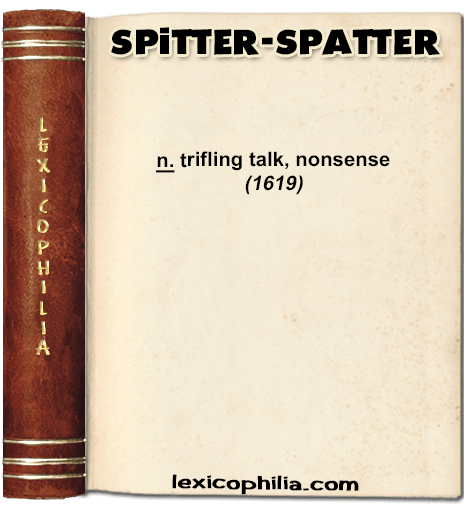
Word of the Day: SPITTER-SPATTER


ETYMOLOGY
from spatter (to scatter or disperse in fragments)


EXAMPLE
“...Or when the court removes, or what’s a clock,
Or where’s the wind (or some such windy mock)
With such fine scimble, scemble, spitter-spatter,
As puts me clean besides the money-matter?
Thus with poor mongrel shifts, with what, where when?
…”

From: A Kicksey Winsey: Or, A Lerry Come-Twang
By John Taylor, 1619

Word of the Day: MAUMISH


ETYMOLOGY
possibly from maum (mellow, soft, esp. over-ripe) + ish 


EXAMPLE
“…but she fed more vpon fancie, than glutted hir selfe with any cates there presente: more vpon daintie deuices, than any parcell of repast: for this meate forsooth was mawmish, & this melancholie: this dish would driue hir to drincke, and this cause hir to drie…”

From: Narbonus The Laberynth of Libertie
By Austin Saker, 1580