Word of the Day

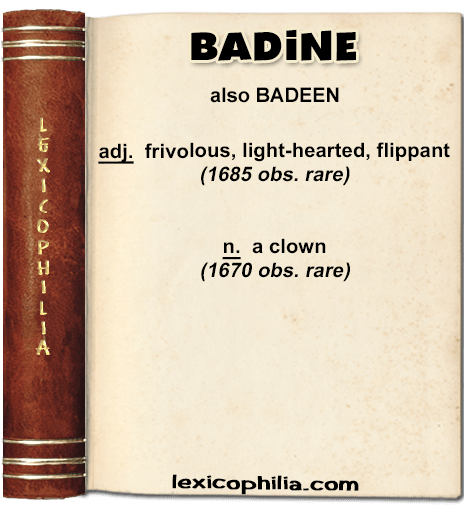
Word of the Day: BADINE


ETYMOLOGY
from French badin (as a noun – a light-hearted person, fool, idiot; also used to denote the fool or clown in drama), (as an adjective – light-hearted, cheerful, foolish, silly),
from Old Occitan badin, adjective and noun, from badar (to gape), from Latin badare (to gape) + -in (-ine)


EXAMPLE
“…Such a Badeen ne’er came upon the Stage,
So droll, so monkey in his play and rage;
Sprawling upon his back, and pitching pyes,
Twirling his head, and flurring at the flies.
A thousand tricks and postures would he show,
Then rise so pleas’d both with himself and you,
That the amaz’d beholders could not say
Whether the bird was happier, or they…”

From: Poems by Sir W.T.
By William Temple, 1670
‘Upon My Lady Giffard’s Loory’
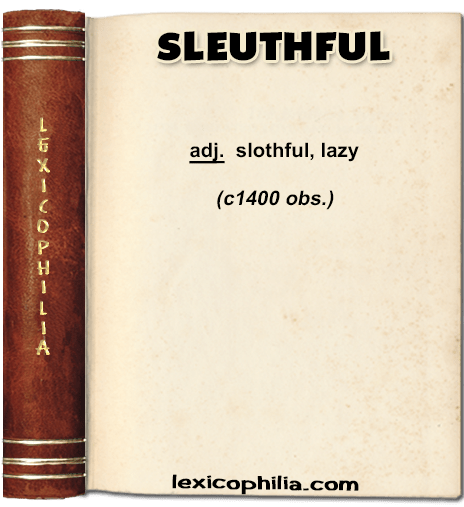
Word of the Day: SLEUTHFUL


ETYMOLOGY
from sleuth (sloth, laziness obs.) + -ful


EXAMPLE
“…And he þat hauys greet egℏen̛ ys enuyous & witℏ-outen shame, sleuthful, and vnobeyssant. He þat hauys lityƚƚ eghen̛, lyk to heuenly colour, or blake, ys of sharpe vnderstondynge, curteys, and leel…”

From: Secreta Secretorum,
(a treatise which purports to be a letter from Aristotle to his student Alexander the Great on an encyclopedic range of topics, including statecraft, ethics, physiognomy, astrology, alchemy, magic, and medicine)

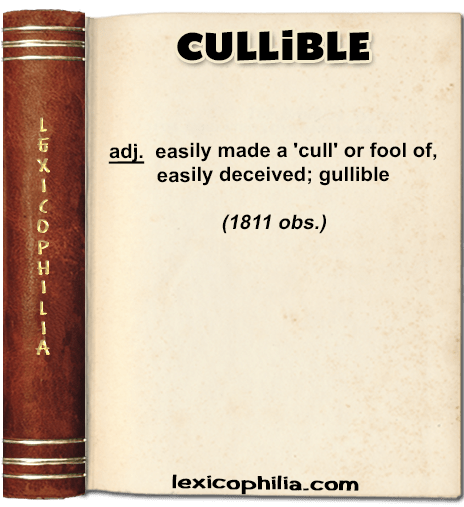
Word of the Day: CULLIBLE


ETYMOLOGY
from the Oxford English Dictionary:
“This adjective, which is presupposed in the derivative cullibility (known 1728), would normally be derived from a verb cull ; but none such is recorded”


EXAMPLE
“…The cullibity of man praeterite, I allow, but because men are & have been cullible, I see no reason why shd always continue so, – Have there not been fluctuations in the opinions of mankind; and as the stuff which soul is made of must be in every one the same …”

From: The Letters of Percy Bysshe Shelley,
Edited by Frederick Lafayette Jones, 1964,
– Shelley to Hogg, January 12, 1811

Word of the Day: MUNDICIDIOUS


ETYMOLOGY
from Latin mundus (world) + –cidious from –cida (killer)


EXAMPLE
“…Since I knew what to feare, my timerous heart hath dreaded three things: a blazing starre appearing in the aire: a State Comet, I mean a favourite rising in a Kingdome, a new Opinion spreading in Religion: these are Exorbitancies: which is a formidable word: a vacuum and an exorbitancy, are mundicidious evils…”

From: The Simple Cobler of Aggawam in America
By Rev. Nathaniel Ward, 1647

Word of the Day: LICKSPITTLE


ETYMOLOGY
from lick (vb.) + spittle (a house or place for the reception of the indigent or diseased)


EXAMPLE
“…Yes – and to hear his lickspittles speak, you would think that a man of great and versatile talents was a miracle; whereas there are some thousands of them publicly acknowledged in England at this day…”

From: Noctes Ambrosianae (J. Wilson) in Blackwood’s Edinburgh Magazine,
Volume XVIII, July-December, 1825

Word of the Day: OPEN-TAIL


ETYMOLOGY
from open + tail (posterior extremity)


EXAMPLE
“…Kate still exclaimes against great Medlers,
A busie-body hardly she abides,
Yet she’s well pleas’d with all Bum-fiddlers,
And hir owne Body stirring still besides:
I muse her  stomacke  now so much should faile,
To loath a Medlar, being an Open-taile…”

From: The Scourge of Folly,
By John Davies, 1611

Word of the Day: QUAINTRELLE


ETYMOLOGY
from Middle French (queint-cointerelle feminine of cointerel (beau, fop), from cointe (quaint)


EXAMPLE
“…It folweth nouht that thouh j be thus kembt and a litel make the queyntrelle that for swich cause j am fair I am foul old and slauery foule stinkinge and dungy…”

From: Pilgrimage of the Lyf of the Manhode,
from the French of G. de Guilleville, c1430

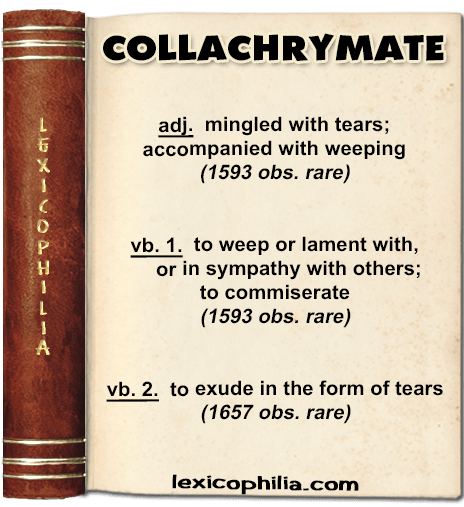
Word of the Day: COLLACHRYMATE


ETYMOLOGY
adj.: from Latin collacrimatus, pa. pple. of collacrimare;
vb. : from Latin collacrimat- ppl. stem of collacrimare, from col- (together) + lacrimāre (to shed tears, weep), from lacrima (tear)


EXAMPLE
“…A tormentor would collachrymate my case, and rather choose to have been tortured himself than torment me with ingratitude as thou dost…”

From: Christs teares ouer Ierusalem,
By Thomas Nashe, 1593

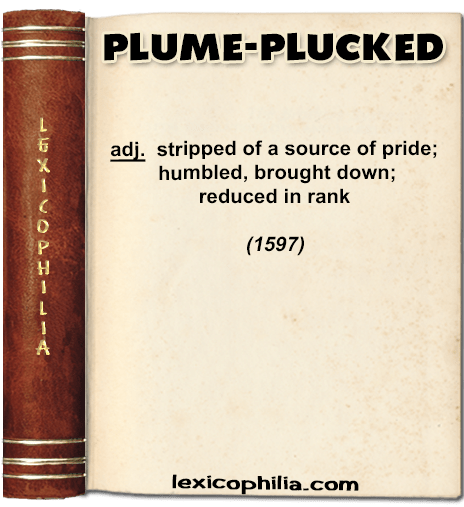
Word of the Day: PLUME-PLUCKED


ETYMOLOGY
from plume (mark of honour or distinction) + plucked


EXAMPLE
“…Yorke. Great Duke of Lancaster, I come to thee
From plume-pluckt Richard, who with willing Soule
Adopts thee Heire, and his high Scepter yeelds
To the possession of thy Royall Hand…”

From: The Tragedie of King Richard the Second
By William Shakespeare, 1597