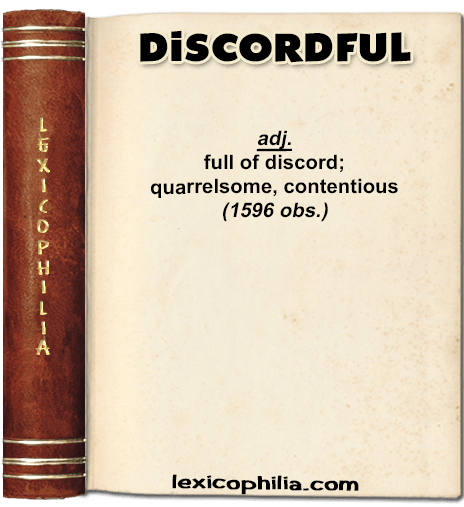
Word of the Day: DISCORDFUL


ETYMOLOGY
from discord + -ful


EXAMPLE
“…Thus as they marched all in close disguise,
Of fayned loue, they chaunst to ouertake
Two knights, that lincked rode in louely wise,
As if they secret counsels did partake;
And each not farre behinde him had his make,
To weete, two Ladies of most goodly hew,
That twixt themselues did gentle purpose make
Vnmindfull both of that discordfull crew,
The which with speedie pace did after them pursew
…”

From: The Second Part of The Faerie Queene
By Edmund Spenser, 1596

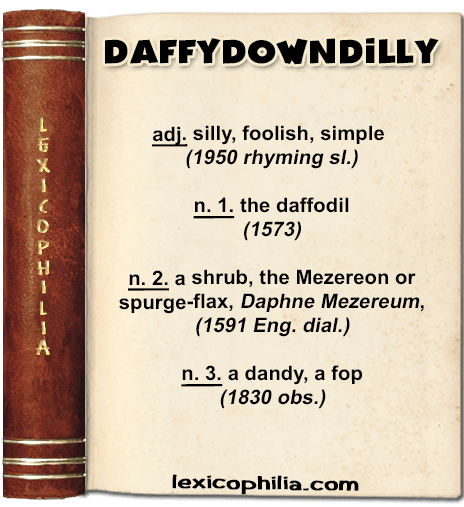
Word of the Day: DAFFYDOWNDILLY


ETYMOLOGY
n. 1. a playful expansion of daffodilly. (from daffodil + -y);
n. 2: so called in Yorkshire from the slight similarity of the Greek name Daphne with Daffodil


EXAMPLE

“…Herbes, branchis & flowers for windowes & potts
• 1 Bayes, sowe or set in plants in Ianuarie.
2 Batchelers buttens,
3 Botles, blewe, red & tauney,
4 Collembines.
5 Campions.
6 Daffadondillies.
7 Eglantine, or swete bryer.
8 Fetherfewe.
9 Flower armour, sowe in Maye.
10 Flower deluce,
11 Flower gentil, whight & red.
12 Flower nyce.
13 Gelyflowers, red, whight & carnacions, set in Spring, & Heruest in potts, payles or tubs, or for sommer in bedds.
14 Holiokes, red, whight & carnacions.
15 Indian eye, sowe in Maye, or set in slips in March.
16 Lauender, of al sorts
…”

From: Fiue Hundreth Points of Good Husbandry
By Thomas Tusser, 1573

Word of the Day: DEMULCEATE


ETYMOLOGY
irreg. formed on Latin demulcere (to stroke down, to soothe caressingly) + -ate


EXAMPLE
“…Gallantry, sir, (said he, turning to me) or the exalted science of demulceating the amiable reservedness, and overcoming the attractive pudicity, of the gentler sex, by the display of rare and excellent endowments, was a discipline worthy of the accomplished chevaliers of these most memorable eras …”

From: Blackwood’s Edinburgh Magazine
Volume I, April – September, 1817
Fragment of a Literary Romance

Word of the Day: DUMBLEDORE


ETYMOLOGY
compound of dumble (similar to bumble) +‎ dor (a buzzing flying insect)


EXAMPLE
“…I thank you for your poetry. What is the burnie-bee? Is it not the humble-bee, or what we call the ‘dumbledore‘ – a word whose descriptive droning deserves a place in song?…”

From: A Memoir of the Life and Writing of William Taylor
By John Warden Robberds, Sir Robert Southey, 1799

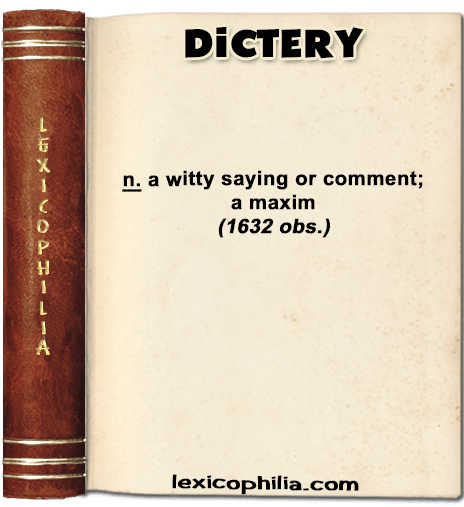
Word of the Day: DICTERY


ETYMOLOGY
from Latin dicterium (a witty saying, bon-mot), of uncertain origin


EXAMPLE
“…I took a snatch where I could get it; nay more, I railed at marriage downright, and in a public auditory, when I did interpret that sixth Satire of Juvenal, out of Plutarch and Seneca, I did heap up all the dicteries I could against women; but now recant with Stesichorus…”

From: The Anatomy of Melancholy
By Robert Burton, 1632

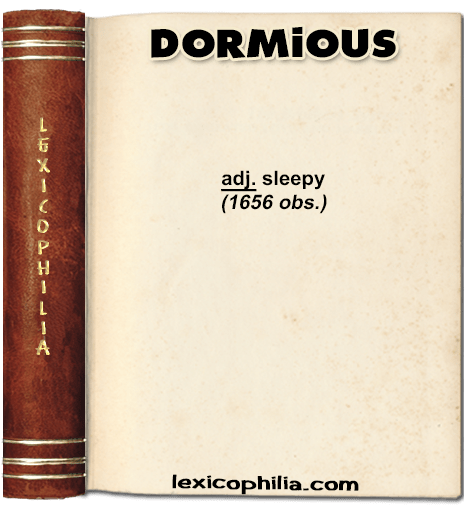
Word of the Day: DORMIOUS


ETYMOLOGY
from Latin dormire (to sleep) + -ous


EXAMPLE
“…and the busie Bell-man bounced twice at the door, and as well the Champion as Soto began to grow dormious, which occasioned the Host to petition their present departure to bed, which (with heavie heads heaven knows) they went to…”

From: Don Zara del Fogo: a Mock-Romance
By Samuel Holland, 1656

Word of the Day: DEROGATORIOUS


ETYMOLOGY
from Latin derogatorius derogatory + -ous


EXAMPLE
“…if the said archbishop intermeddled after the said provocation, his doings were derogatorious not only to the dignity of the patriarche but to the supremacy of the Pope and to the authority also of the general Counsell…”

From: A Treatise on The Pretended Divorce Between Henry VIII and Catharine of Aragon
By Nicholas Harpsfield, a1575
Modernized Text By Nicholas Pocock, 1878

Word of the Day: DADDER


ETYMOLOGY
possibly imitative (perhaps of the chattering of teeth)


EXAMPLE
“…Full gayly was that grete lorde . girde in the myddis,
A brighte belte of ble, . broudirde with fewles,
With drakes and with dukkes, . daderande tham semede,
For ferdnes of fawcons fete, . less fawked thay were…”

From: Winnere and Wastoure 
(“Winner and Waster” is a Middle English poem written in alliterative verse around the middle of the 14th century)