Word of the Day: GRIMGRIBBER

ETYMOLOGY
from Grimgribber,Ā an imaginary estate subject of a legal discussion in the playĀ Conscious LoversĀ (1722) by Sir Richard Steele,Ā British essayist and dramatist

EXAMPLE
“… Mankind in general are not sufficiently aware that words without meaning, or of equivocal meaning, are the everlasting engines of fraud and injustice; and that theĀ grimgribberĀ of Westminster Hall is a more fertile, and a much more formidable, source of imposture than theĀ abracadabraĀ of magicians. …”

From: Epea pteroenta, or, The diversions of Purley
By John Horne Tooke, 1786

Word of the Day: GLIMFLASHY

ETYMOLOGY
from glim (a light of any kind; a candle, a lantern) + flashy (given to show)

EXAMPLE
“… What ho, my kiddy,” cried Job, “don’t be glimflashy: why you’d cry beef on a blater; the cove is a bob cull, and a pal of my own; and, moreover, is as pretty a Tyburn blossom as ever was brought up to ride a horse foaled by an acorn.. …”

From: Pelham; Or, The Adventures of a Gentleman
Volume I, Second Edition, 1828

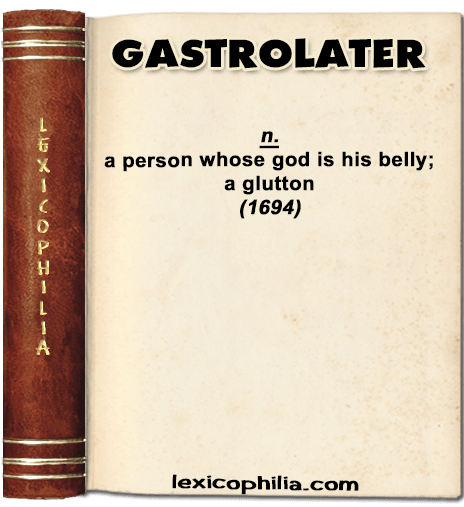
Word of the Day: GASTROLATER

ETYMOLOGY
fromĀ FrenchĀ gastrolatre,
fromĀ GreekĀ Ī³Ī±ĻƒĻ„Ļ(Īæ)-, Ī³Ī±ĻƒĻ„Ī®Ļ (belly) + -λατρος (serving)

EXAMPLE
“… At the Court of that great Master of Ingenuity,Ā PantagruelĀ observ’d two sorts of troublesom and too officious Apparitors, whom he very much detested. The first, were call’dĀ Engastrimythes; the others,Ā Gastrolaters. …”

From: Pantagruel’s Voyage to the Oracle of the Bottle
Being the fourth and fifth books of the works of François Rabelais
Translated by Peter Anthony Motteux, 1694

Word of the Day: GNATHONIC

ETYMOLOGY
fromĀ LatinĀ Gnathonicus,
fromĀ GnathonemĀ (gnatho),
fromĀ Latin Gnatho, the name of aĀ parasiteĀ in the “”Eunuchus” of Terence

EXAMPLE
“… The gnathonick Parasite sweareth to all that this benefactor holdeth. The mercenary Pensioner will bow before he break. He, who only studieth to have the praise of some witty invention can not strick upon another anwile. …”

From: A Dispute Against the English-Popish Ceremonies, obtruded upon the Church of Scotland
By G. Gillespie, 1637

Word of the Day: GAINSTAND

ETYMOLOGY
from gain-Ā (against, in opposition to) +Ā standĀ (vb.)

EXAMPLE (for vb.)
“… Throuch his falsheid and craftynes
He sall flow in to welthynes
The Godlye pepyll he sall noye
By creuell deith, and thame distroye
The kyng of Kyngis, he sall ganestand
Syne be distroyit withouttin hand. …”

From: Ane Dialog Betuix Experience and ane Courteour off the Miserabyll Estait of the Warld
By David Lindsay, 1554

Word of the Day: GULIST

ETYMOLOGY
fromĀ LatinĀ gulaĀ (gullet, appetite, gluttony) + -ist

EXAMPLE
“… He that sell’s himselfe to the custome of disloyalty to his Creator, become’s ignorant of his offence; and, instead of correction, prove’s unskilfull in the knowledge of his sinne. The gluttonous satiety of our swellingĀ Gulists, argue’s their necessity of offending by forgetfulnes: and their own abundance barr’s them frō the just weighing of the poverty of the distressed. The common drunkard cannot be taken with a due thanks-giving for that superfluity which he corrupt’s, from whence many thirstie soules might sucke a reasonable supply for necessity. …”

From: The Honor of Chastity
By John Featley, 1632

Word of the Day: GELASIN

alsoĀ GELAZIN

ETYMOLOGY
from FrenchĀ gelasin, fromĀ GreekĀ Ī³ĪµĪ»Ī±Ļƒįæ–Ī½ĪæĻ‚ (gelasinus), from γελᾶν (to laugh)

EXAMPLE
“… The beauty of the face consisteth in a large, square, well extended and cleere front, eye-browes well ranged, thin and subtile, the eye well diuided, cheerefull, sparkling: as for the colour I leaue it doubtfull, the nose leane, the mouth little, the lips coraline, the chinne short and dimpled, the cheekes somewhat rising and in the middle the pleasant gelasin, the eares round and well compact, the whole countenance with a liuely tincture white and vermilion. …”

From: Of Wisdome, three bookes written in French by Peter Charron
Translated by Samson Lennard ?1608