Word of the Day: GORREL


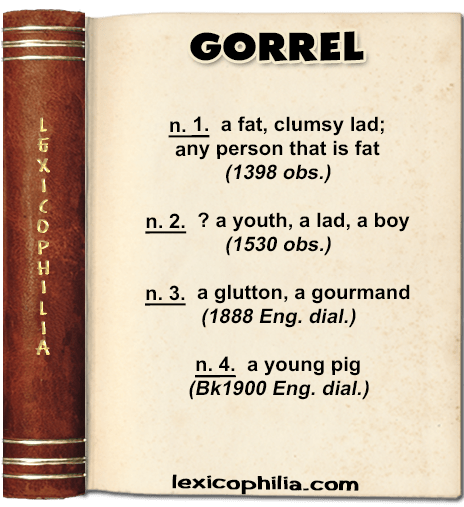
ETYMOLOGY
from Old French gorelgorreau (a pig, hog);
related to Old French gore (sow): of unknown origin.


EXAMPLE (for n. 1.)
“…Crampe that comyth of replycyon fallyth ofte to fatte men and flesshly and well fedde and gorrelles…”

From: Bartholomew de Glanville’s De Proprietatibus Rerum,
Translated by John Trevisa, 1495

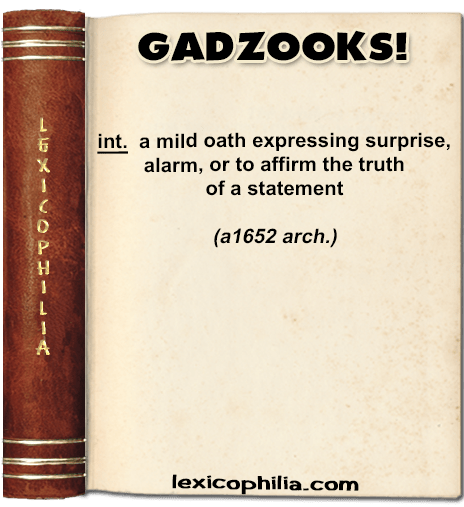
Word of the Day: GADZOOKS!


ETYMOLOGY
from gad (used to express strong feeling) + zooks (origin unknown)


EXAMPLE
“…Buz. Ile first take tother cup, and then out with’t altogether—And now it comes—If my Mistress do bring him home a bastard, she’s but even with him.

Nat. He has one I warrant. Has he cadzooks?…”

From: The English Moor or the Mock-Marriage,
in Five Nevv Playes, viz. The English Moor. The Love-sick Court. Covent Garden Eeeded. The New Academy. The Queen and Concubine,
By Richard Brome, 1659

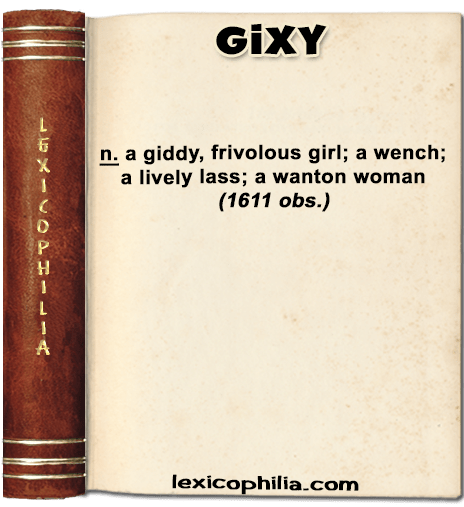
Word of the Day: GIXY

ETYMOLOGY
? possibly connected with gig (an eccentric person)


EXAMPLE
“…Hereupon it fell out, after the expiring of a scantling of Weeks, that Master Carvel became as jealous as a Tygar, and entred into a very profound suspition, that his new-married Gixy did keep a Buttock-stirring with others: to prevent which inconveniency, he did tell her many tragical Stories of the total Ruine of several Kingdoms by Adultery…”

From: The Third Book of the Heroick Deeds and Sayings of the good Pantagruel.
By Francois Rabelais
Translated by Thomas Urquhart, 1693

Word of the Day: GRUNDYITE

ETYMOLOGY
after Mrs. Grundy, a character mentioned in the play Speed the Plough (1798) by Thomas Morton (1764?-1838), English playwright


EXAMPLE
“…Meantime there is some meaning in having a gentleman and a classic at the head of affairs, who may now and then direct the stream of public bounty to us, poor devils, whom the Grundyites would not only remunerate, but kick out of society as barely respectable…”

From: Alfred Lord Tennyson: A Memoir
Letters 1842-1845
By Alfred Tennyson, 1897

Word of the Day: GRIEVEMENT

ETYMOLOGY
from grieve + -ment

EXAMPLE
“…The manner of his Marching forth,
Some Authors tell us, and his Worth,
His Stature, Courage, Strength and Age,
His Armour and his Equipage,
His Warlike Feats in former Days,
Perform’d in Scotch and Gallick Frays,
His Battels won and great Atchievments,
Wounds, Bruises, Bangs, and other Grievments;
Which Happen’d oft to be his Fate,
For no Man’s always Fortunate:
All which I leave to Ancient story;
Now see the end of all his Glory
…”

From: England’s Reformation from the time of King Henry VIII to the End of Oates’s Plot,
A Poem in Four Canto’s
By Thomas Ward, 1708

Word of the Day: GRUMBLETONIAN

ETYMOLOGY
from grumble (vb.), in imitation of Muggletonian and Grindletonian, names of religious sects in the 17th century

EXAMPLE
“…Whether great Sect of Grumbletonians in the Countrey, whom nothing will satisfie, been’t the worst Enemies which this Countrey can have?…”

From: Further Quaeries upon the Present State of New-English Affairs
By S.E., 1690

Word of the Day: GABBERIES

ETYMOLOGY
from French gaberie (mockery, jest, deceit)

EXAMPLE
“…Those high-priced, verbose air- beaters, who think their gabberies are the centers of gravity for the entire universe, ought to be sent away back to sit down until they can learn to stand by the pledges in the platform of their party …”

From: The Literary Digest
Volume XXVI, March 1903
Territorial Press on Statehood Failure