Word of the Day: MISOCAPNIST


ETYMOLOGY
from miso- +‎ stem of Ancient Greek καπνός (kapnós, “smoke”) +‎ -ist


EXAMPLE
“…smoking at all times, in all places, and in all companies, offending the nostrils of all misocapnists with the fumes of his mundungus, and disgusting all decent people with his ptyalism, as an auricular sage, with great delicacy, terms the perpetual ejection of saliva…”

From: A Paper: -of Tobacco
By Joseph Fume (real name: William Andrew Chatto), 1839

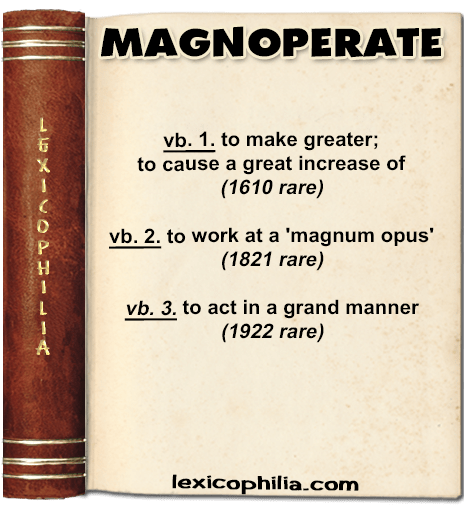
Word of the Day: MAGNOPERATE

ETYMOLOGY
from Latin magnopere (greatly) (short for magno opere [with great labour, especially, much]) + -ate

EXAMPLE
“…so that after-ages may rightly admire what noble Mecaenas it was that so inchayned the aspiring wits of this understanding age to his only censure, which will not a little magnoperate the splendor of your well knowne honor to these succeeding times…”

From: Baculum Geodæticum 
By Arthur Hopton, 1610

Word of the Day: MENTIMUTATION

ETYMOLOGY
from Latin menti-mens (mind) + mutation

EXAMPLE
“…I..shall be allowed the full benefit of all the..illaqueations, extrications,..mentimutations, rementimutations,..that I..can devise…”

From: Discolliminium: Or, A Most Obedient Reply to a Late Book, Called, Bounds & Bonds, So Farre as Concerns the First Demurrer and No Further
By Nathaniel Ward, 1650

Word of the Day: MALTWORM

ETYMOLOGY
from malt + worm

EXAMPLE
“…And Kytte, my wyfe, that as her lyfe
Lovethe well good ale to seke,
Full ofte drynkythe she that ye maye se
The teares ronne downe her cheke.
Then dothe she troule to me the bolle
As a goode malte-worme sholde,
And say, “Swete harte, I have take my parte
Of joly goode ale and olde
…”

From: The Poetical Works of John Skelton (1843)
Drinking Song (I Cannot Eate But Lytyll Meate)

Word of the Day: MAMMOTHREPT

ETYMOLOGY
from  Latin mammothreptus, from Greek µαµµόθρεπτος (brought up by one’s grandmother),
from µάµµη (grandmother) + θρεπτός (vbl. adj.), from τρέϕειν (to bring up)

EXAMPLE
“…Amor. Nay play it I pray you, you do well, you do well: how like you it Sir?
Hed. Very well in troath.
Amor. But very well? O you are a meere Mammothrept in iudgement then; why do you not obserue how excellently the Ditty is affected in euery place? that I do not marry a word of short quantity, to a long Note, nor an zscending Sillable to a discending Tone
…”

From: The Fountaine of Selfe-Loue;
or, Cynthias Reuels
By Benjamin Jonson, 1601

Word of the Day: MONNISHER

ETYMOLOGY
probably from Angloromani (English Romani) mónoshi (woman, wife),
from Romani månuš (man) +  (feminine suffix)

EXAMPLE
“…I was standing near the prosecutor’s shew-glass, talking to a young man; the prisoner and another came to the glass, where I saw the medal lying: I saw them point at it; the other said, it would just do for him, and bid the prisoner look who was in the shop; he answered there was a Monisher in the shop; I suppose a cant word for a woman: Mrs. Storey was there: they went in; then I went into the house where I live; they came out in about three or four minutes: I went after them to the corner, and saw them running along Leicester-fields as fast as they could: I came back, and asked Mrs. Storey whether that medal was gold? she said it was she looked, and it was gone…”

From: The Proceedings of the Old Bailey, London’s Central Criminal Court
18th September, 1765