Word of the Day: TACENT


ETYMOLOGY
from Latin tacentem, present participle of tacere (to be silent)


EXAMPLE
“…And although he was much angred thereat, yet he seemed to be glad: and because he would obliege him further, he went vvith all his Court. Great was the resort thither of Ladies & Knights, and at the Kings entrance there was a fair Tragedy, whose subject I will be tacent of.…”

From: The Loves and Adventures of Clerio & Lozia.: A Romance
By Antoine Du Périer
Translation by F. Kirkman, 1652

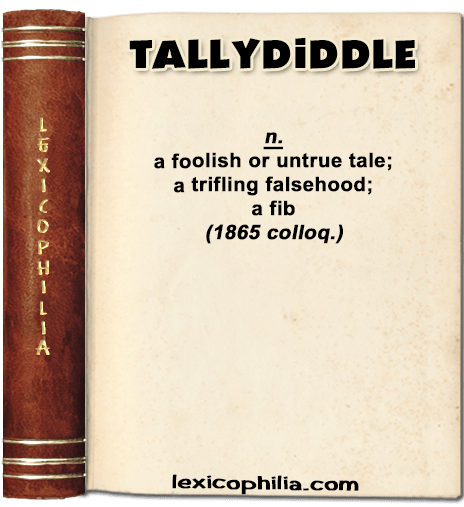
Word of the Day: TALLYDIDDLE


ETYMOLOGY
variant of taradiddle (a trifling falsehood, a petty lie)


EXAMPLE
“…Oh, don’t call them lies, sister; it’s such a strong, ugly word. Please call them tallydiddles, for I don’t believe she meant any harm. Besides – besides – if they should turn out to be truth? Really, sister, that’s the weight on my mind; so many things sounded as if they might be true…”

From: Wives & Daughters
By Elizabeth Gaskell, 1866

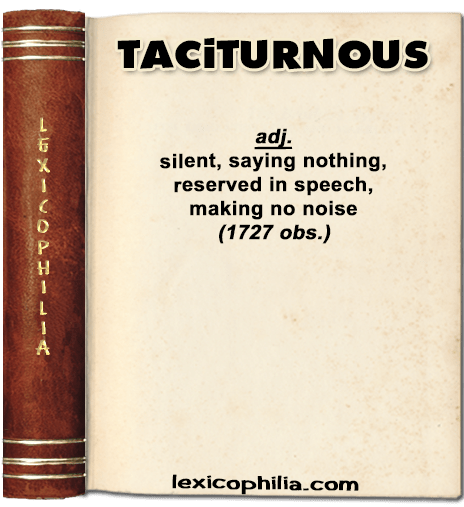
Word of the Day: TACITURNOUS


ETYMOLOGY
from Latin taciturnus (taciturn) + -ous


EXAMPLE
“…The Legate was more taciturnous, and seldom entered into conversation with the Embassador, who, very prudently, forbore to ask questions about China in his presence…”

From: An Historical Account of the Embassy to the Emperor of China
By Earl George Macartney Macartney, 1797

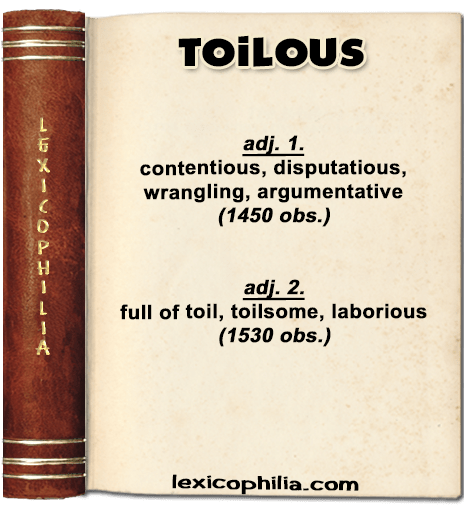
Word of the Day: TOILOUS


ETYMOLOGY
from toil (strife, turmoil, dispute) + -ous


EXAMPLE
“….R
to riotus, to reueling, ne rage not to rudeli.
S
to straunge, ne to stirynge, ne straungeli to stare.
T
to toilose, ne to talewijs, for temperaunce is beest.
V
to venemose, ne to veniable, & voide al vilonye.
W
to wielde, ne to wraþful, neiþer waaste, ne waade not to depe
..”

From: Aristotle’s A B C
in The Babees Book,
Lambeth Manuscript. a1430

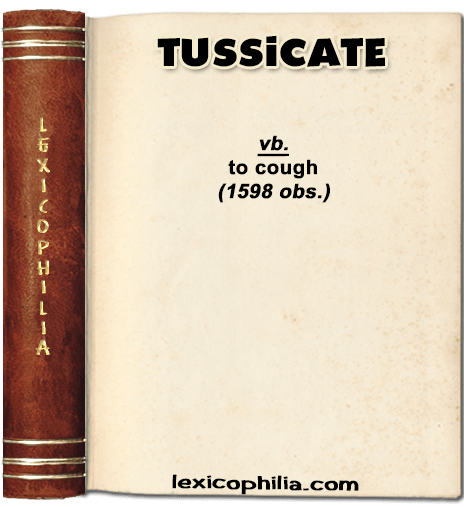
Word of the Day: TUSSICATE


ETYMOLOGY
from Latin tussicus (afflicted with tussis a cough)


EXAMPLE
“…Phisition Mirus talkes of saliuation,
Of Tophes and Pustules, and Febricitation;
Who doth ingurgitate, who tussicate,
And who an vlcer hath inueterate.
Thus while his Inkehorne termes he doth apply,
Euacuated is his ingenie.
..”

From: Chrestoleros. Seuen Bookes of Epigrames
By Thomas Bastard, 1598

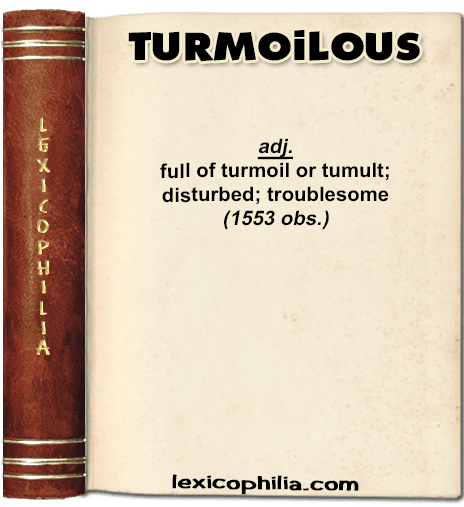
Word of the Day: TURMOILOUS


ETYMOLOGY
from turmoil + -ous


EXAMPLE
“…but trueth hys frende more then they bothe, euen so I thinke it no iniurye nor contumelye to Saynct Augustyne, yf the same were sayde of hym also geuynge hym otherwyse hys dewe commendacions, as he was surelye an excellent man, of dyuyne wytte, and knowledge, and so trauayled in settynge foorth Christes true Relygion in those turmoylous dayes, in perpetual combatte, agaynste learned heretykes and Prynces of the worlde, that he is worthelye called a Doctour and Pyller of Christes Churche…”

From: A Treatyse of the Newe India with other New Founde Landes and Islandes
By Sebastian Münster
Translated by Richard Eden, 1553

Word of the Day: TITUBATE


ETYMOLOGY
from Latin titubat-, past participial stem of titubare (to walk unsteadily, to totter, to stagger, to falter, to vacillate or dither, to make a mistake, slip up, or stumble (in speech or action)


PRONUNCIATION
TIT-yuh-bayt


EXAMPLE
“…Repercussed by the ryght redolent & rotounde rethorician R. Smyth P. with annotacios of the mellifluous and misticall Master Mynterne, marked in the mergent for the enucliacion of certen obscure obelisques, to thende that the imprudent lector shulde not tytubate or hallucinate in the labyrinthes of this lucubratiuncle…”

From: An Artificiall Apologie (title page)
By R. Smyth, 1540

Word of the Day: TEPEFY


ETYMOLOGY
from Latin tepefacere (to make tepid),
from tepere (to be lukewarm)


EXAMPLE (for vb. 1)
“…Sonorous, thro’ the patient’s bosom pours
Its antidotal notes, the flood of life,
Loos’d at its source by tepefying strains,
Flows like some frozen silver stream unthaw’d
At a warm zephyr of the genial spring
…”

From: The Power of Harmony
By John Gilbert Cooper, 1745

Word of the Day: THEFTUOUS


ETYMOLOGY
alteration (influenced by -uous) of Middle English thiftwis,
from thifte (theft) + wis (wise)


PRONUNCIATION
THEFF-tyoo-uhss


EXAMPLE
“…It is declared, that whosoever intercommuns with Thieves, or assists them in their theftous stealings, or deeds, either in going, or coming, or gives them meat, harbour, or assistance, or trysts with them any manner of way, they shall be pursued, either Civilly, or Criminally; but this act strikes not against such as have entertained the Thief any considerable time, after the committing of the Theft, and before Letters of Intercommuning were execute…”

From: The Laws and Customes of Scotland
By Sir George Mackenzie, 1678