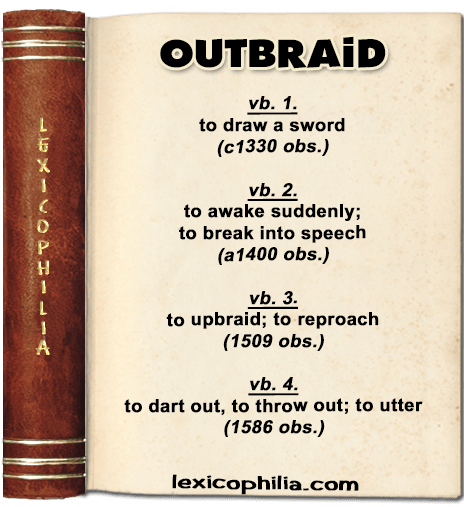
Word of the Day: OUTBRAID

ETYMOLOGY
vb. 1. 2. 4. from out- + braid (to make a sudden movement with the hand, etc.; to brandish a spear;. to deal a blow)
vb. 3. altered form of abraid (to reproach, to reprove)

EXAMPLE (for vb. 3.)
“… And for that this displeasour doth hym dere
His frende: he soone
out-braydeth of the same
Hym-self (for malyce) drawynge by the here
So hath this fole by malyce and yll name
His rewarde lost for it rebuked and shame
And no meruayle: for no man that hath skyll
Shall thanke hym for goodnes done agaynst his wyll
…”

From: The Shyp of Folys of the Worlde
By Alexander Barclay, 1509

Word of the Day: ABREVY

ETYMOLOGY
from Middle French abrevier, from Latin abbreviare (to abbreviate, to shorten)

EXAMPLE
“… Fyrst, diuide the denominator by hys numerator, and if anye number doe remaine, let your diuisor be diuided by the same number, and so you must continue vntyll you haue so diuided yt there may nothing remaine, then is it to be vnderstande, that your last diuisor (wherat you did ende, and that 0. did remaine after your last diuision) is the greatest number, by the which you must abreuiat, as you did in the laste example, but in case that your last diuisor be 1. it is a token that the same number can not be abreuied. Example, of 54/11 diuide 81. (which is the denominator) by 54. which is his numerator, and there resteth 27. then diuide 54. by 27. and there remaineth nothing, wherefore your last diuisor 27. is the number, by the which you must abreuiat 54/81 as in the last example is specifyed. …”

From: The Welspring of Sciences, which teacheth the perfecte worke and practise of arithmeticke both in vvhole numbers & fractions
By Humfrey Baker, 1564
The thirde Chapter treateth of abbreuiation of one great broken number into a lesser broken
Word of the Day: LEIGHSTER

ETYMOLOGY
representing Old English type líegestre, feminine agent-noun to leogan,
from lie (to tell a lie)

EXAMPLE
“… “Yif ich say ich hadde a hi-leman,
“That ich leighe meselue opon :
“Than ich worth of old and yong
“Be hold
leighster and fals of tong.
“Yete me is best take mi chaunce,
“And sle me childe, and do penaunce.
…”

From: Lai le Freine, c1325
in Metrical romances of the thirteenth, fourteenth, and fifteenth centuries: published from ancient manuscripts
By Henry William Weber, 1810

Word of the Day: GERFUL

ETYMOLOGY
from gere (a wild and changeful mood; a sudden fit of passion or feeling) + -ful

EXAMPLE
“… Now vp, now doun, as boket in a welle
Right as the friday, soothly for to telle
Now it shyneth, now it reyneth faste
Right so,/kan geery Venus ouer caste
The hertes of hir folk, right as hir day
Is
gereful, right so chaungeth she array
Selde is the friday, al the wowke ylike
Whan þat Arcite had songe, he gan to sike
…”

From: The Ellesmere MS of Chaucer’s Canterbury Tales
By Geoffrey Chaucer, c1386

Word of the Day: BELSIRE

ETYMOLOGY
from Middle English belsyre,
from belfair (beautiful) (from Old French)

EXAMPLE
“… With those delicious Brooks, by whose immortall streames
Her greatnesse is begunne: so that our Riuers King,
When he his long Descent shall from his
Bel-sires bring,
Must needs (Great Pastures Prince) deriue his stem by thee,
From kingly Cotswolds selfe, sprung of the third degree:
…”

From: Poly-Olbion
By Michael Drayton, 1612

Word of the Day: TROIL

ETYMOLOGY
vb.: from Old French troilliertruilliertreuiller, from Middle High German trüllen

EXAMPLE (for vb.)
“… Thus with treison and with trecherie · þow troiledest hem boþe,
And dudest hem breke [here] buxomnesse · þorw false by-heste;
Thus haddest þou hem oute · and hyder atte laste.
…”

(Thus with treason and with treachery · thou troiledest them both,
And diddest them break their buxomness · through false byhest;
Thus haddest thou them out · and hither at the last.
)

From: The Vision of William concerning Piers the Plowman
By William Langland, 1393