Word of the Day: TROIL

ETYMOLOGY
vb.: from Old French troilliertruilliertreuiller, from Middle High German trüllen

EXAMPLE (for vb.)
“… Thus with treison and with trecherie · þow troiledest hem boþe,
And dudest hem breke [here] buxomnesse · þorw false by-heste;
Thus haddest þou hem oute · and hyder atte laste.
…”

(Thus with treason and with treachery · thou troiledest them both,
And diddest them break their buxomness · through false byhest;
Thus haddest thou them out · and hither at the last.
)

From: The Vision of William concerning Piers the Plowman
By William Langland, 1393

Word of the Day: COCKLEBELL

ETYMOLOGY
apparently originally from cock (an edible bivalve mollusc found on the coasts of Britain, probably a cockle, obs.) + bell

EXAMPLE (for n. 2)
“… My beard had sometimes yce on it as big as my little finger, my breath turning into many cock-bells as I walked…”

From: The Bargrave MS. Diary, 1645
in A Dictionary of the Kentish Dialect and Provincialisms in use in the County of Kent
By William Douglas Parish, & William Francis Shaw, 1887

Word of the Day: ORGULOUS

ETYMOLOGY
from Anglo-Norman orguillous, orgeillus, orgoilous, orgullous,
orgulous, orgulus, orgilousorgillus and Old French orguillus,
orgoillus, orguilleus, orgueilleux;
from  orgueil (pride, haughtiness) + ‑ous 

EXAMPLE 1 (for adj. 1.)
“… yet habbeþ manitime maked of watere wyn; gostliche. wanne þurch his grace maked of þo euele manne good man. of þe orgeilus umble. of þe lechur chaste. of þe niþinge large. and of alle oþre folies; so ha maket of þo watere wyn. þis his si signefiance of þe miracle. …”

From: An Old English miscellany containing a bestiary, Kentish sermons, Proverbs of Alfred, religious poems of the thirteenth century
Edited by Richard Morris, 1872


EXAMPLE 2 (for adj. 1)
”…I was banished from my own country, and was dishonoured, and with hard labour gained I what I have got ; and now I stand in the King’s favour, and he asketh of me my daughters for the Infantes of Carrion. They are of high blood and full orgullous, and I have no liking to this match ; but if our Lord the King adviseth it we can do no other-wise: …”

From: Chronicle of the Cid
By Robert Southey, 1808

Word of the Day: BEAUPERE

ETYMOLOGY
from Old French beau (fine, good_ + pre (father), or, in sense 2, per, peer (equal, peer):

From OED: In Old French, beau père was politely used in addressing every one whom one called ‘father’; i.e. one’s own father, a ‘father’ in the church, a god-father, a step-father, a father-in-law, an elderly man occupying a fatherly position in one’s regard; about the 16th or 17th century, this use of beau became obsolete, and beau-père was retained as a distinctive term for ‘father-in-law’ and ‘step-father’ as distinct from a real father. In English the use appears to have been much more limited.

EXAMPLE
“… Tho he hadde his tale itold and ymaked al his wise,
He sat adoun and the Bischop of Cicestre gan arise. “
Beau pere,” he seide to the Pope: “me thinȝth hit
faith to the,
“To desturbi thing that falleth: to harm of communeaute;
…”

From: The Life and Martyrdom of Thomas Beket, c1300
Edited by J.H. Black, 1848

Word of the Day: REPRUCE

ETYMOLOGY
from Anglo-French repruce, variant of reproche (reproach)

EXAMPLE
“… Þou settest us repruse [MS depruse.] to our neȝburs, vndernimyng [Here an e follows, but is dotted out.] and scorne to hem þat ben in our cumpas. …”

From: The Earliest Complete English Prose Psalter, c1350
Preface, introduction, notes, and glossary, by Karl D. Bülbring, 1891

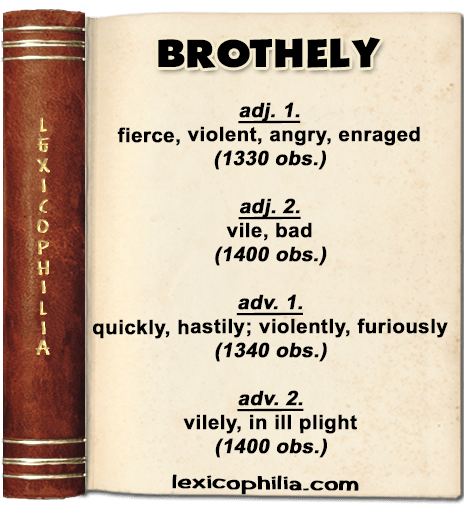
Word of the Day: BROTHELY

ETYMOLOGY
Middle English: in sense adj. 1, from broth (impetuous, violent, wrathful) + -ly;
sense adj. 2, possibly a derivative of brothel

EXAMPLE (for adj. 1)
“… þan said Isaac tille him, “ert þou his mayntenour?
Fulle
broþely & brim he kept vp a trencheour,
& kast it at Statin, did him a schamfulle schoure.
His nese & his ine he carfe at misauentoure.
…”

From: Peter Langtoft’s Chronicle, (as illustrated and improv’d by Robert of Brunne), 1330

Word of the Day: DEIGNOUS

ETYMOLOGY
apparently  a shortened form of dedeignous (disdainous), French dédaigneux, Old French desdeignous 

EXAMPLE
“… Boste & deignouse pride & ille avisement
Mishapnes oftentide, & dos many be schent.
þe proude kyng Pharaon, þat chaced Israel, [Exempla viciorum, quibus gra|tia extin|guitur.]
Dronkeld euerilkon, & Gode’s folk went wel.
Sodom & Gomor fulle vile synne þat stank,
Boþe for euer more doun tille helle þei sank. …”

From: Robert Mannyng of Brunne, The Chronicle, c1330

Word of the Day: MOSTWHAT

ETYMOLOGY
from most (greatest in size, bulk, etc.) + what (pronoun); probably after somewhat (adv.)

EXAMPLE (for adv. 2.)
“…  The parentes and freindes with whom I haue to deale, be mostwhat no latinistes: and if they were, yet we vnderstand that tounge best, whervnto we are first borne, as our first impression is alwaie in English, before we do deliuer it in Latin. …”

From: Positions vvherin those primitiue circumstances be examined, which are necessarie for the training vp of children, either for skill in their booke, or health in their bodie,
By Richard Mulcaster, 1581