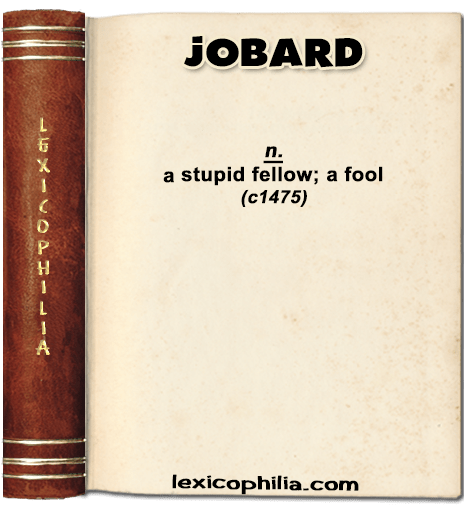
Word of the Day: JOBARD

ETYMOLOGY
from French jobard (a person who is easily fooled or very credulous)

EXAMPLE
“… False supplantyng, clymbyng of foolis
Unto chayers of worldly dignite,
Looke of discrecioune sette
jobbardis upon stoolis,
Whiche hathe distroyed many a comunalte,
Marchol to sitte in Salamons see,
What folwithe after no reason no justice,
Injuste promocioune and parcialite,
By false prerogatyf theyr neyghburghs to dispise.
…”

From: A Selection from the Minor Poems of Dan John Lydgate
Printed for the Percy Society, 1840
The Moralite of the Hors, the Goose, and the Sheepe
Composed c1440

Word of the Day: STALWORTH

ETYMOLOGY
from Old English stǽlwierðe, from stǽl (place) + wierðe (worth – adj.);

From OED: “The length of the vowel in the first syllable seems to be authenticated by some of the early Middle English forms; the shortening of ǽ to ă in the first element of a compound is normal. The Old English stǽl(the quantity of which is certain from the three occurrences in poetry) appears not to be immediately connected with the synonymous stæl with short vowel (dat. stale); according to some scholars it represents a contraction of Old Teutonic *staþl- or *stađl-, the relation of Old English stǽl to staðol foundation being considered parallel with that of mǽl speech to the synonymous mæðel. The 13th century form staðelwurðe, occurring only once strongly confirms this view.
The early Middle English forms with medial e, stele-, steale-, stalewurðe are difficult to account for.

EXAMPLE (for n.)
“… Such semblaunt to þat segge semly ho made
Wyth stille stollen countenaunce, þat
stalworth to plese,
Þat al forwondered watz þe wyȝe, and wroth with hymseluen,
Bot he nolde not for his nurture nurne hir aȝaynez,
Bot dalt with hir al in daynté, how-se-euer þe dede turned
towrast.
…”

From: Sir Gawain and the Green Knight
Author unknown; a late 14th-century chivalric romance in Middle English alliterative verse;
Edited by Sir Israel Gollancz through the Early English Text Society, 1940

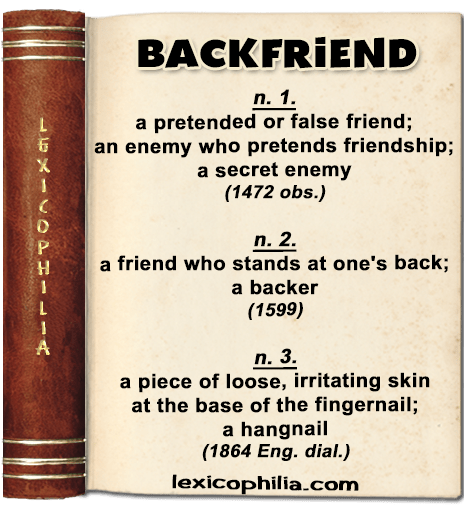
Word of the Day: BACKFRIEND

ETYMOLOGY
from back (n.) or (adv.) + friend;
possibly originally a friend who ‘kept back,’ and did not come forward to assist, and so was no real friend

EXAMPLE (for n. 1.)
“… And as for my lorde chamberleyn, he is nott yit comen to town. When he comythe, than schall I woote whatt to doo. Syr John off Parre is yowre freende and myn, and I gaffe hym a fayre armyng sworde wyth-in thys iij dayes. I harde somwhatt by hym off a bakk freende off yowrys; ye schall knowe moore here-afftre. …”

From: Paston Letters and Papers of the Fifteenth Century
By Paston family, 1472
Published for the Early English Text Society – Edited by Norman Davis, Richard Beadle, and Colin Richmond. 2004

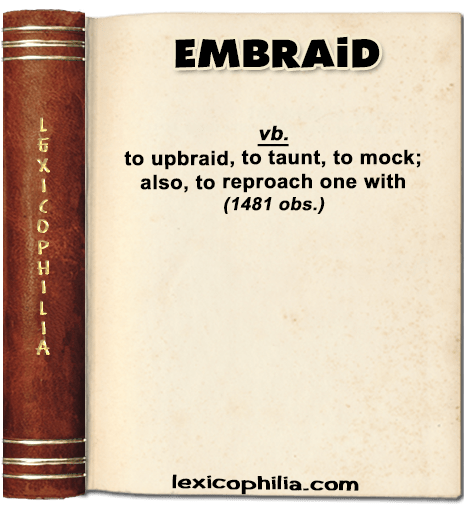
Word of the Day: EMBRAID

ETYMOLOGY
from en- braid (to upbraid, to reproach);
possibly aphetic from abraid (to upbraid)

EXAMPLE
“… No besynes of famylyar thynges shal agayn your wyll departe you from suche plesaunt ydelnes, for I truste to oure goddes that my lytil feelde, of the which I am enbrayded by Corneli, shal suffise for our dayly lyvelode. …”

From: Gaius Flaminius refutes Publius Cornelius, his Rival for the Hand of Lucretia
In Tully of Old Age and Friendship
Translated by William Caxton, 1481

Word of the Day: CONTRADICTORIOUS

ETYMOLOGY
from Latin contradictorius (contradictory) + -ous

EXAMPLE (for adj. 1.)
“… after the grete clerk Plinius, libro quinto, capitulo decimo octavo, what distaunce is betwene cenit of oure hedde and a poynte contradictorious to hit in heuyn, soe moche distaunce is from the este in to the weste;…”

From: Polychronicon 
By Ranulf Higden
Translated by John Trevisa, a1475

Word of the Day: DOG-BOLT

ETYMOLOGY
of origin uncertain

EXAMPLE (for n.1.)
“… And as for Ser John Hevenyngham, Ser John Wyndefeld, and othere wurchepfull men ben mad but here doggeboltes, the which I suppose wull turne hem to diswurchep here-after…”

From: Paston Letters and Papers of the fifteenth century
Edited by Norman Davis, Richard Beadle, and Colin Richmond, 2004
Letter from Margaret Paston to John Paston, 1465

Word of the Day: AIDANT

ETYMOLOGY
from Anglo-Norman aidaunt, aydaunt, and from Anglo-Norman and French aidant (helping, and helper, ally), present participle of aider (to aid)

EXAMPLE (for adj.)
“… All blest secrets all you vnpublisht vertues of the earth,
Spring with my teares beaydant (
be aydant) and remediat,
In the good mans distresse, seeke, seeke, for him,
Lest his vngouernd rage dissolue the life.
That wants the meanes to lead it.
…”

From: True Chronicle Historie of the Life and Death of King Lear and his three daughters
By William Shakespeare, 1608

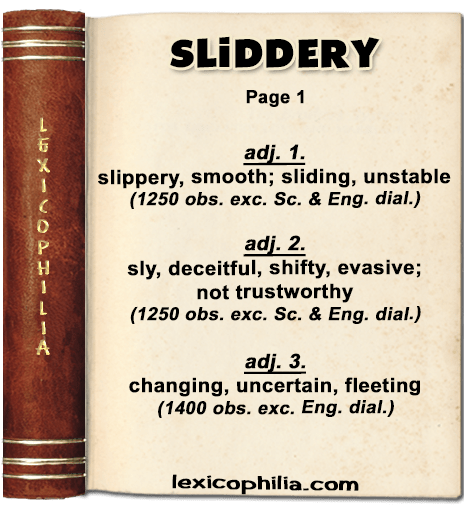
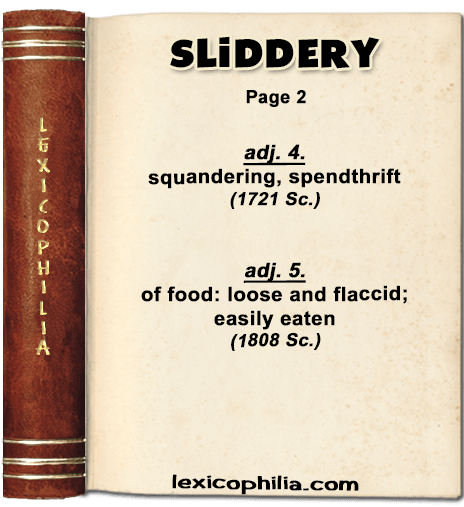
Word of the Day: SLIDDERY

ETYMOLOGY
from slidder (to slide, to slip) + -y

EXAMPLE (for adj. 3)
“… Full slyddrie is the sait that thay on sit,
And for thair fault till Hell sune sall thay flit,
For suddanlie thay sall die with mischeif,
Thair distructioun salbe without releif.
…”

From: A compendious book of godly and spiritual songs : commonly known as ‘The gude and godlie ballatis’
By John Wedderburn , Robert Wedderburn
Reprinted from the edition of 1567
Edited by Alexander Ferrier Mitchell, 1897
Quam bonus Deus Israell. Psal. lxxiij

Word of the Day: JOVY

ETYMOLOGY
from Latin Jovius, from Jovis (Jove, poetical equivalent of Jupiter, name of the highest deity of the ancient Romans)

EXAMPLE
“… ‘And now I lepe louy pe [merry foot.] ;
Now I sterte, & now I ffle.
Selde abydyng in O thouht,
Al daungerous I sette at nouht,
…”

From: The Pilgrimage of the Life of Man
English by John Lydgate, 1426,
from the French of Guillaume de Deguileville

Word of the Day: OBMISS

ETYMOLOGY
from Latin obmiss-, participial stem of obmittere, late spelling of omittere (to omit)

EXAMPLE
“… but to thende that eny gaynsaynge sholde be Imputed ayenst me to haue obmyssed for to dyscute som of the condycyons and euyll operacyons of the cursed proserpyne …”

From: Caxton’s Eneydos, 1490
English from the French Liure Des Eneydes, 1483
Edited by W.T. Culley, and F.J. Furnivall, 1890