ETYMOLOGY
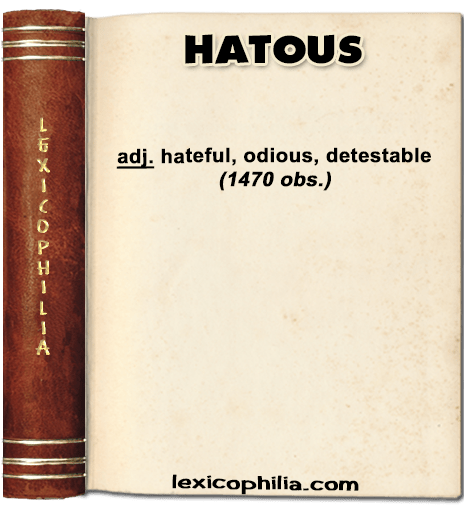
from hate (n.) + -ous
EXAMPLE
“…Her offryngis, sacrificis, and praiers weren hatouse and abhominacioun to him, as it is tauȝt þere bi long processe…”
From: The Works of a Lollard Preacher (2001)
The Sermons Omnis Plantacio (c1400)
ETYMOLOGY
from hate (n.) + -ous
EXAMPLE
“…Her offryngis, sacrificis, and praiers weren hatouse and abhominacioun to him, as it is tauȝt þere bi long processe…”
From: The Works of a Lollard Preacher (2001)
The Sermons Omnis Plantacio (c1400)

ETYMOLOGY
from Latin aromata or French aromat, as if adapted from Latin aromatosus or French aromateux
EXAMPLE
“…And thenne it hath vertue tascende by the lightnes of the fume and to comforte by his qualite and to conioyne by the gumme and to conferme by that it is aromatous or wel smellyng. And all in lyke wyse i the orison or prayer whiche ascendeth to the mynde of god. It conforteth the soule as to the synne passed in axyng medecyne…”
From: Legenda Aurea/The Golden Legend
By Jacobus de Voragine
Translated by William Caxton, 1483

ETYMOLOGY
from medieval Latin accidiosus (listless, slothful),
from accidia (slothfulness, apathy, lethargy) + Latin -osus (-ous)
PRONUNCIATION
uhk-SID-ee-uhss
EXAMPLE
“…Þe accidious man haþ ydilnesse, sleuþe, & sleep for his god…”
From: The Pore Caitif, edited from MS. Harley, a1400
(a late fourteenth-century Middle English manual of religious instruction intended for the use of the laity)
ETYMOLOGY
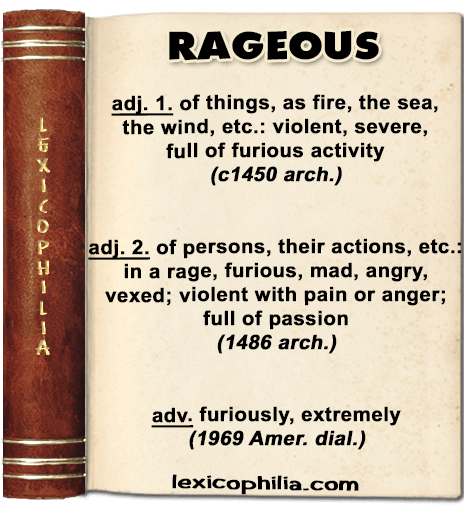
partly from Anglo-Norman ragous (raging), from rage (rage) + -ous,
and partly directly from rage (n.) + -ous
EXAMPLE (for adj. 1)
“…What nede y spende more enke or parchement,
That fele the crampe of deth myn hert so nyghe
As thorugh this rageous fyre which hath me hent?
Thus calle y for yowre socoure pitously…”
From: The English Poems of Charles of Orleans
Edited by R. Steele, 1941
Fortunes Stabilnes, c1450
ETYMOLOGY
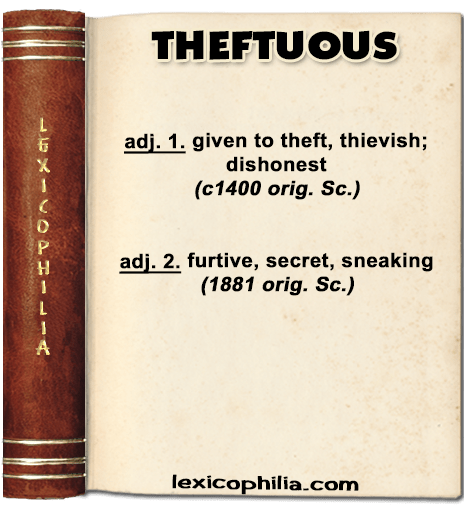
alteration (influenced by -uous) of Middle English thiftwis,
from thifte (theft) + wis (wise)
PRONUNCIATION
THEFF-tyoo-uhss
EXAMPLE
“…It is declared, that whosoever intercommuns with Thieves, or assists them in their theftous stealings, or deeds, either in going, or coming, or gives them meat, harbour, or assistance, or trysts with them any manner of way, they shall be pursued, either Civilly, or Criminally; but this act strikes not against such as have entertained the Thief any considerable time, after the committing of the Theft, and before Letters of Intercommuning were execute…”
From: The Laws and Customes of Scotland
By Sir George Mackenzie, 1678

ETYMOLOGY
from Latin proditorius proditory (traitorous, treacherous) + -ous
EXAMPLE
“…The seide lordes did holde solenne parliamentes by usurpacion of that proditorious commission into the grete preiudice of youre regaly…”
From: Polychronicon
By Ranulf Higden, a1475

ETYMOLOGY
Old English wrixlian, -an (to alter, change, exchange, etc.),
also ᵹewrixlian, altered form of ᵹewixlian, = Old Frisian wixlia, Old Saxon wehsalon, Old High German wehsalon (German wechseln)
EXAMPLE (for vb. 2)
“…Kynges, & knightes, & other kyde Dukes,
That the charge, & the chaunse hase of þis choise wer,
Thurgh oure might & oure monhod maintene to gedur!
What whylenes, or wanspede, wryxles our mynd?
Þat for meuyng of a man,—Menelay the kyng,—
And the wille of a woman, as ye weton all,
Oure londes haue leuyt, & oure lefe godys…”
From: Destruction of Troy,
The gest hystoriale of the destruction of Troy,
An alliterative romance translated from Guido de Colonna’s Hystoria Troiana
ETYMOLOGY
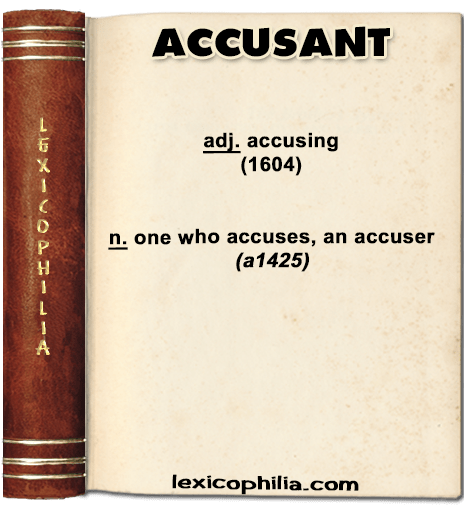
from French accusant (n. person who accuses), (adj. that accuses)
PRONUNCIATION
uh-KYOO-zuhnt
EXAMPLE
“…The whole Councell beeing afterward called together, they gaue them-selues to the vnderstanding of the matter. As for the crime and the punishment, was of the accusant called vpon in these wordes: The Iudgement of death is due to this man, because hee hath done this or that. But the Defendant repelled it, with these wordes. The Iudgement of death is not due this man, because hee hath not done it, or because hee hath doone it righteously …”
From: A Defence of the Government Established in the Church of Englande
By John Bridges, 1587

ETYMOLOGY
from Anglo-Norman and Middle French acoler, acoller, Middle French accoler (to throw the arms round the neck of, to embrace),
from a (a-) + col (neck)
EXAMPLE
“…Þen acoles he þe knyȝt and kysses hym þryes,
As sauerly and sadly as he hem sette couþe…”
From: Sir Gawain and the Green Knight
By Anonymous, c1400

ETYMOLOGY
from each + where
EXAMPLE
“…A sely synful was she þis
For al hir synne turned in to blis
She was lyuynge in cuntre þere
Whenne ihesus preched vche where
And mony a pert myracle did
Wher wiþ to men he him kid
And mony seke he ȝaf her hele
And as he coom bi o castele…”
From: Cursor Mundi (The Cursur o the World).
A Northumbrian poem of the XIVth century, a1400
 Lexicophilia