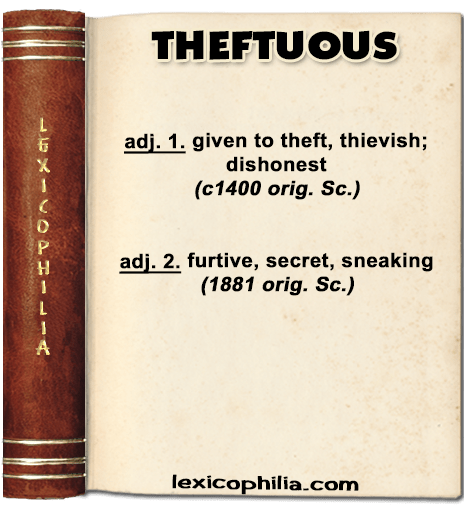
Word of the Day: THEFTUOUS


ETYMOLOGY
alteration (influenced by -uous) of Middle English thiftwis,
from thifte (theft) + wis (wise)


PRONUNCIATION
THEFF-tyoo-uhss


EXAMPLE
“…It is declared, that whosoever intercommuns with Thieves, or assists them in their theftous stealings, or deeds, either in going, or coming, or gives them meat, harbour, or assistance, or trysts with them any manner of way, they shall be pursued, either Civilly, or Criminally; but this act strikes not against such as have entertained the Thief any considerable time, after the committing of the Theft, and before Letters of Intercommuning were execute…”

From: The Laws and Customes of Scotland
By Sir George Mackenzie, 1678

Word of the Day: WRIXLE


ETYMOLOGY
Old English wrixlian-an (to alter, change, exchange, etc.),
also ᵹewrixlian, altered form of ᵹewixlian, = Old Frisian wixlia, Old Saxon wehsalon, Old High German wehsalon (German wechseln)


EXAMPLE (for vb. 2)
“…Kynges, & knightes, & other kyde Dukes,
That the charge, & the chaunse hase of þis choise wer,
Thurgh oure might & oure monhod maintene to gedur!
What whylenes, or wanspede, wryxles our mynd?
Þat for meuyng of a man,—Menelay the kyng,—
And the wille of a woman, as ye weton all,
Oure londes haue leuyt, & oure lefe godys
…”

From: Destruction of Troy,
The gest hystoriale of the destruction of Troy,
An alliterative romance translated from Guido de Colonna’s Hystoria Troiana

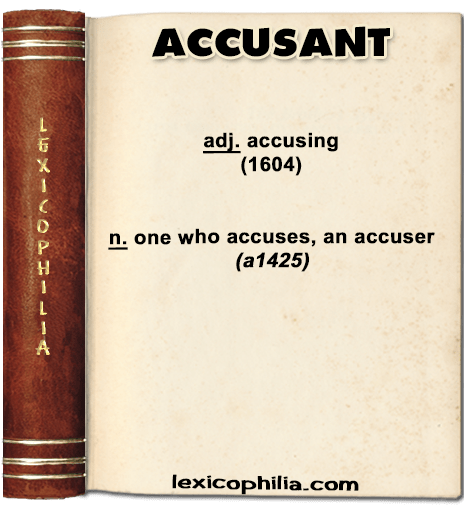
Word of the Day: ACCUSANT


ETYMOLOGY
from French accusant (n. person who accuses), (adj. that accuses)


PRONUNCIATION
uh-KYOO-zuhnt


EXAMPLE
“…The whole Councell beeing afterward called together, they gaue them-selues to the vnderstanding of the matter. As for the crime and the punishment, was of the accusant called vpon in these wordes: The Iudgement of death is due to this man, because hee hath done this or that. But the Defendant repelled it, with these wordes. The Iudgement of death is not due this man, because hee hath not done it, or because hee hath doone it righteously …”

From: A Defence of the Government Established in the Church of Englande
By John Bridges, 1587

Word of the Day: EACHWHERE


ETYMOLOGY
from each + where


EXAMPLE
“…A sely synful was she þis
For al hir synne turned in to blis
She was lyuynge in cuntre þere
Whenne ihesus preched vche where
And mony a pert myracle did
Wher wiþ to men he him kid
And mony seke he ȝaf her hele
And as he coom bi o castele
…”

From: Cursor Mundi (The Cursur o the World).
A Northumbrian poem of the XIVth century, a1400

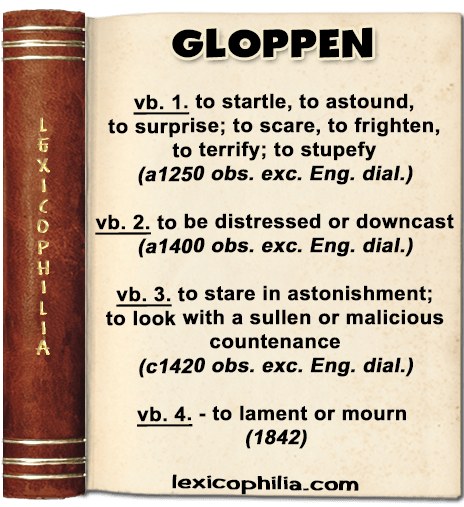
Word of the Day: GLOPPEN


ETYMOLOGY
from Old Norse glupna (to be downcast);
a root of identical form appears in Old Frisian glûpa, Middle Low German glûpen (to lie in wait for), Dutch gluipen (to watch slily, to sneak), Old Swedish glupa (to gape, swallow), Swedish glupande, Danish glubende (ravenous, fierce);
whether there is any etymological connection is uncertain


EXAMPLE (for vb. 1)
“…Quen [he] þar-of son had a sight,
Al was he gloppend for þat light
…”

From: Cursor Mundi
(The Cursur of the World)
A Northumbrian Poem of the XIVth Century

Word of the Day: NOSE-HOLE


ETYMOLOGY
from nose + hole


EXAMPLE
“…Whan a bodi is stinged of an Adder than shall the woūde be wasshed ther with and clowtes wet layd ther vpō I Cotton wet in the same water & put in the nose holes is good agaynst Polippus that is stynkinge flesshe in the nose…”

From: The vertuose boke of distyllacyon of the waters of all maner of herbes 
By Hieronymus Brunschwig
Translated by Laurence Andrewe, 1527

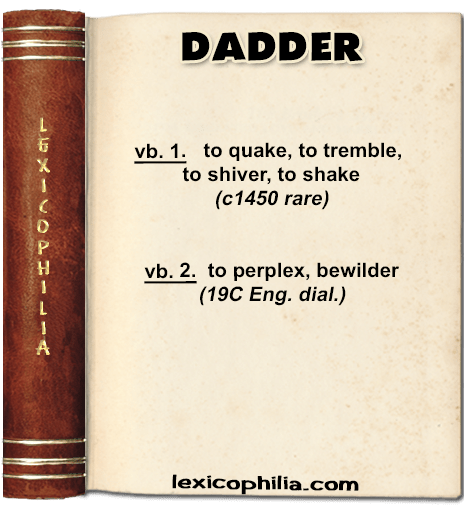
Word of the Day: DADDER


ETYMOLOGY
possibly imitative (perhaps of the chattering of teeth)


EXAMPLE
“…Full gayly was that grete lorde . girde in the myddis,
A brighte belte of ble, . broudirde with fewles,
With drakes and with dukkes, . daderande tham semede,
For ferdnes of fawcons fete, . less fawked thay were…”

From: Winnere and Wastoure 
(“Winner and Waster” is a Middle English poem written in alliterative verse around the middle of the 14th century)

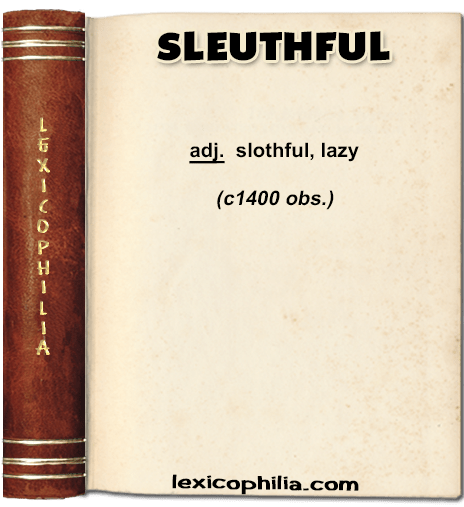
Word of the Day: SLEUTHFUL


ETYMOLOGY
from sleuth (sloth, laziness obs.) + -ful


EXAMPLE
“…And he þat hauys greet egℏen̛ ys enuyous & witℏ-outen shame, sleuthful, and vnobeyssant. He þat hauys lityƚƚ eghen̛, lyk to heuenly colour, or blake, ys of sharpe vnderstondynge, curteys, and leel…”

From: Secreta Secretorum,
(a treatise which purports to be a letter from Aristotle to his student Alexander the Great on an encyclopedic range of topics, including statecraft, ethics, physiognomy, astrology, alchemy, magic, and medicine)