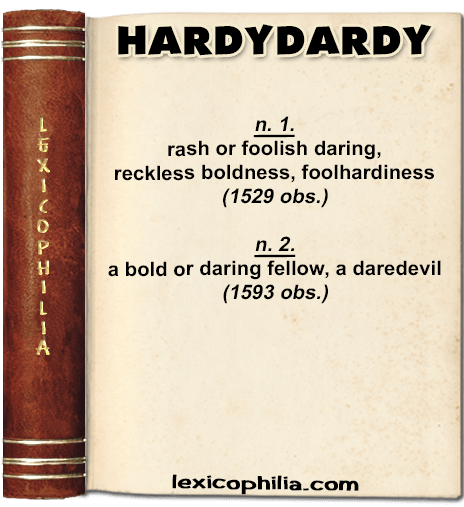
Word of the Day: HARDYDARDY

ETYMOLOGY
a reduplicated extension of hardy (capable of enduring fatigue, hardship, etc.)


EXAMPLE
“…So lytyll dyscressyon, and so myche reasonyng ;
So myche hardy dardy, and so lytell manlynes ;
So prodigall expence, and so shamfull reconyng ;
So gorgyous garmentes, and so myche wrechydnese ;
So myche portlye pride, with pursys penyles
So myche spente before, and so myche vnpayd behynde ;—
Syns Dewcalyons flodde there can no clerkes fynde
…”

From: Speke, Parrot
In Poetical Works (1843)
By John Skelton, a1529

Word of the Day: HODDY-DODDY


ETYMOLOGY
the element dod is evidently the same as in dodman (a shell-snail);
hoddy-dodhoddy-doddy, & hodman-dod, are perhaps from nursery reduplications;
but the element hoddy- appears itself to have come to be associated to mean ‘snail’ (or ? horned);
for n. 2. (a cuckold) – with reference to the ‘horns’ of a cuckold


EXAMPLE (for n. 1.)
“…My living lieth here and there, of God’s grace,
Sometime with this good man, sometime in that place;
Sometime Lewis Loiterer biddeth me come near;
Somewhiles Watkin Waster maketh us good cheer;
Sometime Davy Diceplayer, when he hath well cast,
Keepeth revel-rout, as long as it will last;
Sometime Tom Titivile keepeth us a feast;
Sometime with Sir Hugh Pie I am a bidden guest;
Sometime at Nichol Neverthrive’s I get a sop;
Sometime I am feasted with Bryan Blinkinsop;
Sometime I hang on Hankyn Hoddydoddy’s sleeve;
But this day on Ralph Roister Doister’s, by his leave
…”

From: Ralph Roister Doister,
By Nicholas Udall, a1556

Word of the Day: OFFENCIOUS


ETYMOLOGY
from offence (an illegal act) + -ious


EXAMPLE
“…Retes
Tis Ramus, the Kings professor of Logick.

Guise,
Stab him.

Ramus.
O good my Lord, wherein hath Ramus been so offencious.

Guise.
Marry sir, in hauing a smack in all,
And yet didst neuer sound any thing to the depth.
Was it not thou that scoftes the Organon,
And said it was a heape of vanities?
He that will be a flat decotamest,
And seen in nothing but Epetomies:
Is in your iudgment thought a learned man….”

From: The Massacre at Paris:
With the Death of the Duke of Guise
By Christopher Marlowe, a1593

Word of the Day: REBELLANT


ETYMOLOGY
from Old French rebellant, pr. pple. of rebeller (to rebel),
(used as adj. and n. in 14th–16th c.)


EXAMPLE 1 (for adj.)
“…That other infortuny is exterialle, that man scholde haue his inferior rebellante to hym, in that he was inobediente to God his maker…”

From: The Chronicles and Memorials of Great Britain and Ireland During the Middle Ages,
Edited by Churchill Babington, 1869
Polychronicon Ranulphi Higden Monachi Cestrensis (Harley MS. 2261)
By Ranulf Higden


EXAMPLE 2 (for n.)
“…With Tantalus hild starued Ghosts, whose pleasure was their paine,
Whose euer Hords had neuer vse, and gettings had no gaine.
To Besides assisted Soules of Vnthrifts, whose supplies
Did passe from them as Sea through Cieues, whose wastes no wealthes suffise.
Vnto Ixeon stood their Sprights that had their lusts for law,
Rebellants to a common good, and sinning without awe.
To Titius lastly ioyned Ghosts, whose hearts did emptie hate
As Todes their poyson, growing when it seemeth to abate.…”

From: Albions England; or, historicall map of the same island 
By William Warner,

Word of the Day: FORCELY


ETYMOLOGY
from force (n.) + -ly


EXAMPLE (for adv.)
“…Luke we the fische that swimmis in the se,
Luke we in eirth all kynd of bestyall,
The foulis fair sa forcelie thay fle,
Scheddand the air with pennis grit and small;
Syne luke to man that he maid last of all
Lyke to his image and his similitude;
Be thir we knaw that God is fair and gude.
…”

From: The morall fabillis of Esope the Phrygian
Translation by Robert Henryson
The Preiching of the Swallow. a1500

Word of the Day: BABBLATIVE


ETYMOLOGY
from babble (to talk excessively, to chatter excitedly or quickly) + -ative.


EXAMPLE 1
“…Manye of them which lacke good bringing vp and haue not beene trayned in learning and ciuilitie, are of disposition, wauering, vnconstant, captious, deceitfull, falseharted, destrous of alterations and tumultes, babblatiue, and full of muche vaine tattling: in consultacion and counsell so suttle and craftie, that whatsoeuer they once conceyue in mynde or purpose to do, without delay that do they iudge best, forthwith to be enterprysed, & out of hande to be atchieued: and whereunto so euer they addict their mindes, therin proue they right excellente…”

From: The Touchstone of Complexions
By Leuine Lemnie
Translation by Thomas Newton, 1576


EXAMPLE 2
“…He could mesmerize a room full of scientists, an auditorium flush with factory workers, or a parlor pack of literati, including his salon companions Oliver Wendell Holmes, Ralph Waldo Emerson, and Henry Wadsworth Longfellow, the sharpest talkers in a smart and garrulous town. He was one of those brilliant, babblative sorts whose immense skill in their main work is nearly eclipsed by their gift for talk…”

From: Reef Madness: Charles Darwin, Alexander Agassiz, and the Meaning of Coral
By David Dobbs, 2005


PRONUNCIATION
BAB-luh-tiv

Word of the Day: OBTRACTUOUS


ETYMOLOGY
from Latin obtract-, past participial stem of obtractare,
variant of Latin obtrectare (to disparage) + ‑uous


EXAMPLE
“…and so made unlaufull assemble; and then and there the vayngloryouse Abbot of Eynesham callyd his seruants abowt hym and seid, How sey you, syrs? with obtractuouse words, and the vycar knoweth and can say yf he be a true man…”

From: Selections from the Record of the City of Oxford
Edited by William H. Turner, 1880
‘Proceedings in relation to certain Informations sent to the Privy Council by John Parkyns against the Abbots of Eynesham and Oseney’, Jan 18, 1537

Word of the Day: AURIPOTENT


ETYMOLOGY
from Latin auri- (gold) + potentem (powerful)


EXAMPLE 1
“…For to descriue thair honest Ornament,
Thair riche array, and thair habillement:
My feble wit standis in extasie,
So bene, so big, and so Auripotent,
So ground michtie it was, and precellent:
It dullis far my small capacitie.
Thairfoir I most at this time let it be.
Bot ʒe sall wit thair was na thing absent
Of gold, nor silk, that ganit sic cumpanie
….”

From: Ane treatise callit The Court of Venus deuidit into four buikis,
By John Rolland, 1575


EXAMPLE 2
“…and the vexatious vigilance with which the stern lady-patronesses of the time were wont to sift the merits of candidates, were intended as a protest against the auripotent nabobs and mill-owners who came purse in hand to demand admission…”

From: Belgravia
A London Magazine
Conducted by M.E. Braddon. Vol. IV, May-June, 1871
‘The Season’

Word of the Day: VERECUND


ETYMOLOGY
from Latin verecundus, from vereri (to reverence, fear)


EXAMPLE 1
“…And sum of thame I sall now specifie,
Quhilk to ressoun salbe correspondent.
Than said Venus with vult verecund,
Say quhat ʒe will and keip ʒow within bound
Not pretendand to argune throw ʒour will:
Bot to ressoun that ʒour Sermone resound,
Or ellis the lak to ʒour self sall redound
…”

From: Ane treatise callit The Court of Venus deuidit into four buikis
By John Rolland, 1575


EXAMPLE 2
“…In my Father’s house,” says Christ, “are many mansions.” Verily, that appears to be also the case in some of His Scotch Evangelical servants’ houses here. And verecund Mr. McCosh, who will not venture to suggest any better arrangement of the heavens, – has he likewise no suggestion to offer as to the arrangement of No. 23, St. James’s Street?…”

From: Fors Clavigera: Letters to the Workmen and Labourers of Great Britain,
By John Ruskin, 1873

Word of the Day: CLINCHPOOP


ETYMOLOGY
of uncertain origin;
perhaps from one who clinches or clenches the poops of vessels,
a clincher (a workman who clinched the bolts in shipbuilding)


EXAMPLE 1.
“…Yf a Gentlemanne haue in hym anye humble behauour, then Roysters doo cal suche one by the name of a Loute, a Clynchepope, or one that knoweth no facyons…”

From: The Institucion of a Gentleman
By Humfrey Braham, 1555


EXAMPLE 2.
“…Cléante
Ma chere, ma chere, c’est vrai, c’est vrai,
But my rival is a juggins –

Angélique
A muggins –

Cléante
A noodle and a looby –

Angélique
A lopdoodle, a dunderhead, a pigsconce and a booby

Cléante
A Clinchpoop, a gobemouche, a snollygoster, a gongoozler

Angélique
A lickspiggot, a fuzzdutty, a jobbernowl, an ass –

Thomas
It’s highly amusing.

Cléante
Who’s in love with the sound of his own braying …”

From: The Hypochondriac
Roger McGough’s translation of Molière’s Le Malade Imaginaire, 2009