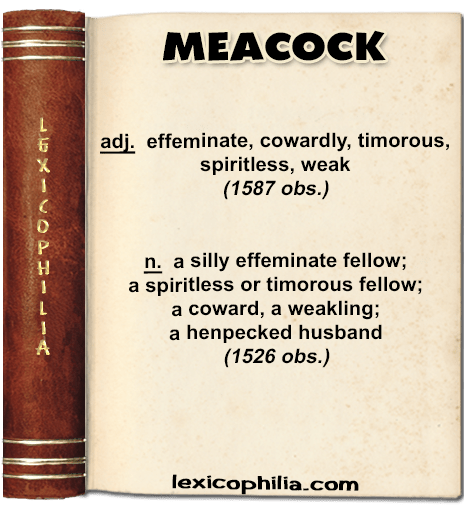
Word of the Day: MEACOCK


ETYMOLOGY
of obscure origin: perhaps originally a name of some bird  
(From Murray’s N.E.D.: “the suggestion that it is from meek (adj.) is untenable”)


EXAMPLE
“…He shuld be no cowarde, no maycocke, ne fearfull persone that dare no thyng enterprise….”

From: Here Begynneth a Deuout Treatyse in Englysshe, called the Pylgrimage of Perfection,
By William Bonde, 1526

Word of the Day: MORIGERATE


ETYMOLOGY
from Latin morigeratus, past participial stem of morigerari (to to be obedient or compliant), from morigerus


EXAMPLE
“…Certaynely in the auncient tyme, whan thou were peopled with ryght and trewe Romayns, and not as thou arte nowe with bastarde chylderne, than the armies, that wente froo Rome, were as well disciplyned and morigerate, as the schooles of the philosophies, that were in Grece…”

From: The Golden Boke of Marcus Aurelius,
By Antonio de Guevara, 1546

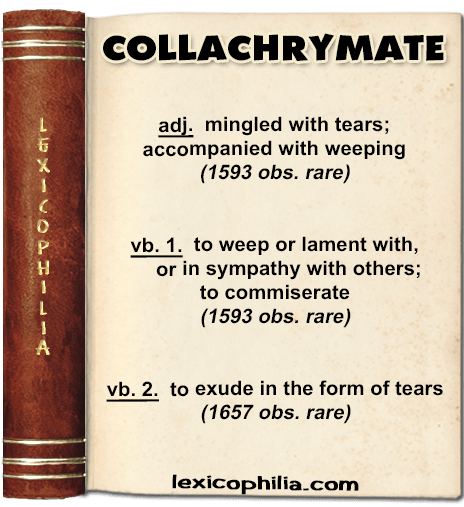
Word of the Day: COLLACHRYMATE


ETYMOLOGY
adj.: from Latin collacrimatus, pa. pple. of collacrimare;
vb. : from Latin collacrimat- ppl. stem of collacrimare, from col- (together) + lacrimāre (to shed tears, weep), from lacrima (tear)


EXAMPLE
“…A tormentor would collachrymate my case, and rather choose to have been tortured himself than torment me with ingratitude as thou dost…”

From: Christs teares ouer Ierusalem,
By Thomas Nashe, 1593

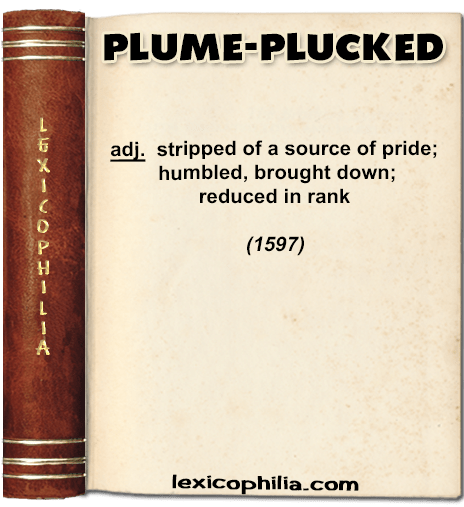
Word of the Day: PLUME-PLUCKED


ETYMOLOGY
from plume (mark of honour or distinction) + plucked


EXAMPLE
“…Yorke. Great Duke of Lancaster, I come to thee
From plume-pluckt Richard, who with willing Soule
Adopts thee Heire, and his high Scepter yeelds
To the possession of thy Royall Hand…”

From: The Tragedie of King Richard the Second
By William Shakespeare, 1597

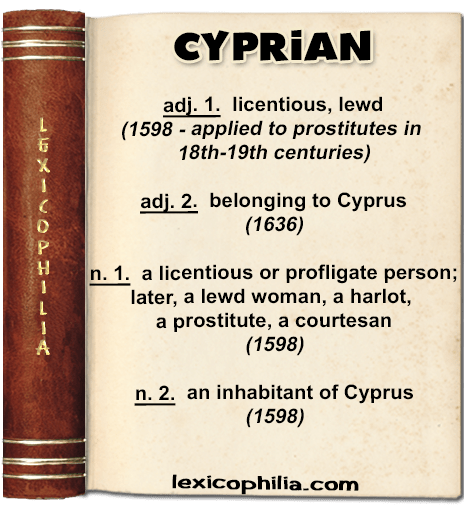
Word of the Day: CYPRIAN


ETYMOLOGY
from Latin Cyprius (of Cyprus) + -an;
in French cyprien


EXAMPLE
“…Shall Curio streake his lims on his dayes couch,
In Sommer bower? and with bare groping touch
Incense his lust, consuming all the yeere
In  Cyprian dalliance, and in Belgick cheere?
Shall Faunus spend a hundred gallions,
Of Goates pure milke, to laue his stallions,
As much Rose iuyce? O bath! ô royall, rich
To scower Faunus, and his salt proude bitch!
…”

From: The Scourge of Villanie
By John Marston, 1598

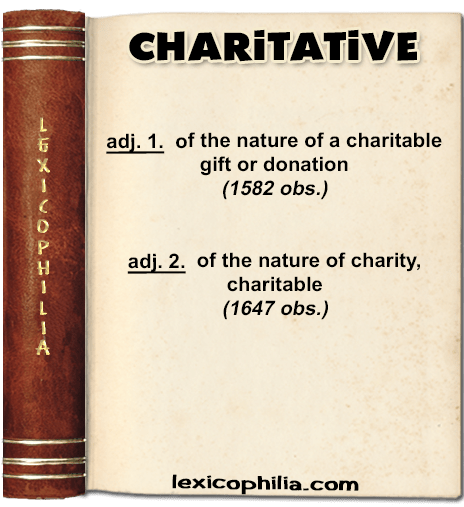
Word of the Day: CHARITATIVE


ETYMOLOGY
from Old French charitatif-ivecaritatif-ive, medieval Latin caritativus (charitable)


EXAMPLE
“…And  for  that  this  only  controversy  is  the  cause  of  this visitation,  I  do  mean  that  it  shall  be  merely  charitative,  and not  to  burden  the  clergy  of  any  procurations  as  yet;  and withal  not  to  trouble  your  lordship  much  longer  about  this matter  there,  than  you  shall  be  occasioned  otherwise  to  tarry for  the  speeding  of  the  visitation  of  the  church…”

From: The Remains of Edmund Grindal, 1843

Word of the Day: MUBBLE FUBBLES


ETYMOLOGY
of uncertain origin; possibly imitative


EXAMPLE
“…for there is no more sullen beast, than a he drab. Ile make him pull his powting croscloath over his beetle browes for melancholie, and then my next booke, shall be Martin in his mubble fubbles…”

From: Pappe with a Hatchet: 
Being a Reply to Martin Mar-prelate 
By John Lyly, 1589

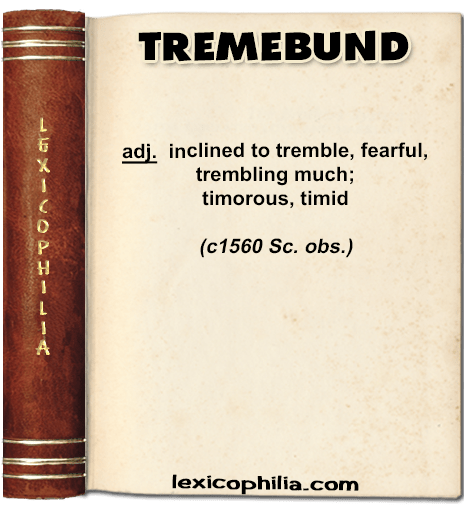
Word of the Day: TREMEBUND


ETYMOLOGY
from Latin tremebundus (trembling), from tremere (to tremble)


EXAMPLE
“…Thay tak delyt in martiall deidis,
And are of nature tremebund,
Thay wald men nurist all thair neidis,
Syne confortles lattis thame cnfound:
So find I thair affectioun
Contrair thair awin complexioun…”

From: Chronicle of Scottish Poetry,
From the Thirteen Century to the
By James Sibbald, 1802
Of Wemen-kind, By Alexander Scott, c1560