Word of the Day: VAFROUS


ETYMOLOGY
from Latin vafervafr- (sly, cunning, crafty) + -ous


EXAMPLE
“…thinkyng surely that they for the most part, would neuer cosent & longe agree with the Englishmen, accordyng to their olde vaffrous varietie: wherfore least ye he should offend or ministre cause of occasio to them (as in dede all me were not his frendes in Scotlad at that tyme) he desired y Ambassadours to cosent w truce & abstinece of warre for suen yeres…”

From: The Vnion of the Two Noble and Illustre Famelies of Lancastre [and] Yorke
By Edward Hall, 1548

Word of the Day: SMARTFUL


ETYMOLOGY
from smart (sharp physical pain) + -ful


EXAMPLE
“…What kind harted husband: can se his kind wife,
In like carefull case, without wo at his hart.
What naturall father can se: for his life,
His naturall childerne, in dread quake and start.
Without his hart smarting, in most smartfull smart.
I thinke, ye thinke none: and euin so thinke I.
Meruell not then: though the spider be toucht nie…”

From: The Spider and the Flie 
By John Heywood, 1556

Word of the Day: PERIPATICIAN


ETYMOLOGY
shortened from Middle French peripateticien, from peripateticus (a person who walks about, a traveller; also, moving about from place to place) + French -ien (-ian)


EXAMPLE
“…Yet certes Moecha is a Platonist,
To all, they say, but whoso do not list;
Because her husband, a far traffick’d man,
Is a profest Peripatecian…”

From: Virgidemiarum. The Three Last Bookes
By Joseph Hall, 1598

Word of the Day: OPITULATION


ETYMOLOGY
from Latin opitulari (to bring aid, to assist), from opem (aid) + tul- (to bring)


EXAMPLE
“…The excellence of this boocke, hath therfore, incitatede, & as it vveare copellede me to vse this audacitye (in signe of gratitude, for soe manye, & innumerable benefites, vvhich next after God, of your Royall Mtye. through your continualle ayde, & opitulatione vve reape) humblelye to presente, and dedicate this verye necessarye boocke…”

From: The Frenche Chirurgerye, or All the Manualle Operations of Chirurgerye
By Jacques Guillemeau,
Translated out of Dutch into English, by A.M., 1598

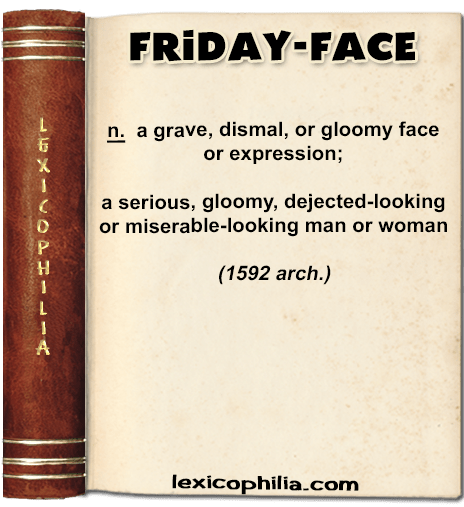
Word of the Day: FRIDAY-FACE


ETYMOLOGY
probably from the time when Friday was a day of abstinence


EXAMPLE
“…The Fox on a time came to visit the Gray, partly for kindred, chiefly for craft, and finding the hole empty of all other company, saving only one Badger enquiring the cause of his solitariness: he described the sudden death of his dam and sire with the rest of his consorts. The Fox made a Friday face, counterfeiting sorrow: but concluding that death’s stroke was inevitable persuaded him to seek some fit mate wherewith to match.…”

From: Greene’s, Groat’s-Worth of Witte, bought with a million of repentance 
Robert Greene, 1592

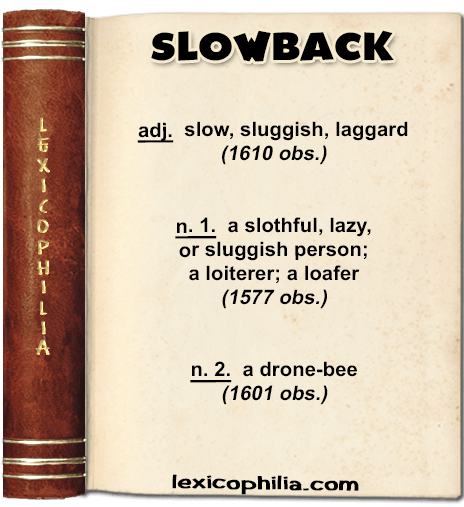
Word of the Day: SLOWBACK


ETYMOLOGY
from slow (adj.) + back (n.)


EXAMPLE
“…For God doth not assiste slouthfull persons and idle slowbackes. Now I call those needelesse occupations, whiche idle and ill disposed people do vse, thereby to be troublesome to their neighbours and to deceiue other men, exercising, I confesse, an occupation, but such an one as is vtterly vnlawfull & vnprofitable to all men…”

From: Fiftie Godlie and Learned Sermons Diuided into Fiue Decades
By Heinrich Bullinger, 1577

Word of the Day: HIBBER-GIBBER


ETYMOLOGY
reduplicated derivative of gibber (unintelligible talking, rapid and inarticulate utterance)


EXAMPLE
“…and I wott not what maruelous egges in mooneshine: but a flye for all your flying Speculations, when one good fellow with his oddiestes, or one madd knaue with his awke hibber-gibber, is able to putt downe twentye of your smuggest artificiall men, that simper it so nicely, and coylie in their curious pointes…”

From:  Pierces Supererogation
Or A New Prayse of The Old Asse,
Gabriell Harvey, 1593

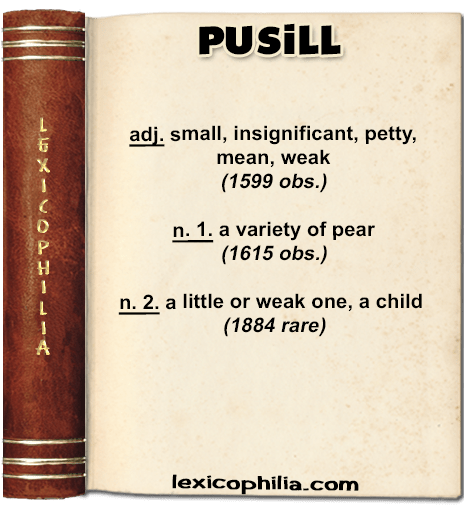
Word of the Day: PUSILL


ETYMOLOGY
from: a) Middle French pusillepuzilpusil (very small, weak),
b) Latin pusillus (very small, insignificant, petty) from pusus (boy) + -illus 


EXAMPLE
“…And to amase her weake, and pusill minde,
In creepe through crannies of imagination.
Deformd Idean formes, and phansies blinde.
Sent foorth by hir sicke sences, instigation.
Like staringe greisly fendes, threatninge invasion.
Presenting to her heart, the homely iarres.
And houshold cares, accurringe nuptiall warres…”

From: Eustathia, or the Constancie of Susanna
By Robert Roche, 1599

Word of the Day: CUPSTANTIAL


ETYMOLOGY
a humorous perversion of substantial, intended to suggest ‘drunken’


EXAMPLE
“…He that is borne vnder Capricornus shall be a slouenly, ill-fauoured, and vncleane fellowe, bicause the gote is a beast filthie, stinking and vncleane. He that is borne vnder Aquarius and Pisces shall be fortunate by water, bicause watermen haunt the waters, and fishes swim in the same. These be cupstantiall reasons and well seasoned arguments, and as strong to prooue their purpose, as a castell of paper to resist the enimie…”

From: Phillip Stubbes’s Anatomy of the Abuses in England in Shakspere’s Youth, A.D. 1583
Folly of the Zodiacal Signs influencing men.