Word of the Day: INFICIENT

ETYMOLOGY
from Latin inficientem (that does nothing), from in- + facientem (doing)

EXAMPLE
“… Lent. How well thy power can shun that which
I followe with obedience. Too true yfaith;
Thou mightst as well put out the eie of day,
Or cover sinne from heaven, or to erect
A towre of sand on the uncertain surge,
Or any thing that were more inficient,
Then to remoove one doting thought of mine
From her disdain. Thy aide, deere Tulley,
Be thou an Orratour for Lentulus,
My tongue stands tund to a harsher method
…”

From: Euerie Woman in her Humor 
Unknown author, 1609

Word of the Day: OVER-MONEY

ETYMOLOGY
from over- (prefix) + money; humorous usage after undermine (to work secretly or stealthily against)

EXAMPLE
“…At Preston in Andernesse, August 17. 1648. Duke Hambleton resolving to play an Aftergame of Loyalty, entred England with an Army more numerous then well Disciplined. Most beheld him as one rather cunning than wise, yet rather wise, than valiant. However he had Officers who did Ken the War-craft, as well as any of our Age. He would accept of no English Assistance, so to engrosse all the work and wages to himself. Some suspect his Officers trust was undermined, (or over-moneyed rather) whilst others are confident, they were betrayed by none save their own security. …”

From: The History of the Worthies of England
By Thomas Fuller, a1661

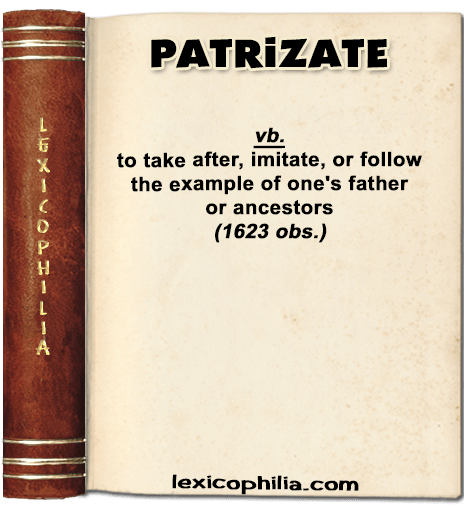
Word of the Day: PATRIZATE

ETYMOLOGY
from Latin patrissat- patrizat-, past participial stem of patrissare, patrizare (to act like or take after one’s father)

EXAMPLE
“…One was Walter Devereux Earl of Essex, who made him his bosome-friend, and the said Earl, lying on his death-bed, took his leave of him with many kisses, Oh my Ned (said he) farewell, thou art the faithfullest and friendliest Gentleman that ever I knew. In testimony of his true affection to the dead Father in his living Son, this Gentleman is thought to have penned that most judicious and elegant Epistle and presented it to the young Earl, conjuring him by the cogent arguments of example and rule, to patrizate. …”

From: The History of the Worthies of England
By Thomas Fuller, 1662

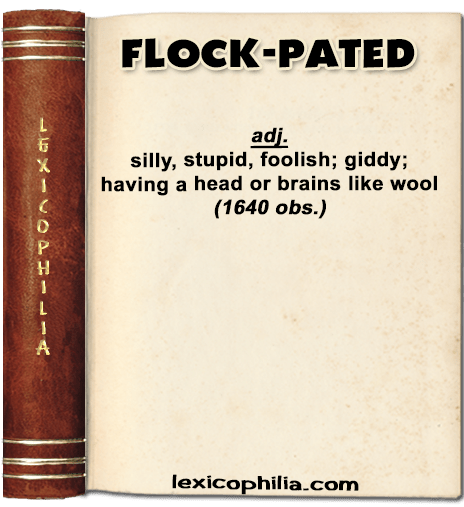
Word of the Day: FLOCK-PATED

ETYMOLOGY
from flock (material consisting of the coarse tufts and refuse of wool or cotton, used for quilting garments, and stuffing beds, cushions, mattresses, etc.) + pated (having a head or mind of the specified kind)

EXAMPLE
“…He that would be a Scholler,
Must hate your drinks that is muddy:
But a cup of good Canary
Will make him the better to study.
O this is a good old Woman, etc.

And he that would be a Poet,
Must no wayes be flocke-pated:
His ignorance if he show it,
He shall of all Schollers be hated.
O this is a good old Woman, etc.

He that would be a Goodfellow,
Of meanes must be prepared:
If that he love drinke and Tobacco,
Or else he shall be jeared.
O this is a good old Woman, etc.
….”

From: “The Merry Old Woman”, c1640
In The Roxburghe Ballads, Ballad Society, 1869-99

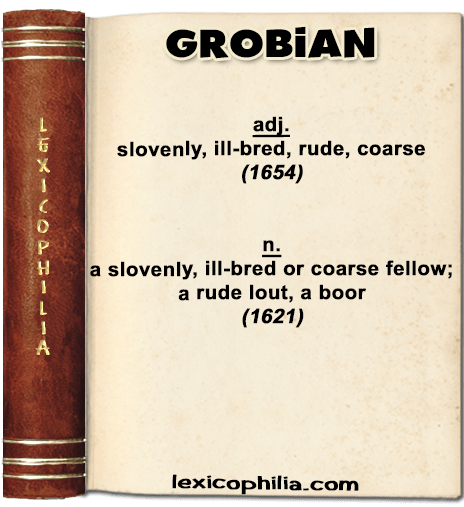
Word of the Day: GROBIAN

ETYMOLOGY
from German Grobian, from medieval Latin Grobianus, name of an imaginary personage, often referred to by writers of the 15th – 6th century in Germany as the type of boorishness,
from German grob (coarse, rude)

EXAMPLE
“…In breefe, he became from an Idiot and a Clowne, to be one of the most compleat Gentlman in Cyprus and did many valorous exploits, and all for the loue of Mistris Iphiginia. In a word, I may say thus much of them all, let them be neuer so clownish, rude and horrid, Gobrians and sluts, if once they be in loue, they will be most neat & spruce and beginne to trick vp, and to haue a good opinion of themselues. …”

From: The Anatomy of Melancholy VVhat It Is
By Robert Burton, 1621

Word of the Day: EAR-DROPPER

ETYMOLOGY
from ear + dropper

EXAMPLE
“… But, that he was a Creature of the Duke’s, and commended to him by Bishop Williams, the Historian is strangely out again. It is possible an Ear-dropper might hear such things talk’d at Cock-pits and Dancing-schools, miserable Intelligence to thrust into an History …”

From: Scrinia Reserata a Memorial Offer’d to the Great Deservings of John Williams, D. D.
By John Hacket, a1670

Word of the Day: THRUMBLE

ETYMOLOGY
vb. 1: of uncertain origin
vb. 2, 3, 4: apparently from thrum (to press, to condense) + -le
vb. 5: apparently from thrum (to play on a stringed instrument) + -le

EXAMPLE (for vb.3)
“…PETER, quho was ever maist sudden, answers, and sayis: Thou art thrumbled and thrusted be the multitude, and ʒit thou speeris quha hes twitched thee, hee answers againe and he sayis, it is not that twitching that I speak of: It is ane vther kinde of twitching …”

From: Sermons vpon the Sacrament of the Lords Supper
By Robert Bruce, ?1591

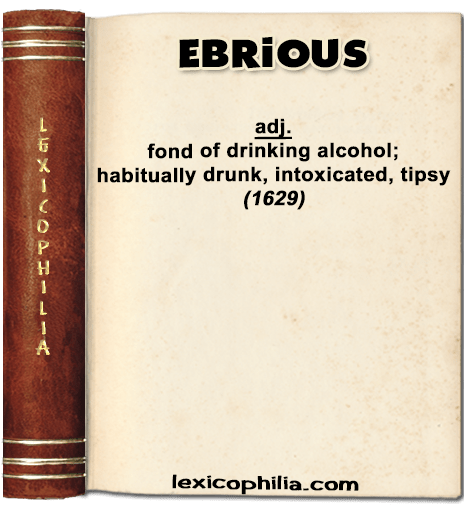
Word of the Day: EBRIOUS

ETYMOLOGY
from Latin ebrius (drunk intoxicated_ + -ous

EXAMPLE
“…This branded and illegall witnesse then, being at the very best a forraigner, doth only marre, not helpe their cause: The second was but an Anglo-Belgicus, a dissolute, ebrious and luxurious English-Dutchman…”

From: The Church of Englands Old Antithesis to New Arminianisme 
By William Prynne, 1629

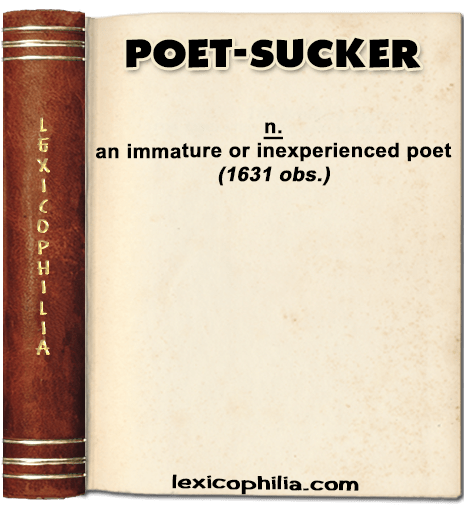
Word of the Day: POET-SUCKER

ETYMOLOGY
from poet + sucker (a greenhorn, a simpleton)

EXAMPLE
“…But gi’ me the man can start up a Justice of Wit out of six-shillings beer, and give the law to all the poets and poet-suckers i’ town. Because they are the players’ gossips? ‘Slid, other men have wives as fine as the players’, and as well dressed. Come hither, Win. …”

From: Bartholmew Fayre, A Comedie
By Ben Jonson, 1631