Word of the Day: ELENCHIZE


ETYMOLOGY
from elench ,from Latin elenchus, from Greek ἔλεγχος (cross-examination) + -ize


EXAMPLE
“…Lady. So do all Politicks in their Commendations.
   Host. This is a State-bird, and the verier Fly;
Tipto. But  Hear him problematize.   Prudence. Bless us, what’s that?
   Tipto. Or syllogize, elenchize.   Lady. Sure, petard’s,
To blow us up.   Lat. Some inginous strong words!
   Host. He means to erect a Castle i’ the Air,
And make his Fly an Elephant to carry it
….”

From: The New Inne, or The Light Heart, a Comedy
By Ben Jonson, 1631
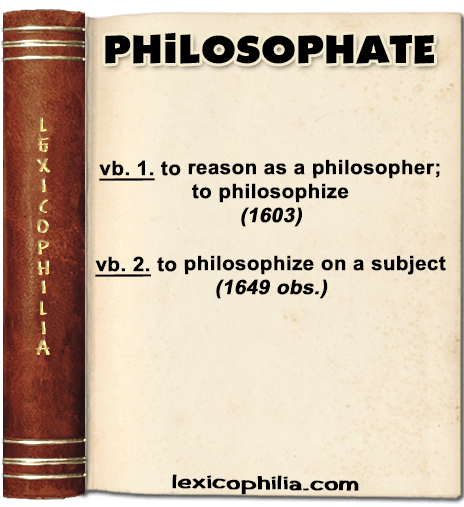
Word of the Day: PHILOSOPHATE


ETYMOLOGY
from Latin philosophāt-, ppl. stem of philosophārī (to do the philosopher, to philosophize), from philosophus (a philosopher)


EXAMPLE
“…If, as some say, to philosophate be to doubt; with much more reason to rave and fantastiquize, as I doe, must necessarily be to doubt: For, to enquire and debate belongeth to a scholler, and to resolve appertaines to a cathedrall master…”

From: The Essayes, or Morall, Politike, and Millitarie Discourses of Lord Michaell de Montaigne 
Translated by John Florio, 1603


PRONUNCIATION
fuh-LOSS-uh-fayt

Word of the Day: SNATTER


ETYMOLOGY
vb.: from Dutch snateren or Low German snat(t)ern (Greek schnattern, Swedish snattra),
of imitative origin


EXAMPLE (for vb.)
“…for if thou considerest the things are easie attained, every ditch offering the some of them, and the preparation so trinial, that there is as much art to make a mess of pottage; in this above all other I have deserved well at thy hand, if thou hast a heart to improve it, neither do I doubt, although many will be angry and snatter at it, but this entrance which I have given in this receipt will stand while the world indures and get strength, and my memory held in honor, for so good service in it…”

From: The Unlearned Alchymist His Antidote
By Richard Mathews, 1662

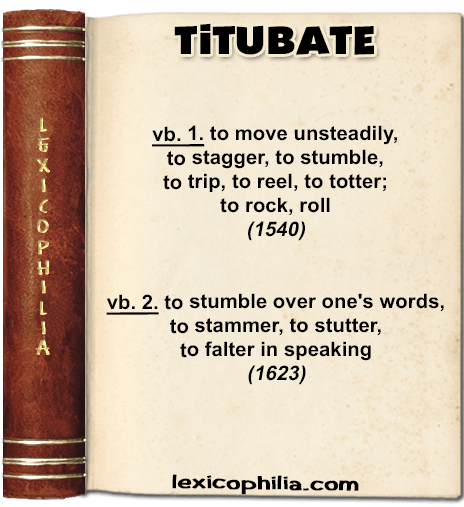
Word of the Day: TITUBATE


ETYMOLOGY
from Latin titubat-, past participial stem of titubare (to walk unsteadily, to totter, to stagger, to falter, to vacillate or dither, to make a mistake, slip up, or stumble (in speech or action)


PRONUNCIATION
TIT-yuh-bayt


EXAMPLE
“…Repercussed by the ryght redolent & rotounde rethorician R. Smyth P. with annotacios of the mellifluous and misticall Master Mynterne, marked in the mergent for the enucliacion of certen obscure obelisques, to thende that the imprudent lector shulde not tytubate or hallucinate in the labyrinthes of this lucubratiuncle…”

From: An Artificiall Apologie (title page)
By R. Smyth, 1540

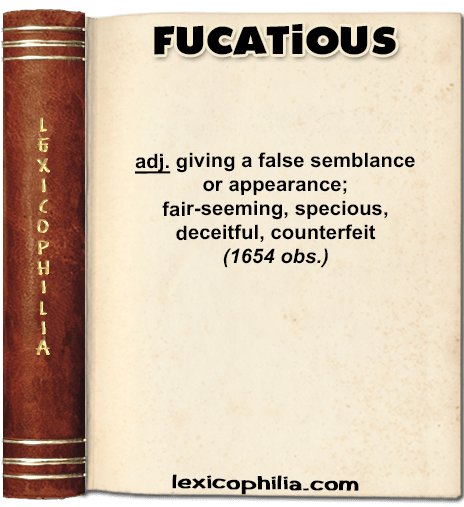
Word of the Day: FUCATIOUS


ETYMOLOGY
from fucation (a painting the face; hence, the giving of a false semblance or appearance, counterfeiting), (from Latin fucatus, pa. pple. of fucare (to paint, rouge)) + -ous


EXAMPLE
“…but then the condition must be possible in his power to whom ’tis made, and the perfor∣mance according to the promisers Wil or liking; els it can∣not be candid or current. For to offer a courtesy under impossible condition, is frivolous or fucatious: as if one should offer mony to a blind Man on condition he wil tel what coin ’tis; which is al one as to deny an alms: nay in som sort wors, sith ’tis a denial with delusion and derision, or a meer mockery…”

From: Theoremata Theologica: Theological Treatises.
Octo theses theologicæ: Eight theses of divinity
By Robert Vilvain, 1654

Word of the Day: AUXILIATE


ETYMOLOGY
from Latin auxiliat- ppl. stem of auxiliari (to help, to assist)


EXAMPLE
“…of which are some Plants, or parts thereof, and some Minerals, which being absolutely described, put the Apothecary upon doubts, who is ignorant of the genuine dilucidation: whose tenuity, that we may auxiliate, we will give him the names of the five opening roots; and they are the roots of Smallage, Sperage, Parsley, Fennel, and Butchers-broom. Besides which, other five are much celebrated, to wit, the roots of Grass, the greater Madder, Oenone, Ca∣pers, and Eryngium…”

From: A Medical Dispensatory
Containing the Whole Body of Physick
Composed by the Illustrious Renodaeus,
Englished and Revised by Richard Tomlinson, 1657
The Fourth Book Of Roots

Word of the Day: TEPEFY


ETYMOLOGY
from Latin tepefacere (to make tepid),
from tepere (to be lukewarm)


EXAMPLE (for vb. 1)
“…Sonorous, thro’ the patient’s bosom pours
Its antidotal notes, the flood of life,
Loos’d at its source by tepefying strains,
Flows like some frozen silver stream unthaw’d
At a warm zephyr of the genial spring
…”

From: The Power of Harmony
By John Gilbert Cooper, 1745