Word of the Day: RHONCHISONANT


ETYMOLOGY
from Latin rhonchus (a snoring) + sonans, p. pr. of sonare (to sound)


EXAMPLE
“…Out marches the paleontologist Collett,
And with his little hammer
And scientific grammar
First knocks a mammoth tooth,
To put into his grip-sack;
Then constructs an awful name
By means of which to skip back
With a great rhonchisonant fury, on
The epochs carboniferous and Silurian…”

From: Biographical and Historical Record of Vermillion County, Indiana, 1888
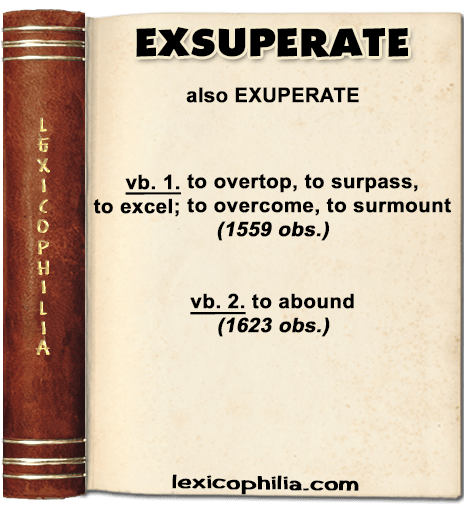
Word of the Day: EXSUPERATE


ETYMOLOGY
from Latin ex(s)uperat- ppl. stem of ex(s)uperare
from ex- + superare (to rise above), from super (above)


EXAMPLE
“…And if bewtie breed such blisfulnesse
Euamouring both God and man
Good Lady let no wilfulnesse
 Exuperate  your bewtye then
To slaye the hertes that yeld & craue
ladye ladye
The graunt of your goodwil to haue
My deare ladye…”

From: The Panges of Loue and Louers Fittes
By William Elderton, 1559

Word of the Day: DECURTATE


ETYMOLOGY
adjective: from Latin decurtatus, pa. pple. of decurtare (to cut off, curtail)
verb: from participial stem of Latin decurtare + -ate


EXAMPLE
“…hee sendes for his Barber to depure, decurtate, and spunge him, whome hauing not paide a twelmonth before, he now raines downe eight quarter angels into his hande…”

From: Lenten Stuffe
By Thomas Nashe, 1599

Word of the Day: INFIDOUS


ETYMOLOGY
from Latin infīdus (untrue, disloyal) + -ous


EXAMPLE
“…The Arabian Interpreters are also miserably out, in rendring Tabaxir Spodium, and Spodium Burnt Ivory: for Tabaxir is the succe or concreted liquor of certain Trees, or very crass and tall Reeds, which by the agitation of the wind, and their mutual collision, sometimes conflagrate; from which burning, Avicenna mendicated his Spodium, or rather Tabaxir, which his infidous Interpreter Clusius calls his Spodium. But we get not this Tabaxir from India, nor the ashes of these burnt Canes from Arabia…”

From: A Medicinal Dispensatory, containing the whole body of physick discovering the natures, properties, and vertues of vegetables, minerals, & animals
By Jean de Renou
Translated by Richard Tomlinson, 1657

Word of the Day: CAUPONATE


ETYMOLOGY
from Latin caupōnāt- ppl. stem of caupōnāri (to traffic or trade in),
from caupōnem (retail tradesman, huckster, innkeeper)


EXAMPLE
“…Nor may these false and flattering Dalilahs of our times (who by cauponating Religion and handling the Scriptures deceitfully, seek to betray the strength, honour, and order this reformed Church in England, under pretences of great kindness)…”

From: Hieraspistes: A Defence by Way of Apology for the Ministry and Ministers of the Church of England
By John Gauden, 1653

Word of the Day: HARRIDAN


ETYMOLOGY
of uncertain origin;
possibly from French haridelle (an old jade of a horse – 1558), (a woman (especially a servant) who is too weak to work – 1690) + a derivative suffix of uncertain origin)


EXAMPLE
“…Parret. Doest take me for a Harridan, or a Cuffey? ha!
Owmuch. I believe thee a very obliging Creature, truely.
Parret. I won’t be believed an obliging Creature by ne’re a Sir Fopling of you all, the Court know me a Creature of Heavens special Handy-work, and if I live to see the City, Bow shall Ring with thy abominations, till Mary-Overs eccho thy lewdness: Tempt me to be an obliging Creature…”

From: Tunbridge-Wells, or, A days courtship a comedy
By Thomas Rawlins, a1670

Word of the Day: TRISTITIATE


ETYMOLOGY
rom Latin tristitia (sadness) + -ate


EXAMPLE
“…What man is it which lives so happily, which feares not something that would sadden his soule if it fell? Nor is there any whom calamity doth so much tristitiate, as that hee never sees the flashes of some warming joy. Beasts with beasts are terrified and delighted…”

From:  Resolves or, Excogitations: A Second Centurie
By Owen Felltham, 1628

Word of the Day: OPIFEROUS

ETYMOLOGY
from Latin opifer (help-bringing),
from opem (help) + -fer


EXAMPLE
“…I heard that a hardy little band tried to read it through , but fell asleep after having read the opiferous leaves of the first chapter . I speak not of the puffs , profusely given to it by generous friends , interested or stipended parties…”

From: Critical Dialogue Between Aboo and Caboo On A New Book:
Or A Grandissime Ascension
Edited by E. Junius (A.E. Rouquette), 1880

Word of the Day: GIXY

ETYMOLOGY
? possibly connected with gig (an eccentric person)


EXAMPLE
“…Hereupon it fell out, after the expiring of a scantling of Weeks, that Master Carvel became as jealous as a Tygar, and entred into a very profound suspition, that his new-married Gixy did keep a Buttock-stirring with others: to prevent which inconveniency, he did tell her many tragical Stories of the total Ruine of several Kingdoms by Adultery…”

From: The Third Book of the Heroick Deeds and Sayings of the good Pantagruel.
By Francois Rabelais
Translated by Thomas Urquhart, 1693