ETYMOLOGY
from Latin multibibus, from multi- + -bibus drinking, bibĕre to drink
EXAMPLE
Now and then I turned aside to avoid some noisy multibibe as he reeled homewards.
ETYMOLOGY
from Latin multibibus, from multi- + -bibus drinking, bibĕre to drink
EXAMPLE
Now and then I turned aside to avoid some noisy multibibe as he reeled homewards.

ETYMOLOGY
– a stiver was a small coin (originally silver) of the Low Countries:
applied to the nickel piece of 5 cents of the Netherlands
EXAMPLE
“…as, according to a very nice calculation, that cutaneous reservoir, vulgarly called the breeches-pocket, and notorious for its unaffected sympathy with the animal spirits, will be stiver-cramped: I shall then indulge them with a touch of the sublime!…”
From: The Life and Extraordinary Adventures of James Molesworth Hobart
By N. Dralloc, 1794
ETYMOLOGY
from grieve + -ment
EXAMPLE
“…The manner of his Marching forth,
Some Authors tell us, and his Worth,
His Stature, Courage, Strength and Age,
His Armour and his Equipage,
His Warlike Feats in former Days,
Perform’d in Scotch and Gallick Frays,
His Battels won and great Atchievments,
Wounds, Bruises, Bangs, and other Grievments;
Which Happen’d oft to be his Fate,
For no Man’s always Fortunate:
All which I leave to Ancient story;
Now see the end of all his Glory…”
From: England’s Reformation from the time of King Henry VIII to the End of Oates’s Plot,
A Poem in Four Canto’s
By Thomas Ward, 1708
ETYMOLOGY
of unknown origin;
possibly an altered form of vandie, vauntie
EXAMPLE
“…How lang shall our land thus suffer distresses,
Whilst traitors, and strangers, and tyrants oppress us!
How lang shall our old, and once brave warlike nation,
Thus tamely submit to a base usurpation?
Thus must we be sad, whilst the traitors are vaudie,
Till we get a sight of our ain bonnie laddie…”
From: Jacobite Songs, 1871
How Lang Shall Our Land
By William Meston,
ETYMOLOGY
from Latin avītus of or pertaining to the avus (grandfather) + -ous
EXAMPLE
“…Being a leucothiop, he was not even a mediocrist, but a mere polypragmatical hafter or barrator. His inscience of avitous justicements, and of lexicology, his perissology and battology, imparted to his tractation of his cause, an imperspecuity which rendered it immomentous to the juratory audients…”
From: Letters to Squire Pedant in the East
Letter No. IX, 1843
By Lorenzo Altisonant (pseudonym Samuel Klinefelter Hoshour),
an Emigrant to the West, 1856
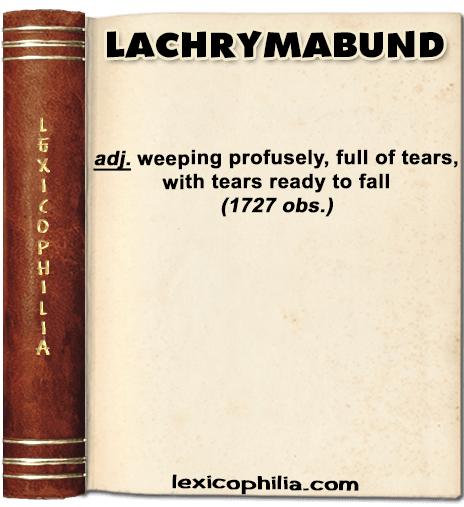
ETYMOLOGY
from Latin lacrimābundus (weeping, in tears),
from lacrimāre (to shed tears) + -bundus
EXAMPLE
“…that I must soon inevitably succumb, unless you most charitably applicate the balsamic lenitives of complyance to your most agonized,
and lachrymabund slave,
TIMOTHY BLUNDERBUSS…”
From: The Adventures of Jerry Buck
By John Slade, 1754

ETYMOLOGY
from Latin fluctisonus; fluctus (wave) + sonus (sound)
EXAMPLE
“…Flash! White raw human waves make a fluctisonous roar!…”
From: G Day, Please God, Get Me Off the Hook
By Neil Baker, 2010

ETYMOLOGY
probably from Angloromani (English Romani) mónoshi (woman, wife),
from Romani månuš (man) + -ī (feminine suffix)
EXAMPLE
“…I was standing near the prosecutor’s shew-glass, talking to a young man; the prisoner and another came to the glass, where I saw the medal lying: I saw them point at it; the other said, it would just do for him, and bid the prisoner look who was in the shop; he answered there was a Monisher in the shop; I suppose a cant word for a woman: Mrs. Storey was there: they went in; then I went into the house where I live; they came out in about three or four minutes: I went after them to the corner, and saw them running along Leicester-fields as fast as they could: I came back, and asked Mrs. Storey whether that medal was gold? she said it was she looked, and it was gone…”
From: The Proceedings of the Old Bailey, London’s Central Criminal Court
18th September, 1765

ETYMOLOGY
of unknown origin
EXAMPLE
“…Thro’ glaury holes, an’ dybs, nae mair
Ye’ll ward my pettles frae the lair,
Nor skinkle jet-black, here an’ there,
Wi’ white-thread hose;
Whan I gang to a kintry Fair,
To mak’ a sprose…”
From: Miscellaneous Poems, Songs, &c.,
Partly in the Scottish Dialect
By Ebenezer Picken, 1788

ETYMOLOGY
from Latin dēsidiōsus (slothful)
EXAMPLE
“…In my travels through the various counties of England, I have marked the lack of feracity, arising from the lower orders becoming desidiose. …”
From: Langreath: A Tale
By Mrs. Eliza Nathan, 1727
 Lexicophilia