Word of the Day: MAGIRIST

ETYMOLOGY
from Greek µάγειρος (cook) + -ist

EXAMPLE
“… As no inhabitable Corner of the Earth ever was without a sufficient Medicinal Produce of it’s own for it’s Inhabitants, so the respective Natives never wanted a competent Number of their own, that made it their Business, to cultivate those several natural Physical Productions, and even to Carry on their Intelligence further therewith, so as to dive deeper into the Knowledge of all the Medicinals; that they could come any way to be acquainted with, or to know the Use of. And such were call’d at first variously pro re nata, as Magists, Magirists, Opsonarians, Caterers, Carvars, Nurserists, Geoponists, Hygeisys, Prophylactists, Remedists, Aliptists, Gymnastists, Unguentarians, Emplastrists, Veterinarians, Hippo-Jatrists, Mulomedicists. Operators, Herbalists, Botanists, Anatomists, Naturalists, Physicists, Medicinists, Myropolists, Ropopolists, …”

From: Athenæ Britannicæ; or, a critical history of the Oxford and Cambridge writers and writings
By Myles Davies, 1716

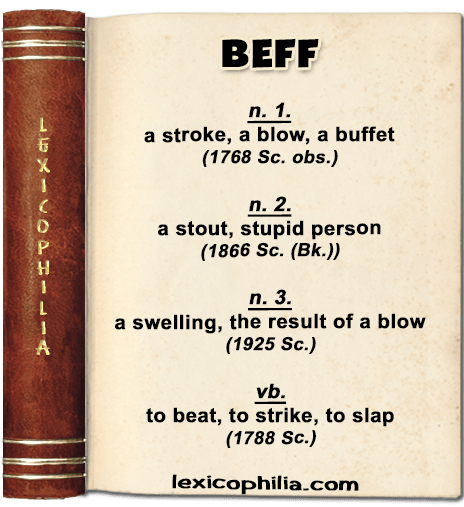
Word of the Day: BEFF

ETYMOLOGY
n. 1. possibly a variant of baff (a blow with anything flat or soft)
n. 2. possibly a variant of baff (a big, clumsy person)
vb. possibly a variant of beft (to strike, to give blows)

EXAMPLE (for n. 1.)
“… Ye shak your head, but o’ my fegs,
Ye’ve set auld Scota on her legs;
Lang had she lien wi’
beffs and flegs,
Bumbaz’d and dizzie,
Her fiddle wanted strings and pegs,
Wae’s me, poor hizzie.
…”

From: Aberdeen Journal, June 1768
The Poems of Beattie
By James Beattie

Word of the Day: GRIZZLEDEMUNDY

ETYMOLOGY
from grizzle (to grin or laugh [Eng. dial.]) + ???

EXAMPLE
“… Bed-blonket akether! Ha! zey zitch a word more, chell cotton thy wastecoat. Chell thong tha, chell gi’ tha zitch a strat in tha chups, ya grizzledemundy. …”

From: The Gentleman’s Magazine
Volume 16, 1746
An Exmoor Scolding; In the Propriety and Decency of Exmoor Language, between two Sisters

Word of the Day: FIRE-FLAUGHT

ETYMOLOGY
from fire (n.) + flaught (a flash; a flash of lightning)

EXAMPLE (for n. 1.)
“… Bot lo, onon, a wonder thing to tell!
Ane huge bleys of flambys braid doun fell
Furth of the clowdis, at the left hand straucht,
In maner of a lychtnyng or
fyre flaucht,
And dyd alicht rycht in the sammyn sted
Apon the crown of fair Lavinias hed;
…”

From: The Æneid of Virgil
Translated by Gavin Douglas, a1522

Word of the Day: CACODOX

ETYMOLOGY
from Greek κακόδοξος (kakodoxos) (of the wrong opinion)

EXAMPLE
“… But that Cacodox Alastor has not only abandon’d the true Principles of Reason and Religion, as identify’d with those of the Protestant Reformation and Church of England, but also those of their fore-Fathers of High-Church …”

From: Athenæ Britannicæ: or, A Critical History of the Oxford and Cambridge writers and writings
By Myles Davies, 1716

Word of the Day: AIRLING

ETYMOLOGY
apparently from air (n.) + -ling 

EXAMPLE (for n. 1.)
“… Some more there be, slight ayrelings, will be wonne,
With dogs, and horses ; or, perhaps, a whore ;
Which must be had : and, if they venter Hues,
For vs, AVRELIA, we must hazard honors
A little. Get thee store, and change of women,
As I haue boyes; and giue ‘hem time, and place, And all conniuence : be thy selfe, too, courtly ;
And entertayne, and feast, sit vp, and reuell ;
Call all the great, the faire, and spirited Dames
Of Rome about thee ; and beginne a fashion
Of freedome, and community.
…”

From: Catiline His Conspiracy
By Benjamin Jonson, 1611

Word of the Day: PLISKY

ETYMOLOGY
of obscure origin

EXAMPLE (for n. 1.)
“… They ‘re fly’d at the heart, it’l be a black Bargain for poor Scotland: for the Engleses are owr auld farren for us, and there’s little Ground to think, they ‘ll gee
us a seen Vantage wee their will, they neer liked us sae well; and its naе forgotten yet, the foul
Plisk they play’d us about our Caledonia Business; …”

From: The Scottish Antiquary Or Northern Notes and Queries
Volume XII, January 1898
A Copy of a Letter from a Country Farmer To His Laird, a Member of Parliament, 1706

Word of the Day: QUISBY

ETYMOLOGY
of uncertain origin;
possibly from quiz (n.) + -by

EXAMPLE
“… Alibi. What wou’d I do then?
Air. Aye, Sir, what wou’d you do then?
Soph. Cou’dn’t he push a little feeble old quisby like you down into a chair?
Alibi, How, pray?
Soph. Shew him how, Robin?
Air. Why there – (puts him into a chair) Just that way
Alibi. Well, now Old Quisby’s down in the chair – what wou’d he do then?…”

From: The Toy
By John O’Keeffe, 1789

Word of the Day: JENTACULAR

ETYMOLOGY
from Latin ientaculum (breakfast); (from ientare (to breakfast)) + -ar

EXAMPLE
“… I wonder that you did not, under this head, acquaint us with that wise injunction, which you have caused to be promulgated within your dominions, against the consumption of tea and coffee; a fashionable vice, which tends only to squandring away money, and mispending the morning, since (as you once ingeniously express’d it) nothing more can be expected from those jentacular confabulations. …”

From: Terræ-filius; or, the secret history of the University of Oxford
By Nicholas Amhurst, 1721