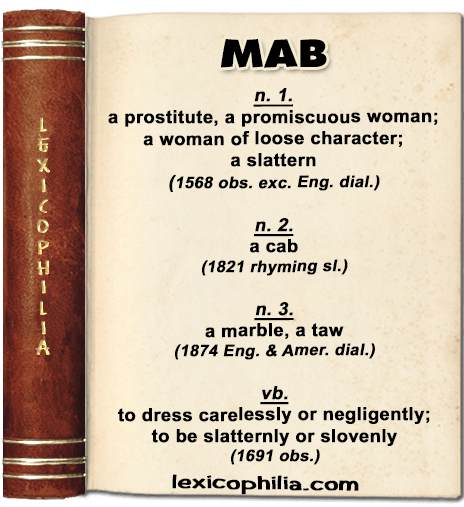
Word of the Day: MAB

ETYMOLOGY
n. of uncertain origin uncertain;
perhaps from the female forename Mab, shortened in Middle English from Mabel, from Amabel
vb. related to mab (a promiscuous woman), perhaps as a variant of mob (to dress oneself untidily

EXAMPLE (for n. 1.)
“… Mido. Take my life for a penny, whither shall I ren?
Esau. Come out, thou little fiend, come out, thou skittish gill.
Abra. Out, alas, alas! Esau will us all kill.
Esau. And come out, thou mother Mab; out, old rotten witch!
As white as midnight’s arsehole or virgin pitch. Where be ye? come together in a cluster.
…”

From: A Newe Mery and Wittie Comedie or Enterlude, Newely Imprinted, Treating vpon the Hhistorie of Iacob and Esau, 1568

Word of the Day: WINDY-WALLETS

ETYMOLOGY
from windy (1. speaking at length; 2. of food or drink: causing flatulence) + wallet (possibly from Scottish sense of a fund of stories, poems, recollections, etc.)

EXAMPLE
“… Gowkscroft and Barnside,
Windy-wallets fu’ o’ pride;
Monynut, and Laikyshiel,
Plenty milk, plenty meal;
Straphunton Mill, and Bankend,
Green cheese as teugh as bend;
Shannabank and Blackerstane,
Pike the flesh to the bane;
Quixwood, and Butterdean,
Lu’ o’ parritch to the een!
…”

From: The Popular Rhymes, Sayings, and Proverbs of the County of Berwick
By George Henderson, 1856

Word of the Day: HABILATORY

ETYMOLOGY
formed on French habiller (to dress), or English habiliment (array, attire, dress), after adjectives etymologically formed in -atory

EXAMPLE
“… The nether garments of this petit-maitre consisted of a pair of blue tight pantaloons, profusely braided, and terminating in Hessian boots, adorned with brass spurs of the most burnished resplendency; a black velvet waistcoat, studded with gold stars, was backed by a green frock coat, covered, notwithstanding the heat of the weather, with fur, and frogged and cordonné with the most lordly indifference, both as to taste and expense: a small French hat, which might not have been much too large for my lord of ——, was set jauntily in the centre of a system of long black curls, which my eye, long accustomed to penetrate the arcana of habilatory art, discovered at once to be a wig. A fierce black mustachio, very much curled, wandered lovingly from the upper lip towards the eyes, which had an unfortunate prepossession for eccentricity in their direction. …”

From: Pelham: Or, The Adventures of a Gentleman
By Edward George E.L. Bulwer- Lytton, 1828

Word of the Day: SUPERNACULAR

ETYMOLOGY
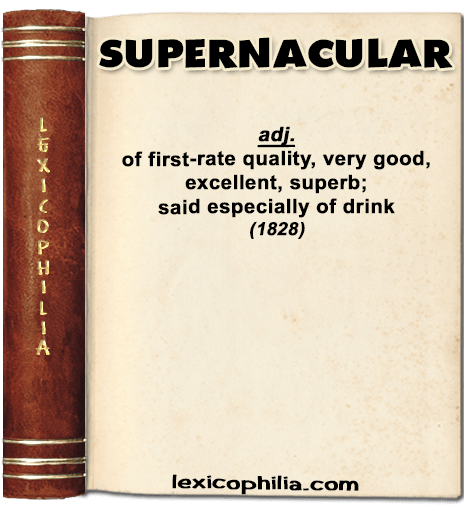
from supernaculum (a drink to be consumed to the last drop; a wine of the highest quality; anything excellent of its kind) + -ar

EXAMPLE
“…The last deposit will be made at Josh Hudson’s, to- morrow evening, when some spirited betting is expected. Both men are well, and something supernacular is expected …”

From: The Morning Chronicle
October 30, 1828
The Ring. Dick Curtis and Edwards

Word of the Day: DISCREPATE

ETYMOLOGY
from Latin discrepat-, past participial stem of discrepare (to differ in sound, to be out of tune, to be out of harmony or inconsistent with, to have differences or discrepancies, to lack agreement, to differ in opinion, to disagree,
from dis- + crepare (to make a noise, to creak)

EXAMPLE (for vb. 1.)
“… So that discrepating from his first propertie, vtterly corrupteth, decayeth, becommeth absumpt in the degree of death. …”

From: The Flower of Phisicke
By William Clever, 1590

Word of the Day: DOCUS

ETYMOLOGY
of unknown origin

EXAMPLE (for n. 1.)
“… Eh man, but ye maun be an unco docus to mistak the yowlin’ o’ a wheen dougs for the squeelin’ o’ ghaists an’ deevils ! I wonner what ye made o’ the twa grumphies it ye had row’t up amang your falalls; gin ye thought it they war young de’ils or what, snoukin’ for a sappy emmeldyug about the harigals o’ ye. …”

From: Saint Patrick: A National Tale of the Fifth Century
By J. Rennie, 1819

Word of the Day: EDACIOUS

ETYMOLOGY
from Latin edaci- (nominative edax), from edere (to eat) + -ous

EXAMPLE (for n. 1.)
“… Nor is this the sole circumstance that should, in mere justice, be
considered in connection with the rise of Christian monachism; for
before the mere facts can be understood, and certainly before the due
measure of blame can be assigned to the parties concerned, it is
indispensable that we divest ourselves of the prejudices, physical,
moral, and intellectual, which belong to our austere climate, high-toned
irritability,
edacious appetites, and pampered constitutions; to our
rigid style of thinking, and to our commercial habits of feeling.
…”

From: Natural History of Enthusiasm
By Isaac Taylor, 1829

Word of the Day: FLIBBERTIGIBBET

also in forms FLEBERGEBET, FLEBERGEBIT, FLEBERGIBET, FLIBBER DE’ JIBB, FLIBBERGIB(BE), FLIBBER-GIBBET, FLIBBERTY-GIBBET, FLIBERDEGIBEK, FLIBERDIGIBBET, FLIBERDIGIBET, FLIPPERTY-GIBBET, FLYBBERGYBE

ETYMOLOGY
apparently an onomatopœic representation of unmeaning chatter or garrulous speech

EXAMPLE (for n. 1.)
“… Better vnborne then vntaught, I haue herde saie,
But ye be better fed than taught far awaie.
Not veraie fat fed, saied this
flebergebet,
But nede hath no lawe, nede maketh her hither iet.
She comth nece Ales (quoth she) for that is her name
More for nede, then for kyndnes, payne of shame.
…”

From: A dialogue conteinyng the nomber in effect of all the prouerbes in the englishe tongue compacte in a matter concernyng two maner of mariages
By John Heywood, 1546

PRONUNCIATION
FLIB-uh-tee-jib-uht

Word of the Day: HURKLE-DURKLE

ETYMOLOGY
from hurkle (to crouch, to stoop, to squat down)

EXAMPLE
“… Lang after peeping greke o’day,
In Hurkle Durkle Habbie lay,
Gae tae yer wark, ye dernan murkle,
And ly nae there in Hurkle Durkle. …”

Note: the phrase ‘in hurkle durkle‘ = in indolence

From: Supplement to the Etymological Dictionary of the Scottish Language
By John Jamieson, 1825

Word of the Day: SNIFFLER

ETYMOLOGY
from sniffle (vb.) + -er

EXAMPLE (for n. 1.)
“… Gin this be courting, well I wat ’tis clear,
I gat na sik a teazle this seven year :
Sae ye maun gee your answer now perqueer,
I maunna ilka day be coming here,
To get sic
sniflers ; courting’s nae a jest.
Another day like this’ll be my priest.’
…”

From: Helenore: Or the Fortunate Shepherdess, a Pastoral Tale
By Alexander Ross, 1768