ETYMOLOGY
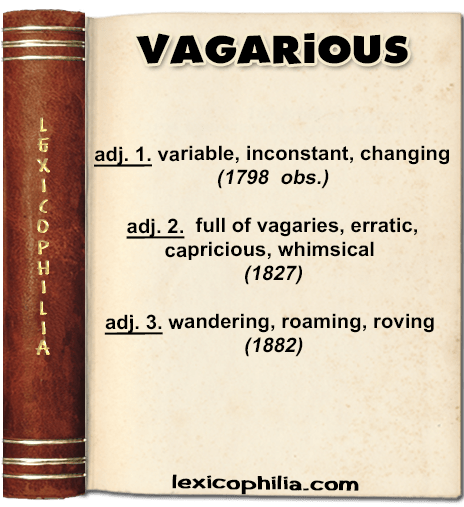
from vagary (from Latin vagari (to wander)) + -ous
EXAMPLE
“…Thus life’s vagarious tenure passes on! And thus, the scenic vision glows with change! …”
From: Tour in Wales
By R.P., 1798
PRONUNCIATION
vuh-GAIR-ee-uhss
ETYMOLOGY
from vagary (from Latin vagari (to wander)) + -ous
EXAMPLE
“…Thus life’s vagarious tenure passes on! And thus, the scenic vision glows with change! …”
From: Tour in Wales
By R.P., 1798
PRONUNCIATION
vuh-GAIR-ee-uhss

ETYMOLOGY
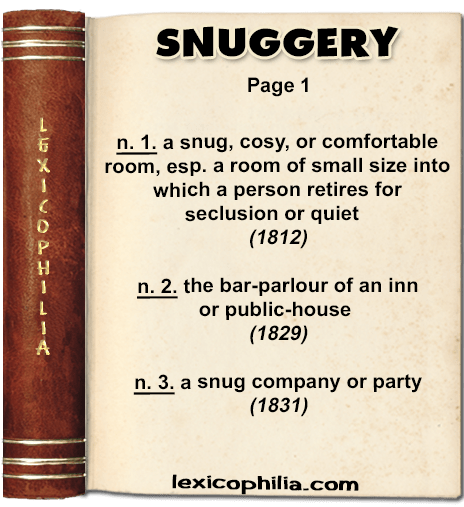
from snug + -ery
EXAMPLE
“…“Here you will be quite to yourselves,” said Lady Clonbrony; “let me establish you comfortably in this, which I call my sanctuary – my snuggery – Colambre, that little table! …”
From: The Absentee
In Tales of Fashionable Life
By Maria Edgeworth, 1812
ETYMOLOGY
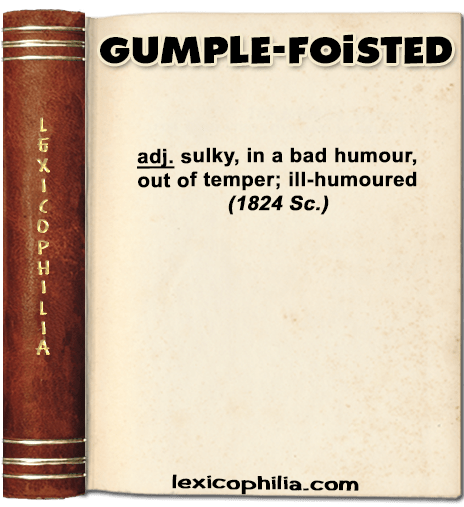
from Scots gumple (to be in a bad mood, to sulk, and as a noun, a fit of the sulks) + feist (found in other formations of similar meaning, e.g. bumple feist (the sulks), amplefeist (a sulky mood)) + -ed
EXAMPLE
“…Aweel, aweel,’ said Peter Peebles, totally unabashed by the repulse, ‘e’en as ye like, a wilful man maun hae his way; but,’ he added, stooping down and endeavouring to gather the spilled snuff from the polished floor, ‘I canna afford to lose my sneeshing for a’ that ye are gumple-foisted wi’ me‘….”
From: Redgauntlet: A Tale of the Eighteenth Century
By Sir Walter Scott, 1824

ETYMOLOGY
from be- + flum;
perhaps influenced by Scots blaflum, bleflum (to cajole)
EXAMPLE
“…that are but ill settled yet, till they durst na on ony errand whatsoever gang ower the door-stane after gloaming, for fear John Heatherblutter, or some siccan dare-the diel, should tak a baff at them: then, on the hand, I beflum’d them wi’ Colonel Talbot – wad they offer to keep up the price again the Duke’s friend? did na they ken wha was master?…”
From: Waverley; or, ‘Tis Sixty Years Since,
By Walter Scott, 1814
ETYMOLOGY
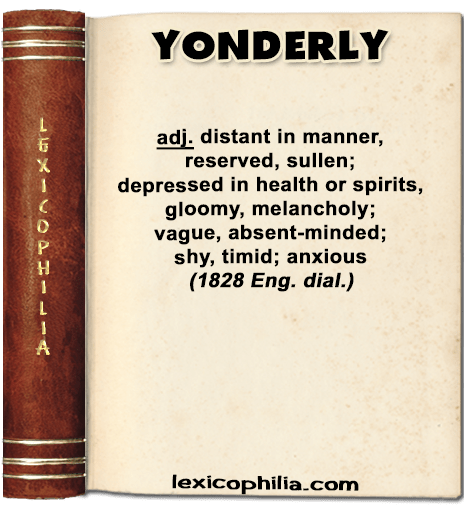
from yonder (adv., adj., pron., & n.) + -ly
EXAMPLE
“…Poor lass, hoo were kinder becose aw were quare;
“Come, Jamie, an’ sattle thisel in a cheer;
Thae’s looked very yonderly mony a day;
It’s grievin’ to see heaw thae’rt wearin’ away,
An’ trailin’ abeawt,
Like a hen at’s i’th meawt;
Do, pritho, poo up to thi tay!…”
From: Lancashire Songs
By Edwin Waugh, 1863
Jamie’s Frolic

ETYMOLOGY
from Latin ubique (wherever, anywhere, everywhere) + -arian
PRONUNCIATION
yoo-buh-KWAIR-ee-uhn
EXAMPLE (for adj. 1)
“…Tho’ detestable the place,
Mean the lodgings, small and base,
Tho’ the crowded hoy pours forth
Company of little worth,
Coach or chariot, tho’ there’s none,
Rattling thro’ the fishing town,
Yet, Maria, yet, my fair,
Happiness shalt find us here:
Happiness our friend shall be,
Ubiquerian deity!…”
From: The Gentleman’s Magazine and Historical Chronicle
Volume XXXII, 1762
Happiness Every Where
Occasioned by a fair Lady’s condemning the Author’s choice of Margate, for a Place of Entertainment

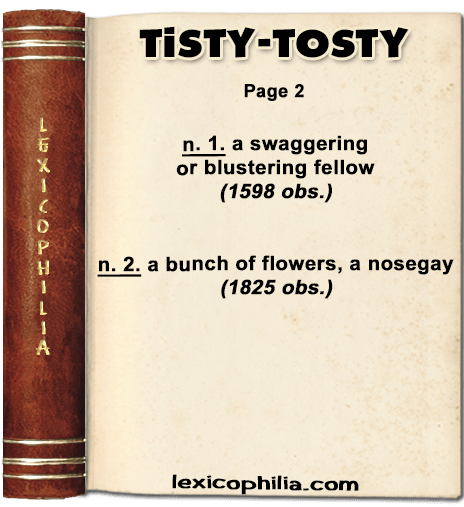
ETYMOLOGY
for int.: perhaps a mere ejaculation
for n. 2.: it has been compared with obsolete tyte tust(e) or obsolete tussemose (a nosegay)
EXAMPLE
“…And now I wil daunce, now wil I praunce,
For why I haue none other woork:
Snip snap Butter is no bone meat:
Knaues flesh is no Porke.
Hey tisty tosty an Ole is a bird,
Iack a napes hath an olde face:
You may beleeue me at one bare woord,
how like you this mery cace?…”
From: A Pleasant Enterlude, Intituled, Like Will to Like Quoth the Deuill to the Collier
By Ulpian Fulwell, 1568


ETYMOLOGY
from snuff + -y
EXAMPLE
“…I’m sure she makes a very Tarquinius Sextus of me, and all about this Serenade,—I protest and vow, incomparable Lady, I had begun the sweetest Speech to her—though I say’t, such Flowers of Rhetorick—’twou’d have been the very Nosegay of Eloquence, so it wou’d; and like an ungrateful illiterate Woman as she is, she left me in the very middle on’t, so snuffy I’ll warrant…”
From: Sir Patient Fancy
By Aphra Behn, 1678

ETYMOLOGY
of uncertain origin;
perhaps from cockle (to move or rock unsteadily; to totter or wobble)
EXAMPLE
“…Their bind was just a Scots pint over-head, and a tappit-hen to the bill, and no man ever saw them the waur o’t. It was thae cockle-brained callants of the present day that would be mair owerta’en with a puir quart than douce folk were with a magnum…”
From: St. Ronan’s Well
By Sir Walter Scott, 1823

ETYMOLOGY
badly formed on edibilis (edible),
after adjs. in –atory
EXAMPLE
“…“Amen to your creed!” said I: “edibilatory Epicurism holds the key to all morality: for do we not see now how sinful it is to yield to an obscene and exaggerated intemperance?…”
From: Pelham, Or, Adventures of a Gentleman
By Edward Bulwer Lytton, 1828
 Lexicophilia