Word of the Day: PHILOFELIST

ETYMOLOGY
from philo, combining form (loving, having an affection for) + Latin feles (cat) + -ist

EXAMPLE
“… An extract from the Register of Cat’s Eden has got abroad, whereby it appears that the Laureate, Dr. Southey, who is known to be a philofelist, and confers honours upon his Cats according to their services, has raised one to the highest rank in peerage, promoting him through all its degrees by the following titles, His Serene Highness the Arch-Duke Rumpelstilzchen, Marquis Macbum, Earl Tomlemagne, Baron Raticide, Waowlher and Skaratchi. …”

From: The Doctor, &c.
By Robert Southey, 1847

Word of the Day: PECKSNIFF

ETYMOLOGY
from the name of Mr. Pecksniff, a hypocritical character in Charles Dickens’s novel “The Life and Adventures of Martin Chuzzlewit

EXAMPLE
“… Should Welby Pugin ever favour us with a Supplement to his Contrasts, he will uo doubt bring forward as one most egregious instance of architectural bathos the unlucky structure commented upon in the preceding paragraph. He might also hold up for reprehension a good many Pecksniff specimens of Gothic and Tudor of very recent date – certainly more recent than would be imagined, for some of them seem to be almost twin-brothers to Strawberry Hill, or else to the front of Guildhall …”

From: The Civil Engineer and Architect’s Journal, Scientific and Railway Gazette
Volume 7, 1844

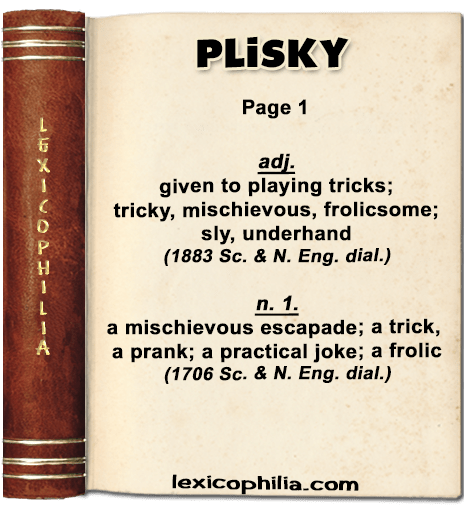
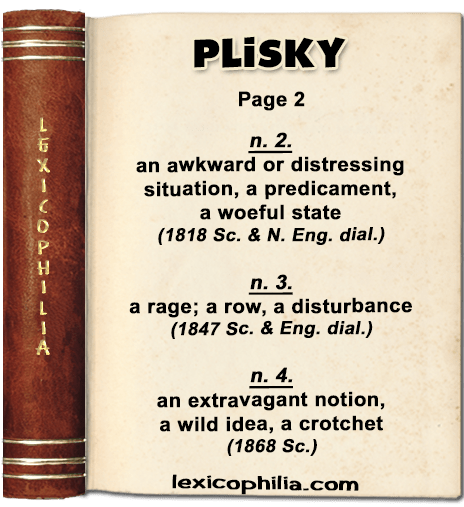
Word of the Day: PLISKY

ETYMOLOGY
of obscure origin

EXAMPLE (for n. 1.)
“… They ‘re fly’d at the heart, it’l be a black Bargain for poor Scotland: for the Engleses are owr auld farren for us, and there’s little Ground to think, they ‘ll gee
us a seen Vantage wee their will, they neer liked us sae well; and its naе forgotten yet, the foul
Plisk they play’d us about our Caledonia Business; …”

From: The Scottish Antiquary Or Northern Notes and Queries
Volume XII, January 1898
A Copy of a Letter from a Country Farmer To His Laird, a Member of Parliament, 1706

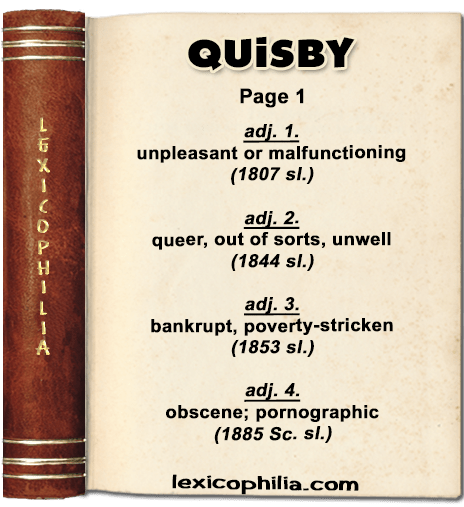
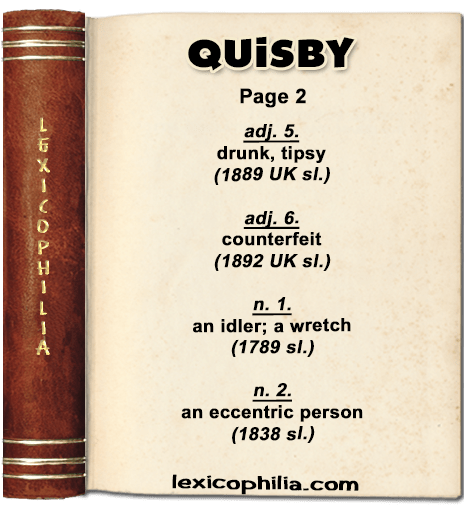
Word of the Day: QUISBY

ETYMOLOGY
of uncertain origin;
possibly from quiz (n.) + -by

EXAMPLE
“… Alibi. What wou’d I do then?
Air. Aye, Sir, what wou’d you do then?
Soph. Cou’dn’t he push a little feeble old quisby like you down into a chair?
Alibi, How, pray?
Soph. Shew him how, Robin?
Air. Why there – (puts him into a chair) Just that way
Alibi. Well, now Old Quisby’s down in the chair – what wou’d he do then?…”

From: The Toy
By John O’Keeffe, 1789

Word of the Day: CRAB-STICK

ETYMOLOGY
from crab (the common name of the wild apple) + stick

EXAMPLE (for n. 2.)
“… Yes, I remember. I was remarking that sangaree and calipash, mangoes and guava jelly, dispose the heart to love, and so they do. I was not more than six weeks in Jamaica when I felt it myself. Now, it was a very dangerous symptom, if you had it strong in you, for this reason. Our colonel, the most cross-grained old
crabstick that ever breathed, happened himself to be taken in when young, and resolving, like the fox who lost his tail and said it was not the fashion to wear one, to pretend he did the thing for fun, determined to make every fellow marry upon the slightest provocation. …”

From: Charles O’Malley
The Irish Dragoon
By Charles Lever, 1840

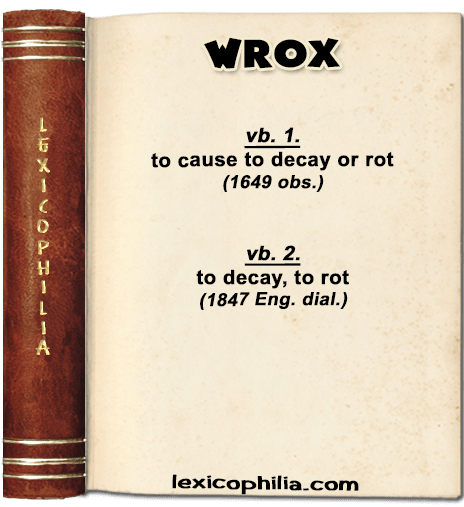
Word of the Day: WROX

ETYMOLOGY
of obscure origin

EXAMPLE
“… be sure to give it a second plowing, just overthwart all the lands, and so cut the Turfe, that the Soard may have all the Winters frost to wroxe, and moulder it, which towards March thou mayst plow again, and so cast it, or raise it, as thy Land requireth …”

From: The English Improver, or a New Survey of Husbandry discovering to the kingdome that some land, both arrable and pasture, may be advanced double or treble
By Walter Blith, 1649
Reducement of Land to Pristine Fertility

Word of the Day: GRIMGRIBBER

ETYMOLOGY
from Grimgribber, an imaginary estate subject of a legal discussion in the play Conscious Lovers (1722) by Sir Richard Steele, British essayist and dramatist

EXAMPLE
“… Mankind in general are not sufficiently aware that words without meaning, or of equivocal meaning, are the everlasting engines of fraud and injustice; and that the grimgribber of Westminster Hall is a more fertile, and a much more formidable, source of imposture than the abracadabra of magicians. …”

From: Epea pteroenta, or, The diversions of Purley
By John Horne Tooke, 1786

Word of the Day: BEDOOZLE

ETYMOLOGY
perhaps from  bedazzle + bamboozle 

EXAMPLE
“… O Shadrack, my Shadrack! Prissilla did speak,
While the rosy red blushes surmantled her cheek,
And the tears of affection
bedoozled her eye,
Shadrack, my Shadrack! I ‘m yourn till I die!
…”

From: The Gazette of the Union, Golden Rule, and Odd-Fellow’s Family Companion
A Saturday Family Journal of General Literature, Odd-Fellowship and Amusement.
Volume X – From January to June Inclusive, 1849
From the Scrabble Hill Luminary

Word of the Day: HUMGRUFFIN

ETYMOLOGY
A made-up word, from humgruff, griffin.

EXAMPLE
“… The Demoniac crowd
In an instant seem’d cowed;
Not one of the crew volunteer’d a reply,
All shrunk from the glance of that keen-flashing eye,
Save one horrid
Humgruffin, who seem’d by his talk,
And the airs he assumed, to be Cock of the walk,
He quailed not before it, but saucily met it,
And as saucily said, “Don’t you wish you may get it?”
…”

From: The Ingoldsby Legends
The Lay of St. Cuthbert, or, The Devil’s Dinner-Party
By Richard Harris Barham (Thomas Ingoldsby), 1842

Word of the Day: TIB

ETYMOLOGY
perhaps the same as Tib, a shortened hypocoristic form of the female name Isabel; now rather rude or slighting (except playfully);
also with dim. -y or -ieTibbie, a common female name in the north

EXAMPLE
“… .Trupeny. Mary then prickmedaintie come toste me a fig,
Who shall then know our
Tib Talke apace trow ye?

An. Alyface. And why not Annot Alyface as fyne as she?

Trupeny. And what had Tom Trupeny, a father or none?

An. Alyface. Then our prety newe come man will looke to be one …”

From: Ralph Roister Doister 
By Nicholas Udall, a1556