Word of the Day: SNATTER


ETYMOLOGY
vb.: from Dutch snateren or Low German snat(t)ern (Greek schnattern, Swedish snattra),
of imitative origin


EXAMPLE (for vb.)
“…for if thou considerest the things are easie attained, every ditch offering the some of them, and the preparation so trinial, that there is as much art to make a mess of pottage; in this above all other I have deserved well at thy hand, if thou hast a heart to improve it, neither do I doubt, although many will be angry and snatter at it, but this entrance which I have given in this receipt will stand while the world indures and get strength, and my memory held in honor, for so good service in it…”

From: The Unlearned Alchymist His Antidote
By Richard Mathews, 1662
Word of the Day: TEPEFY


ETYMOLOGY
from Latin tepefacere (to make tepid),
from tepere (to be lukewarm)


EXAMPLE (for vb. 1)
“…Sonorous, thro’ the patient’s bosom pours
Its antidotal notes, the flood of life,
Loos’d at its source by tepefying strains,
Flows like some frozen silver stream unthaw’d
At a warm zephyr of the genial spring
…”

From: The Power of Harmony
By John Gilbert Cooper, 1745

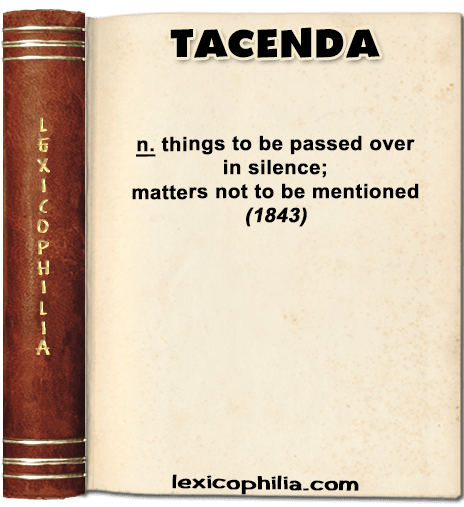
Word of the Day: TACENDA


ETYMOLOGY
Latin, gerundive neuter pl. of tacere (to be silent)


EXAMPLE
“…With due rigour, Willelmus Sacrista, and his bibations and tacenda are, at the earliest opportunity, softly, yet irrevocably put an end to. The bibations, namely, had to end; even the building where they used to be carried on was razed from the soil of St. Edmundsbury, and ‘on its place grow rows of beans:’ Willelmus himself, deposed from the Sacristry and all offices, retires into obscurity, into absolute taciturnity unbroken thenceforth to this hour…”

From: Past and Present
By Thomas Carlyle, 1843

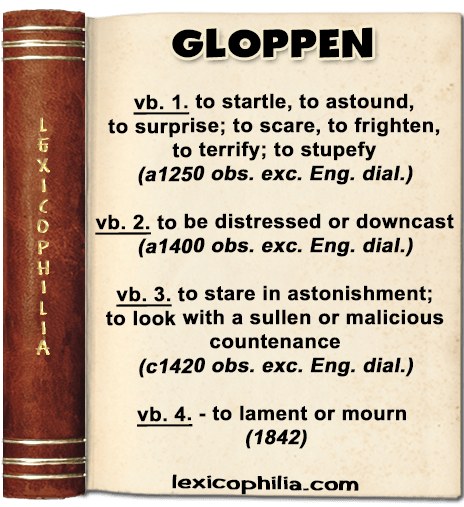
Word of the Day: GLOPPEN


ETYMOLOGY
from Old Norse glupna (to be downcast);
a root of identical form appears in Old Frisian glûpa, Middle Low German glûpen (to lie in wait for), Dutch gluipen (to watch slily, to sneak), Old Swedish glupa (to gape, swallow), Swedish glupande, Danish glubende (ravenous, fierce);
whether there is any etymological connection is uncertain


EXAMPLE (for vb. 1)
“…Quen [he] þar-of son had a sight,
Al was he gloppend for þat light
…”

From: Cursor Mundi
(The Cursur of the World)
A Northumbrian Poem of the XIVth Century

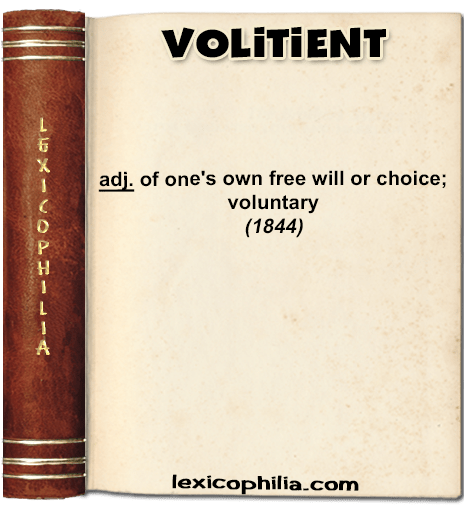
Word of the Day: VOLITIENT


ETYMOLOGY
irregularly from voliti-,
from French volition,
from medieval Latin volition-volitio (noun of action),
from Latin volo (I wish, will) + -ent 


EXAMPLE
“…I chose this ruin: I elected it
Of my will, not of service, What I do, I do volitient, not obedient,
And overtop thy crown with my despair
…”

From: A Drama of Exile
By Elizabeth Barrett Browning, 1844

Word of the Day: CHATTERMAG


ETYMOLOGY
from chatter + mag (a chatterbox)


EXAMPLE
“…Now then, stop that; we don’t want no such dal’d nonsense; we come here to work. Now then, you women, divide into twos, and begin at both ends, or we shan’t get any work done for your chattermagging…”

From: Stubble Farm;
Or, Three Generations of English Farmers
By Hubert A. Simmons, Vol. II, 1880
Chapter I. P. 14

Word of the Day: SAMSONISTIC


ETYMOLOGY
from Samson (in reference to his enormous strength) + -istic


EXAMPLE
“…The new Governor-General seemed to be impressed with the idea that all political officers, small and great, were in fault. Forthwith he commenced dealing out upon them the most ferocious and Samsonistic blows. The shower unfortunately fell, like Don Quixote’s strokes on a certain occasion, upon an innocent race of puppets…”

From: Dry Leaves from Young Egypt
Being a Glance at Sindh Before the Arrival of Sir Charles Napier,
By An Ex-Political (Edward Backhouse Eastwick), 1849
Chapter XII. A Flea

Word of the Day: NOB-THATCH


ETYMOLOGY
from nob (the head) + thatch (covering)


EXAMPLE
“…Sir, I have been three months in the House of Correction, and was discharged yesterday. Mr Chesterton’s “nick” is yet fearfully visible among my hair, whence a great paucity of nob-thatch…”

From: Littell’s Living Age
Volume 11, 1846
The Complaint of a Pickpocket; John Sheppard