Word of the Day: GIG-LAMPS

ETYMOLOGY
from gig (a light two-wheeled one-horse carriage) + lamp

EXAMPLE (for n. 1.)
“… A “Wo-ho-ho, my beauties!” brought the smoking wheelers upon their haunches; and Jehu, saluting with his elbow and whip finger, called out in the husky voice peculiar to a dram-drinker, “Are you the two houtside gents for Hoxfut?” To which Mr. Green replied in the affirmative; and while the luggage (the canvas-covered, ladylike look of which was such a contrast to that of the other passengers) was being quickly transferred to the coach-top, he and Verdant ascended to the places reserved for them behind the coachman. Mr. Green saw at a glance that all the passengers were Oxford men, dressed in every variety of Oxford fashion, and exhibiting a pleasing diversity of Oxford manners. Their private remarks on the two new-comers were, like stage “asides,” perfectly audible.

“Decided case of governor!” said one.

“Undoubted ditto of freshman!” observed another.

“Looks ferociously mild in his gig-lamps!” remarked a third, alluding to Mr. Verdant Green’s spectacles.

And jolly green all over!” wound up a fourth. …”

From: The Adventures of Mr. Verdant Green
By Cuthbert Bede, (real name Edward Bradley), 1853
Word of the Day: FAM

ETYMOLOGY
short for famble;
for n. 4.: shortened from family

EXAMPLE (for n. 1.)
“… Jenny being very genteely dressed, he observed a Gentleman who was a very Rum Muns, (that is, a great Beau) who had a very Glim Star, (that is, a Ring) upon his Feme, (that is, Hand} which she longed to make, so giving the Hint to her Companions to Bulk the Muns forward, (that is, Push) they pushed him quite in; …”

From: Select trials at the Sessions-House in the Old-Bailey, for murder, robberies, rapes, sodomy, coining
From the year 1720, to this time. 1742
The following is a particular Account of the Transactions of the Life of Mary Young, alias Jenny Diver, &c. &c. &c.

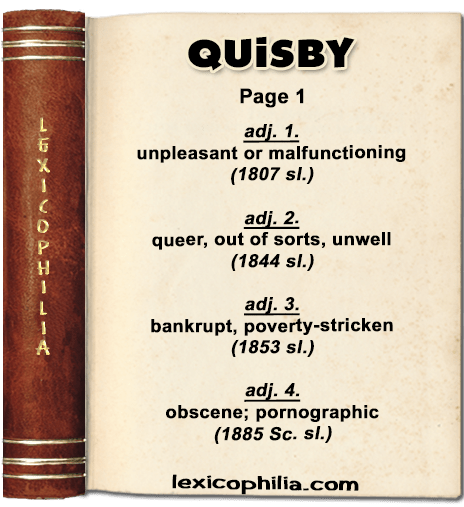
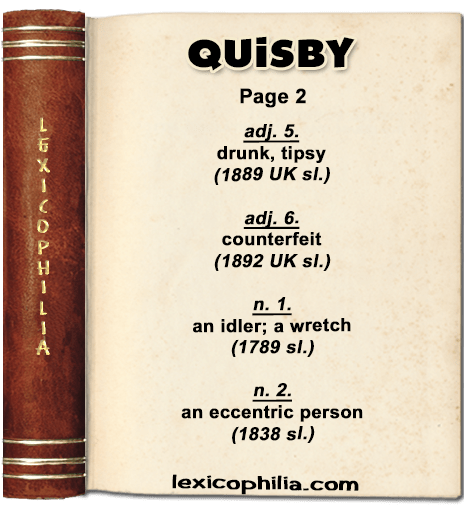
Word of the Day: QUISBY

ETYMOLOGY
of uncertain origin;
possibly from quiz (n.) + -by

EXAMPLE
“… Alibi. What wou’d I do then?
Air. Aye, Sir, what wou’d you do then?
Soph. Cou’dn’t he push a little feeble old quisby like you down into a chair?
Alibi, How, pray?
Soph. Shew him how, Robin?
Air. Why there – (puts him into a chair) Just that way
Alibi. Well, now Old Quisby’s down in the chair – what wou’d he do then?…”

From: The Toy
By John O’Keeffe, 1789

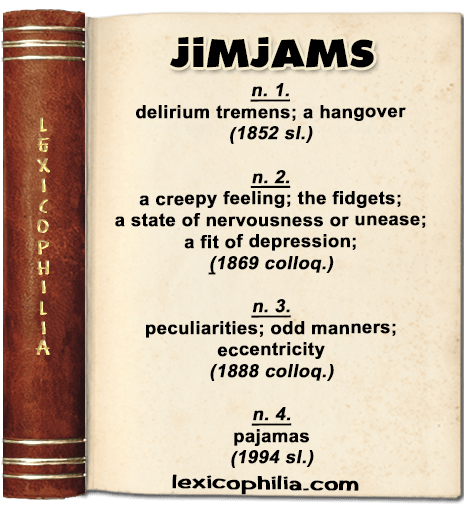
Word of the Day: JIMJAMS

ETYMOLOGY
a reduplicated term, of which the elements are unknown;
from the mid 16th century – in the singular, originally denoted a knickknack or small article

EXAMPLE (for n. 1)
“… Andy Collins, an Irishman, who has lived alone in his cabin, about a mile below us, for a year or more, has been a hard drinker ever since we have known him. He bought his rum by the gallon and kept soaked all the time. Tuesday night he had a bad attack of the jim-jams, and his nearest neighbor, O’Neil, heard him yelling and shrieking like all possessed. …”

From: The Diary of a Forty-Niner
By Chauncey Canfield, 1906
Chapter XVI, February 1, 1852

Word of the Day: OMNINESCIENT

ETYMOLOGY
from omni- combining form of Latin omnis (all) + nescient from Latin nescientem
pres. pple. of nescire (to be ignorant), from ne (not) + scire (to know)

EXAMPLE
“… The appeal is generally from those who know something to those who know less – and at last to those who are omni-nescient. …”

From: A Report of Proceedings at a Public Meeting of the Merchants, Bankers, and Traders of the City of London, held at the London Tavern, on Wednesday, Dec. 3, 1851
For a Reform of the Board of Customs
Part II. Chapter II. Appeals

Word of the Day: TIB

ETYMOLOGY
perhaps the same as Tib, a shortened hypocoristic form of the female name Isabel; now rather rude or slighting (except playfully);
also with dim. -y or -ieTibbie, a common female name in the north

EXAMPLE
“… .Trupeny. Mary then prickmedaintie come toste me a fig,
Who shall then know our
Tib Talke apace trow ye?

An. Alyface. And why not Annot Alyface as fyne as she?

Trupeny. And what had Tom Trupeny, a father or none?

An. Alyface. Then our prety newe come man will looke to be one …”

From: Ralph Roister Doister 
By Nicholas Udall, a1556

Word of the Day: DRUMBELO

also DROMMELL, DROMOS (plural), DRUMBLE (Eng. dial.), DRUMMIL (Eng. dial.)

ETYMOLOGY
possibly from dialect drumble (to talk meaninglessly or monotonously, to blather or ramble)

EXAMPLE
“… This before remēbred ſupplicatiō was attentiuely noted & much feared, amongſt ye curſed companie of drouſie dreaming Dromos, I mean Baals Baldons yt mungrel Maſſalians & cruel churchrobbers whome it touched moſt in effect, in ſo muche that the groſſe Goſpeller, Ethnike Epicures, beaſtly bellygods, wicked worldlyngs and ſpirituall ſhauelyngs, were fallen in a pelting chafe, the bloudy Biſhoppes broyled, the cullionly Cardinalles coured, the proude Priours frouned, the fat Abbots ſwet, the pore Friers curſed, the white Chanons chafed, the poore Nunnes puled like Puttockes, in concluſion, all the ſectarie Sathaniſts were ſore diſpleaſed …”

From: Polybius
The Hystories of the most Famous and Worthy Cronographer Polybius discoursing of the Warres betwixt the Romanes and Carthaginenses
Translated by C. Watson, 1568

Word of the Day: CUFFER

ETYMOLOGY
for. n. 1. & n. 2. from cuff (to strike with the fist or open hand, to buffet) + -er
for n. 4. from cuff (to discuss, to talk over) + -er

EXAMPLE (for n. 1.)
“… LET US LEARN THE LAWS OF FASTING, that we run not uncertainly, nor beat the air, nor be as such cuffers who fight as it were with their shadow. Fasting is a medicine; but physick, although it be never so good, that is prescribed, oftimes becomes unprofitable, by reason of the imprudence of him that useth it. …”

From: The Paschal or Lent-Fast, Apostolical & Perpetual at first deliver’d in a sermon preached before His Majesty in Lent and since enlarged
By Peter Gunning, 1662

Word of the Day: EAR-DROPPER

ETYMOLOGY
from ear + dropper

EXAMPLE
“… But, that he was a Creature of the Duke’s, and commended to him by Bishop Williams, the Historian is strangely out again. It is possible an Ear-dropper might hear such things talk’d at Cock-pits and Dancing-schools, miserable Intelligence to thrust into an History …”

From: Scrinia Reserata a Memorial Offer’d to the Great Deservings of John Williams, D. D.
By John Hacket, a1670