ETYMOLOGY
from Latin pessimus (worst_ + -ize, after optimize
EXAMPLE
“…The rabid rage of a losing cause precipitating and pessimising its own loss…”
From: The Daily Telegraph
September, 1862
ETYMOLOGY
from Latin pessimus (worst_ + -ize, after optimize
EXAMPLE
“…The rabid rage of a losing cause precipitating and pessimising its own loss…”
From: The Daily Telegraph
September, 1862
ETYMOLOGY
from snoozle (to nestle and sleep or doze) + -dom
EXAMPLE
“…There are times with us all, when in a concave mirror we see a minute distorted into long hours; and, again, in the convex glass the long hours dwindle to a point. When summoned by peremptory duty from a warm bed upon a keen, frosty morning, how precious are the last five minutes of snoozledom! You live introspectively all through them; you chew the cud of your own cosiness. …”
From: The Casquet of Literature, a Selection in Poetry and Prose
Edited by C. Gibbon, 1873
‘The Philosophy of Sorrow’
By D’Arcy Wentworth Thompson
ETYMOLOGY
from parvi- comb. form of Latin parvus (small) + scient (knowledgeable, skilled);
probably after omniscient (having infinite knowledge)
EXAMPLE
“…It is called his causal body. Neither can do anything without one. The aggregate of the causal bodies of all souls, that is to say, distributive ignorances, make up I’s’wara’s causal body, which is illusion. Strange to say, the ignorance of a single soul renders that soul subject to misapprehension, and keeps it parviscient, parvipotent, &c; but the aggregation of these individual ignorances, or illusion, allows I’s’wara to be exempt from misapprehension, and communicate to him such attributes as omniscience and omnipotence…”
From: A Rational Refutation of the Hindu Philosophical Systems
By Nehemiah Nilakantha S’Astri’ Gore
Translation by Fitz-Edward Hall, 1862
PRONUNCIATION
par-VISS-ee-uhnt
ETYMOLOGY
from batracho- (comb. form) [from Greek βάτραχος (bátrakhos, frog)] + ‑phobia
EXAMPLE
“…The world looks down upon them, gives them ill names, affects a sort of horror of them, and does its best to kick them out of sight; and the consequence is that the world knows next to nothing about them, and thus misses one of the most marvellous chapters in the whole range of zoological science. The Batrachophobia is at length giving way in one direction, it is true; for the Aquarium, has made it manifest that the Water-Newts, spite of a long-cherished belief to the contrary, are perfectly harmless little creatures…”
From: Links In The Chain;
Or, Popular Chapters On the Curiosities of Animal Life
By George Kearley, 1863
‘The Ancient Order of Batrachians’
PRONUNCIATION
bat-ruh-koh-FOH-bee-uh
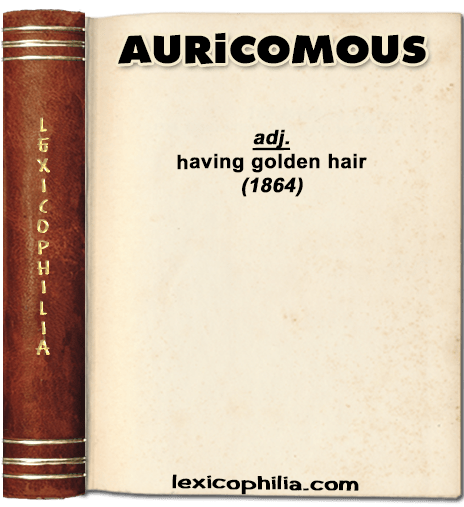
ETYMOLOGY
from Latin auricomus, from auri-, comb. form of aurum (gold) + coma (hair) + -ous
EXAMPLE
“…Mrs. Poignarde, who was walking beside Saltasche, raised her eyelashes, and timidly looked for a recognition. Mrs. Hepenstall, a very frisky matron, and her friend of the auricomous hair, looked blankest forgetfulness…”
From: Hogan, M.P.: A Novel
By May Laffan Hartley, 1881
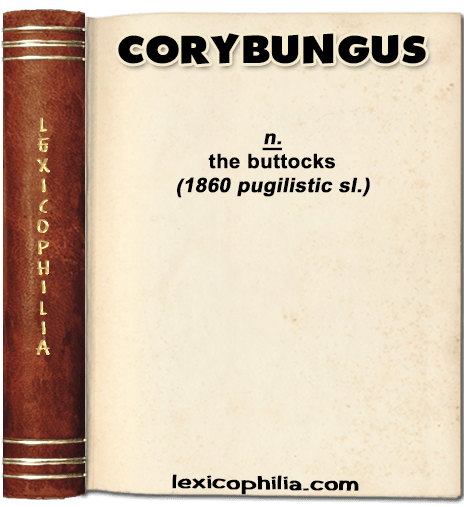
ETYMOLOGY
? perhaps from bung (the buttocks, the backside [obs.]) + -us (abounding in, full of)
EXAMPLE
“…Sims, after a little unartistic squaring, lunged out awkwardly, and caught Tom on the chest with his left. Tom, who was evidently waiting to find out what his adversary could do, returned smartly on the gob, and in getting back, fell on his corybungus…”
From: Tom Sayers, Sometime Champion of England,
His Life and Pugilistic Career
By Thomas Sayers, 1866
‘Fight between Tom Sayers and George Sims, for £75, on Tuesday, the 28th of February, 1854, at Longreach’

ETYMOLOGY
from soiled (defiled) + dove (gentle, innocent, or loving woman)
EXAMPLE
“…In “A Daughter of Eve,” Mr. Hain Friswell, who is favourably known as a producer of light literature, introduces, by way of arousing a sensation, a young lady, whom he euphemistically styles “a soiled dove.” It is impossible to regard modern society without acknowledging the abundant existence of such persons…”
From: Dublin University Magazine
A Literary and Political Journal
January to June 1863
‘Modern Novel and Romance’
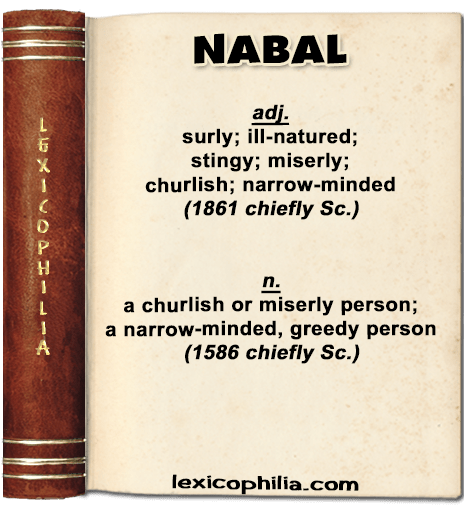
ETYMOLOGY
from the Hebrew proper name Nabal (a wealthy sheep owner who refused to pay tribute to King David for protecting his flocks),
from nabal (a disgraceful, impious, or villainous person)
from nabal (to be foolish, act foolishly)
EXAMPLE
“…As for those men that resemble the rigorous iudge, that neither feare God, nor good man, that neuer thinke of the saluation of their sinful seduced soules, that either be Athiestes or Libertines or Machiuelians or Spend-thriftes or couetous Nabals or great Gamsters or Luxurious and Riotous persons or seditious and traiterous papists, are no fitte men to bee such a husband as I propose …”
From: A sermon preached at Trafford in Lancashire
By William Massie, 1586
PRONUNCIATION
NAY-buhl
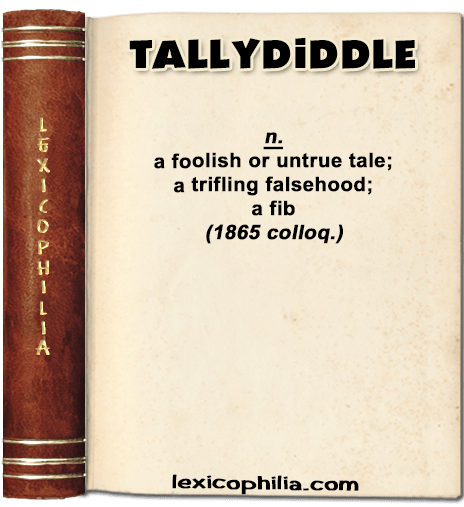
ETYMOLOGY
variant of taradiddle (a trifling falsehood, a petty lie)
EXAMPLE
“…Oh, don’t call them lies, sister; it’s such a strong, ugly word. Please call them tallydiddles, for I don’t believe she meant any harm. Besides – besides – if they should turn out to be truth? Really, sister, that’s the weight on my mind; so many things sounded as if they might be true…”
From: Wives & Daughters
By Elizabeth Gaskell, 1866

ETYMOLOGY
from white + nose
EXAMPLE
“…We now hoisted sail and stood off the land. The wind, together with the sea, was fast rising, many a ‘white nose‘ chequering the blueness of the more open water…”
From: A Naturalist’s Ramble to The Orcades
By A. W. Crichton, 1866
 Lexicophilia