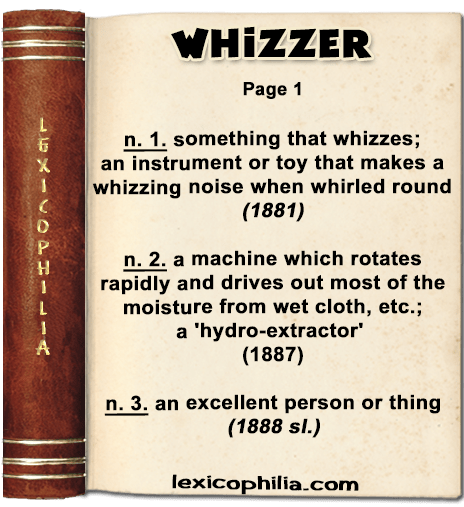
Word of the Day: WHIZZER


ETYMOLOGY
from whizz (to move swiftly or with such a sound) + -er


EXAMPLE
“…The washerwoman finds her occupation almost gone through the introduction of machinery. The larger part of the city of Troy is devoted to the manufacture of engines, whizzers, starchers, and other machines of the steam laundry. The most interesting machine is the whizzer, which dries clothes in 1,000 revolutions a minute…”

From: The Pall Mall Budget, July 1887
Volume 35

Word of the Day: SPARROW-FART


ETYMOLOGY
from sparrow + fart


EXAMPLE (for n. 2.)
“…Miss This Miss That Miss Theother lot of sparrowfarts skitting around talking about politics they know as much about as my backside anything in the world to make themselves someway interesting Irish homemade beauties soldiers daughter am I ay and whose are you bootmakers and publicans I beg your pardon coach I thought you were a wheelbarrow…”

From: Ulysses
By James Joyce, 1922

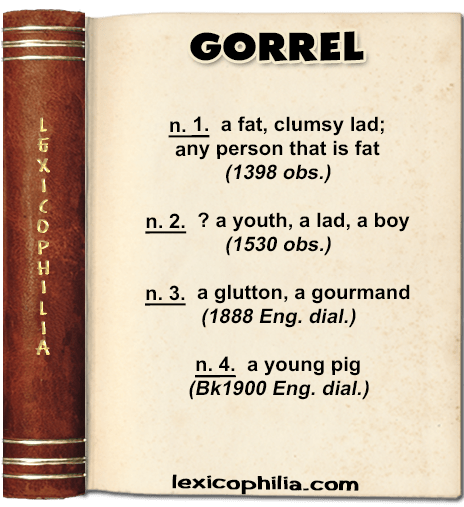
Word of the Day: GORREL


ETYMOLOGY
from Old French gorelgorreau (a pig, hog);
related to Old French gore (sow): of unknown origin.


EXAMPLE (for n. 1.)
“…Crampe that comyth of replycyon fallyth ofte to fatte men and flesshly and well fedde and gorrelles…”

From: Bartholomew de Glanville’s De Proprietatibus Rerum,
Translated by John Trevisa, 1495

Word of the Day: LICKSPITTLE


ETYMOLOGY
from lick (vb.) + spittle (a house or place for the reception of the indigent or diseased)


EXAMPLE
“…Yes – and to hear his lickspittles speak, you would think that a man of great and versatile talents was a miracle; whereas there are some thousands of them publicly acknowledged in England at this day…”

From: Noctes Ambrosianae (J. Wilson) in Blackwood’s Edinburgh Magazine,
Volume XVIII, July-December, 1825

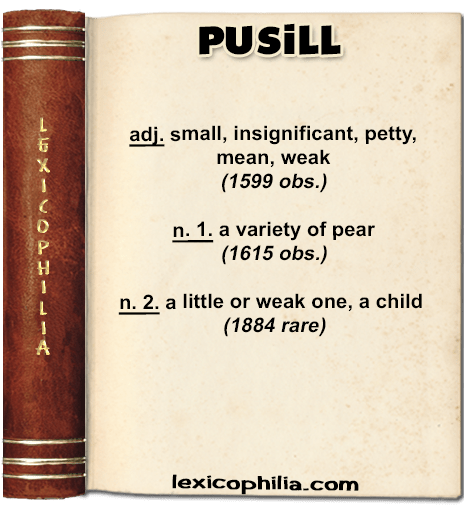
Word of the Day: PUSILL


ETYMOLOGY
from: a) Middle French pusillepuzilpusil (very small, weak),
b) Latin pusillus (very small, insignificant, petty) from pusus (boy) + -illus 


EXAMPLE
“…And to amase her weake, and pusill minde,
In creepe through crannies of imagination.
Deformd Idean formes, and phansies blinde.
Sent foorth by hir sicke sences, instigation.
Like staringe greisly fendes, threatninge invasion.
Presenting to her heart, the homely iarres.
And houshold cares, accurringe nuptiall warres…”

From: Eustathia, or the Constancie of Susanna
By Robert Roche, 1599

Word of the Day: IDIOGLOTTIC

ETYMOLOGY
from idio- (own, personal, private, peculiar, separate, distinct) + glottic (pertaining to language)

EXAMPLE
“…This impression he uttered with the word “pupu,” meaning a very big papa. The boy soon gave up his idioglottic endeavors, learning German before his next-born sister had reached the age of beginning speech. So that language could have no further grammatical development…”

From: Proceedings of the Royal Canadian Institute
Being a Continuation of the “Canadian Journal” of Science, Literature, and History
October, 1888, Vol. XXIV
The Development of Language, by Horatio Hale