Word of the Day: GIG-LAMPS

ETYMOLOGY
from gig (a light two-wheeled one-horse carriage) + lamp

EXAMPLE (for n. 1.)
“… A “Wo-ho-ho, my beauties!” brought the smoking wheelers upon their haunches; and Jehu, saluting with his elbow and whip finger, called out in the husky voice peculiar to a dram-drinker, “Are you the two houtside gents for Hoxfut?” To which Mr. Green replied in the affirmative; and while the luggage (the canvas-covered, ladylike look of which was such a contrast to that of the other passengers) was being quickly transferred to the coach-top, he and Verdant ascended to the places reserved for them behind the coachman. Mr. Green saw at a glance that all the passengers were Oxford men, dressed in every variety of Oxford fashion, and exhibiting a pleasing diversity of Oxford manners. Their private remarks on the two new-comers were, like stage “asides,” perfectly audible.

“Decided case of governor!” said one.

“Undoubted ditto of freshman!” observed another.

“Looks ferociously mild in his gig-lamps!” remarked a third, alluding to Mr. Verdant Green’s spectacles.

And jolly green all over!” wound up a fourth. …”

From: The Adventures of Mr. Verdant Green
By Cuthbert Bede, (real name Edward Bradley), 1853
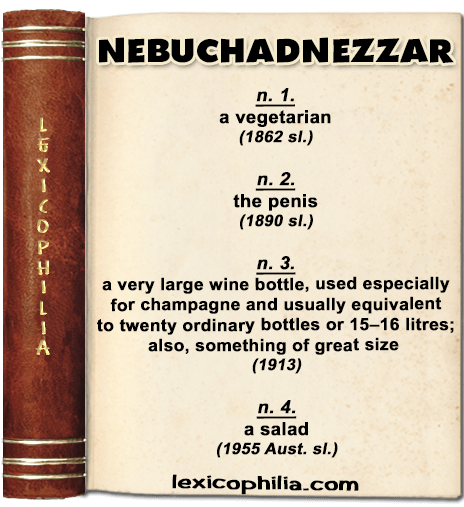
Word of the Day: NEBUCHADNEZZAR

ETYMOLOGY
from the name of Nebuchadnezzar (died c562 BC) ruler of the Babylonian empire (604–562 BC), after French nabuchodonosor (large wine bottle used for champagne)

EXAMPLE (for n. 3.)
“… That didn’t prevent me strewing my whole room with little bits of paper, when I undressed that night. Fireworks ensue, then (children dismissed) supper and afterwards, the most magnificent Nebuchadnezzars, and finally a good form of blind-man’s buff, where everyone stands round the room in a circle and the blind man walks up and prods someone, telling him at the same time to make a noise … sch as the sound of rain falling on mud – and the speaker has to be recognised by the sound of his voice. …”

From: Letters of Aldous Huxley
By Aldous Huxley, 1969
Letter to Leonard Huxley, 11 November, 1913

PRONUNCIATION
neb-yuh-kuhd-NEZ-uh

Word of the Day: WUZZY

ETYMOLOGY
of uncertain origin;
possibly a variant of woozy (dizzy or unsteady); possibly after muzzy (drowsy, spiritless; confused, mentally hazy; dazed and unfocused)

EXAMPLE
“… I am very nearly mad, I am quite slowly turning wuzzy. I see four people instead of one, and I have an irresistible longing to eat the fire and beat my door-handle. …”

From: Antony (Viscount Knebworth): A Record of Youth
By Edward Anthony James Lytton, 1935
Letter written 10 March, 1921

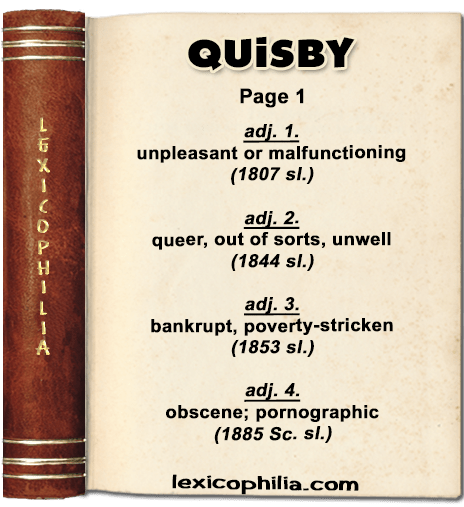
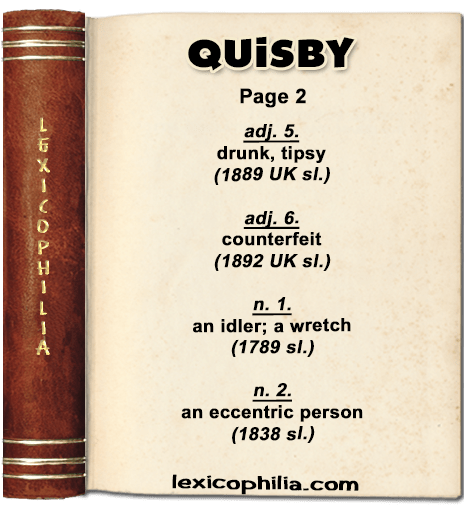
Word of the Day: QUISBY

ETYMOLOGY
of uncertain origin;
possibly from quiz (n.) + -by

EXAMPLE
“… Alibi. What wou’d I do then?
Air. Aye, Sir, what wou’d you do then?
Soph. Cou’dn’t he push a little feeble old quisby like you down into a chair?
Alibi, How, pray?
Soph. Shew him how, Robin?
Air. Why there – (puts him into a chair) Just that way
Alibi. Well, now Old Quisby’s down in the chair – what wou’d he do then?…”

From: The Toy
By John O’Keeffe, 1789

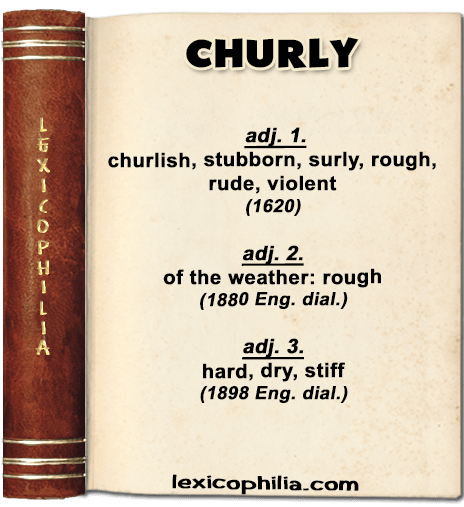
Word of the Day: CHURLY

ETYMOLOGY
from churl -y

EXAMPLE
“… But all this while, the shop where Jonah sleeps,
Is tost, and torne, and batter’d on the deeps,
And well-nigh split upon the threatning Rock,
With many a boystrous brush, and
churley knock.
God help all desp’rate voyagers, and keepe
All such, as feele thy wonders on the deepe.
…”

From: Divine poems: containing the History of -Jonah. Ester. Job. Samson.; Sions – sonets. Elegies.
By Francis Quarles, 1638

Word of the Day: POECILONYM

ETYMOLOGY
from Greek ποικίλος (poikilos) (many-coloured, variegated, various):
a formative element in scientific terms + Greek ὄνοµα (onoma), ὄνυµα (name)

EXAMPLE
“… Considering that the Parliament House (the “Sansad Bhavan”) and the seat of the President (the “Rashtrapati Bhavan”) are both situated in New Delhi – which is the capital of the country – the name of the city is frequently used as a poecilonym for the Government of India. …”

From: The Sovereign
Sprouts Of Good Governance
By Kislay Panday, 2022

PRONUNCIATION
PEE-suh-luh-nim

Word of the Day: FERINE

ETYMOLOGY
from Latin ferinus, from fera (wild beast)

EXAMPLE (for adj. 1)
“… Secondly there are brutish and unnaturall Desires, which the Philosopher calleth 
ferine and inhumane, instancing in those barbarous Countries, where they use to eat mens flesh and raw meat; and in the Woman who ripped up Women with childe that shee might eat their young ones: …”

From: A Treatise of the Passions and Faculties of the Soule of Man
By Edward Reynolds, 1640