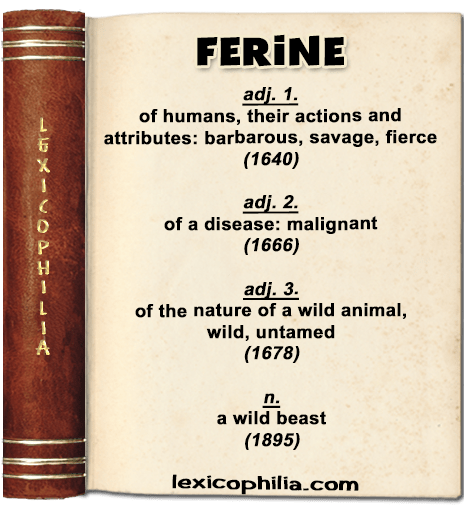
Word of the Day: FERINE

ETYMOLOGY
from Latin ferinus, from fera (wild beast)

EXAMPLE (for adj. 1)
“… Secondly there are brutish and unnaturall Desires, which the Philosopher calleth 
ferine and inhumane, instancing in those barbarous Countries, where they use to eat mens flesh and raw meat; and in the Woman who ripped up Women with childe that shee might eat their young ones: …”

From: A Treatise of the Passions and Faculties of the Soule of Man
By Edward Reynolds, 1640

Word of the Day: COVER-SLUT

ETYMOLOGY
from cover (to put or something over an object, with the effect of hiding from view or protecting) + slut (an untidy, dirty, or slovenly woman; a woman who is habitually careless, lazy, or negligent with regard to appearance, household cleanliness, etc.)

EXAMPLE
“… But as it is a sad thing that the grace of God pretended, should be used as a pander unto wantonness, so it is no less hateful, that the providence of God should be misapplied as a cover-slut of idleness, ignorance, and unconscionableness: for who knowes not that our life is so in Gods hand, as it is ordinarily preserved ro lost by the use or want of things proper thereto? even hunger if self would be certainly mortal, if not appeased by meat appropriated thereto by the appointment of God. …”

From: Natures explication and Helmont’s vindication.
Or A short and sure way to a long and sound life.
By George Starkey, 1658

Word of the Day: HIPPOMOBILE

ETYMOLOGY
from French hippomobile , from hippo- from Greek ἵππος (horse), from hippos (horse) + ‑mobile after automobile 

EXAMPLE
“… Speaking generally, it is the bad driver who uses the horn most, and so brings motor-cars into disrepute by creating unnecessary alarm to other travellers. In overtaking a horse-drawn vehicle it is best to sound the horn when some distance behind, and so soon as it is seen that the signal has been noticed to avoid its use again until past the ” hippomobile.” Of course it is sometimes necessary to use the horn when quite close to a horse-drawn vehicle for instance, when it unexpectedly turns out across one’s path; but even on such occasions two moderate and short blasts are generally sufficient to warn the driver. …”

From: The Motor-Car Journal
London, Friday, March 17th, 1899
Comments, ‘The Motor-Car Horn’

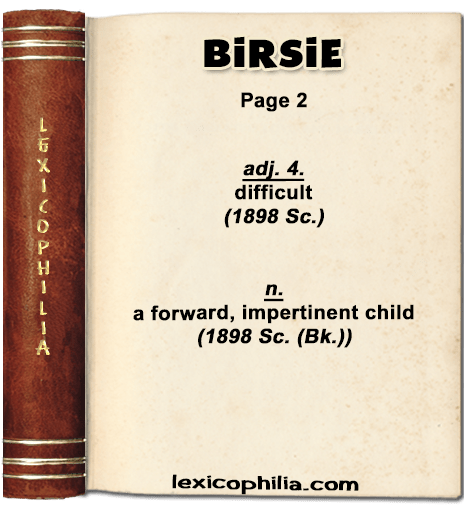
Word of the Day: BIRSIE

ETYMOLOGY
adj. 1. from birse (Sc. – a bristle, hair) + -y
n. from birse (Sc. – to push, to press, to squeeze) + -y

EXAMPLE
“…The mekill howke hym bair was Tryton callyt,
For in hir forstam was the monstre stallyt,
With watry trumpe fleyand the fludis gray;
Quhar as scho salyt, men mycht se hym ay
With  
byrsy body porturyt, and vissage
All rowgh of harys, semyng of cullage
In mannys form fra hys cost to hys crown,
…”

From: Virgil’s Aeneid translated into Scottish verse
By Gavin Douglas, a1522

Word of the Day: PEEPY


ETYMOLOGY
from peep + -y


EXAMPLE (for adj. 1)
“…An individual of the latter kind is distinguished in his earliest petticoats – even before he has well left the nursery. He is then a poor, peepy wretch, with blear eyes, and one everlasting dingy night-cap. constantly sitting by the fire, to the great annoyance of the nurse, who frequently declares him to be more of an infant than even his younger brother the baby…”

From: Chambers Edinburgh Journal
Conducted by William Chambers, and Robert Chambers,
Volume I No. 49, Saturday, January 5, 1833,
‘The Domestic Man’

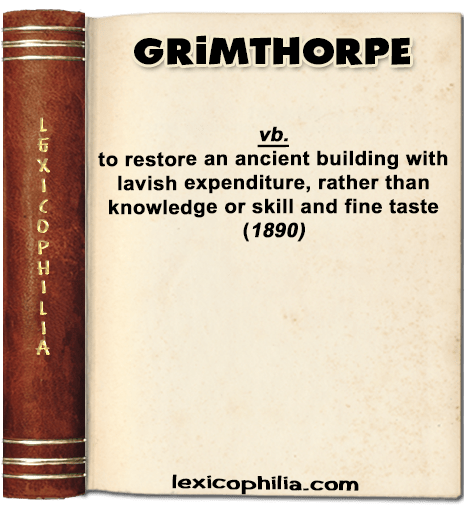
Word of the Day: GRIMTHORPE


ETYMOLOGY
from the name of Sir Edmund Beckett, first Lord Grimthorpe (1816–1905), whose restoration of St. Albans Cathedral, completed in 1904, aroused fierce criticism and controversy


EXAMPLE
“…Talking of Lord Grimthorpe reminds us of an honour that has recently been done unto his name. It shall not be the Antiquary’s fault if this honour is not perpetuated; so that, perchance, the dictionaries of the future may immortalize his titular name in the same way as they have already treated the family appellation of Boycott. Last November, a group of appreciative visitors were standing in the nave of the abbey church of Selby, discussing its probable reparation. “Ah!” remarked one, “if only the wealthy and generous man could be found, what a fine field for his labours!” To this a keen and well-known Yorkshire ecclesiologist replied: “Heaven forbid! the building might be grimthorped!…”

From: The Antiquary,
A Magazine Devoted to the Study of the Past, Vol. XXI, January – June, 1890
‘Notes of the Month’

Word of the Day: CLIP-SHEARS


ETYMOLOGY
formed by compounding clip (that which is clipped or cut);
apparently from the form of its feelers, as having some resemblance to a pair of shears, 
or scissors


EXAMPLE
“…turned out their russet recesses to the birsling sun, and the foggie-toddlers hirpled about their business in the warm sod, among golacks and clip-shears, while the grasshoppers chirped in merry concert…”

From: Proceedings of the Philosophical Society of Glasgow
Edited by Agnes McLean, Vol. XXX. 1898
V. Dr. James Colville on the Scottish Vernacular.

Word of the Day: HIRPLE


ETYMOLOGY
of unknown origin;
the coincidence in sound and sense with Greek ἕρπειν from ἕρπω (hérpō) (to move slowly),
is noticeable.


EXAMPLE
“…The bull: the beir: the bugill: and the bair:
The wodwys: vildcat: and the wild wolfyne:
The hardbakkit hurcheoun: and the hirpland hair:
Baith otter and aip: and pennit porcupyne.
The gukit gait: the selie scheip the swyne:
The bauer bakon and the balterand brok:
The fowmart, with the fyber furth can flok
…”

From: The Morall Fabillis of Esope the Phrygian
“The taill of the sone & air of the forsaid foxe”
Robert Henryson, a1500

Word of the Day: NEBSIE


ETYMOLOGY
from neb (the beak or bill of a bird) + -sie -sy


EXAMPLE
“…“I’ll tell you aboot Mark,: he said next time; ‘we’ll no be disturbed again till the men want their forenoon – that’s the drop whisky, you ken. Simon’s wife’s a nebsy clatterin’ body, but for a’ that, I wish ehre were mair like her…”

From: The Red Scaur
A Novel of Manners
By P. Anderson Graham, 1896

Word of the Day: MARICOLOUS


ETYMOLOGY
from Latin mari-mare (sea) + –colus (inhabiting, colere (to inhabit))


EXAMPLE
“…The members of this genus are small, constantly apterous, gregarious, maricolous, and inhabit relatively still salt and brackish waters of bays, atolls, estuaries, inlets…”

From: Studies on the Fauna of Suriname and Other Guyanas
By D.C. Geijakes, 1962