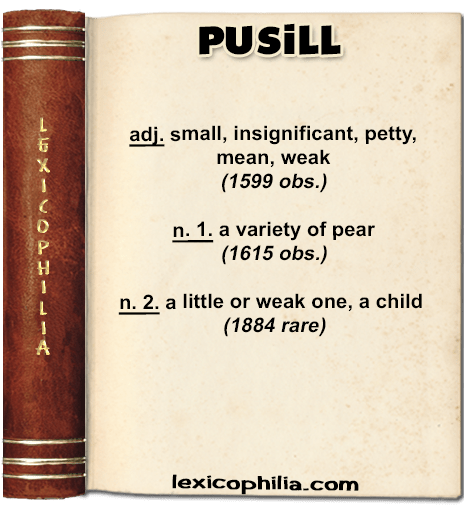
Word of the Day: PUSILL


ETYMOLOGY
from: a) Middle French pusillepuzilpusil (very small, weak),
b) Latin pusillus (very small, insignificant, petty) from pusus (boy) + -illus 


EXAMPLE
“…And to amase her weake, and pusill minde,
In creepe through crannies of imagination.
Deformd Idean formes, and phansies blinde.
Sent foorth by hir sicke sences, instigation.
Like staringe greisly fendes, threatninge invasion.
Presenting to her heart, the homely iarres.
And houshold cares, accurringe nuptiall warres…”

From: Eustathia, or the Constancie of Susanna
By Robert Roche, 1599

Word of the Day: SAMSONISTIC


ETYMOLOGY
from Samson (in reference to his enormous strength) + -istic


EXAMPLE
“…The new Governor-General seemed to be impressed with the idea that all political officers, small and great, were in fault. Forthwith he commenced dealing out upon them the most ferocious and Samsonistic blows. The shower unfortunately fell, like Don Quixote’s strokes on a certain occasion, upon an innocent race of puppets…”

From: Dry Leaves from Young Egypt
Being a Glance at Sindh Before the Arrival of Sir Charles Napier,
By An Ex-Political (Edward Backhouse Eastwick), 1849
Chapter XII. A Flea

Word of the Day: WAKERLY


ETYMOLOGY
from waker (unsleeping, watchful, vigilant obs.) + -ly


EXAMPLE
“…Sothely he, as a good herde, was ful wakkerly and besy vppon the kepynge of that litell flok, his byloued disciples…”

From: The Mirror of the Blessed Life of Jesus Christ;
an adaptation/translation of Pseudo-Bonaventure’s Meditations on the Life of Christ into English
By Nicholas Love, c1400

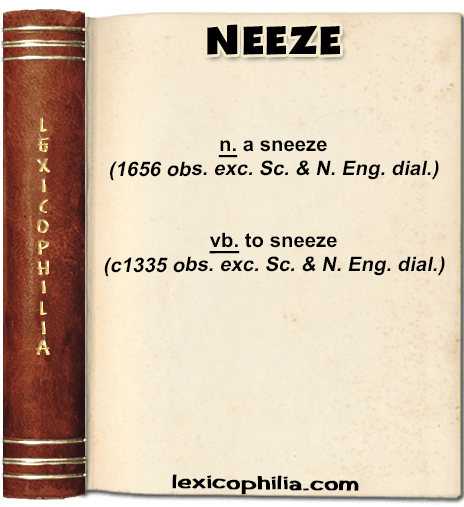
Word of the Day: NEEZE


ETYMOLOGY
From Oxford English Dictionary: either from early Scandinavian (compare Old Icelandic hnjósa , Norwegian nyse , †njosa , Old Swedish niusa (Swedish nysa ), Danish nyse ), or the reflex of an unattested Old English word from the same Germanic base, as is perhaps suggested by the number of cognates in other West Germanic languages: Middle Dutch niesen (Dutch niezen ), Middle Low German nēsen , neysen , neesen , etc., Old High German niesan , niosan , niusan (German niesen)


EXAMPLE (for noun)
“…Soto was in an exteam Agony for his Master: Lamia was grieved and her Hand-Maids heavie, but the Inchantress soon recovered him by watering his Visnomy with her warm Urine (the customary way (it seems) of that Countrey to revive the enfeebled) which not onely illuminated his dim eyes, but circumgyring about his weasand, enforced him to a manly neese, so that within a little time (to their great comfort) he sate up, calling for some Wine, which being brought, he drank a hearty draught to the Inchantress, though one might perceive (with half an eye) wrath and disdain in Capitall Characters on his front; which Lamia perceiving, administred this Julip to allay his fiery Choller….”

From: Don Zara del Fogo; A Mock-Romance
By Samuel Holland, 1656

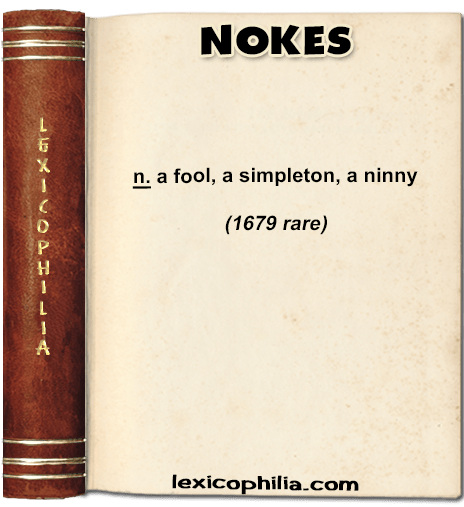
Word of the Day: NOKES


ETYMOLOGY
of uncertain origin


EXAMPLE
“…Foster could make an Irish Lord a Nokes,
And Betty Morris had her City Cokes.
A Woman’s nere so ruin’d, but she can
Be still reveng’d on her Undoer Man:
How lost so e’re, she’ll find some Lover more
A lewd abandon’d Fool, then she’s a Whore…”

From: Artemisa to Cloe.
A letter from a lady in the tovvn to a lady in the country; concerning the loves of the tovvn.
John Wilmot Rochester, 1679

Word of the Day: UNDERFIND


ETYMOLOGY
from under-;
(From E-NED: In Old English, various secondary meanings of under- are represented by such verbs as under(be)ᵹinnan (to begin or attempt), underfón (to receive), underᵹietan-niman-standan (to understand), undersécan (to investigate))


EXAMPLE
“…Ȝif hie cumeð fram mannen, hie cann hwatliche underfinden, an hwos half he is icumen, and ðar after hie hine underfengð …”

From: Vices and Virtues : a Soul’s Confession of its Sins with Reason’s Description of the Virtues,
A Middle-English Dialogue of about 1200 A.D.

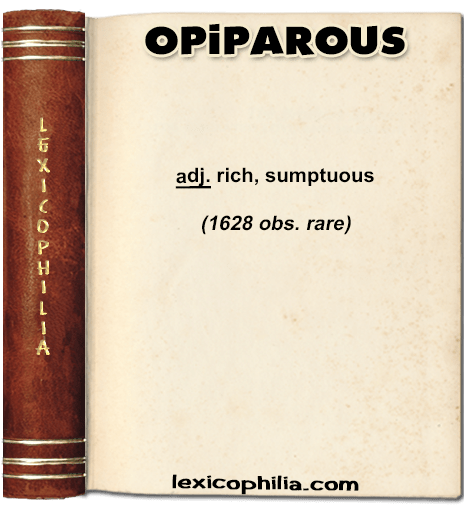
Word of the Day: OPIPAROUS


ETYMOLOGY
from Latin opiparus (richly furnished, sumptuous),
from opem (wealth, means) + parāre (to prepare, furnish, equip) + -ous


EXAMPLE
“…With sweet odours and perfumes, generous wines, opiparous fare, &c., besides the gallantest young men, the fairest virgins, puellae scitulae ministrantes, the rarest beauties the world could afford, and those set out with costly and curious attires…”

From: The Anatomy of Melancholy
By Democritus Junior (Robert Burton)
The Cure of Melancholy. Memb. IV. Exercise Rectified of Body and Mind

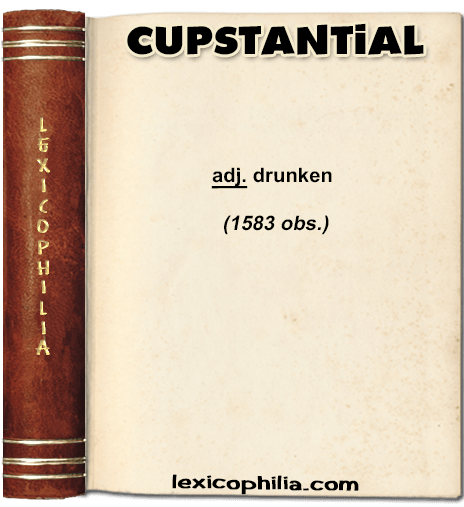
Word of the Day: CUPSTANTIAL


ETYMOLOGY
a humorous perversion of substantial, intended to suggest ‘drunken’


EXAMPLE
“…He that is borne vnder Capricornus shall be a slouenly, ill-fauoured, and vncleane fellowe, bicause the gote is a beast filthie, stinking and vncleane. He that is borne vnder Aquarius and Pisces shall be fortunate by water, bicause watermen haunt the waters, and fishes swim in the same. These be cupstantiall reasons and well seasoned arguments, and as strong to prooue their purpose, as a castell of paper to resist the enimie…”

From: Phillip Stubbes’s Anatomy of the Abuses in England in Shakspere’s Youth, A.D. 1583
Folly of the Zodiacal Signs influencing men.