Word of the Day: FRIMPLE-FRAMPLE

ETYMOLOGY
of obscure origin;
possibly from frample (to put in disorder)

EXAMPLE
“… This is the laund that bigs the winds; winds big the cloods; 
the cloods, the weit, the weit, the grun; an antrin steer 
o syle an rain. Thon
frimple-frample watter rowin 
frae Kenmore tae Dundee is cried the River Tay. 
…”

From: Wild Mushrooms: Writings
By Kate Armstrong, 1993

Word of the Day: CALENT

ETYMOLOGY
from Latin calenscalentem present participle of calere (to be hot)

EXAMPLE
“… The Lion also is a signification of the Sun, for the hairs of his mane do resemble the streaming beams of the Sun, and therefore this constellation is styled with the same Epithets that the Lion and the Sun are, as heat-bearing, aestive, ardent, arent,
calent, hot, flammant, burning, Herculean, mad, horrible, dreadful, cruel, and terrible. It is feigned of the Poets, that this Lion was the Nemaean Lion slain by Hercules, which at the commandment of Juno was fostered in Arcadia, and that in anger against Hercules after his death, she placed him in the heavens. …”

From: The History of Four-Footed Beasts and Serpents describing at large their true and lively figure, their several names, conditions, kinds, virtues …
By Edward Topsell, 1607

Word of the Day: NUGATORIOUS

ETYMOLOGY
from Latin nugatorius (frivolous, insignificant, worthless) + -ous

EXAMPLE
“… The tenet of the Catholick Church concerning Angels and Devils, that they are invisible spirits created of God in their own distinct substances separate from men, is nugatorious: that the Angels are only qualities and motions which God inspires into men, that the Devils are nothing but only boggles in the night to terrifie men arising from mens imaginations. …”

From: Anabaptism, the true fountaine of Independency, Brownisme, Antinomy, Familisme, and the most of the other errours, which for the time doe trouble the Church of England, vnsealed
By Robert Baillie, 1647

Word of the Day: HOUNDSFOOT

ETYMOLOGY
from Dutch hondsvot, German hundsfott (scoundrel, rascal), lit. cunnus canis

EXAMPLE
“… If the Violence of a hooping Cough can cauſe a Rupture , what may not one justly dread from such an Explosion of Wind and Vapour? But hold, Sirs! Methinks I shou’d know the Skream, I have heard something like it before now. O pox! It’s that Hounsfoot Tom Whigg, A Son of a—! He’ll skream to be heard from London to Geneva, when he’s no more hurt than I am this Minute. …”

From: A True and Faithful Account of the Last Distemper and Death of Tom Whigg, Esq., 1710

Word of the Day: GLOAMING

ETYMOLOGY
representing Old English glomung strong feminine, from (on the analogy of ǽfning evening) glom (twilight), probably from the Germanic root glo-;
the etymological sense would thus seem to be the ‘glow’ of sunset or sunrise

EXAMPLE
“… There’s some exceptions, man an’ woman;
But this is Gentry’s life in common.
By this, the sun was out o’ sight,
An’ darker
gloamin brought the night;
The bum-clock humm’d wi’ lazy drone;
The kye stood rowtin’ i’ the loan;
When up they gat, an’ shook their lugs,
Rejoic’d they were na men, but dogs;
An’ each took aff his several way,
Resolv’d to meet some ither day.
…”

From: The Twa Dogs. A Tale
By Robert Burns, 1786

Word of the Day: SCOLOPENDRA

ETYMOLOGY
Latin, from Greek σκολόπενδρα (skolopendra) (centipede)

EXAMPLE (for n. 3.)
“… I have bought it gentlemen, and you in a mist
Shall see what I paid for it, thou hast not drunke yet:
Nere feare the reckning man, more wine , you varletts,
And call your Mistris, your
Scolopendra
If we like her complexion, we may dine here.
…”

From: The Gamester
By James Shirley, 1633

PRONUNCIATION
skol-oh-PEN-druh

Word of the Day: PREVIANT

ETYMOLOGY
from Latin praeviant-praevians, present participle of præviare (to go before), 
from præ-, (pre-) + viare to travel

EXAMPLE
“… Thirdly, and most especially, because that God oftentimes pardoning the ignorance, which men have of Himselfe and the creature, doth so enlighten the heart with His Holy Spirit, that it is suddenly framed without any previant knowledge, to faith and obedience. …”

From: A Treatise Concerning the Trinitie in Unitie
By Alexander Gil, 1601

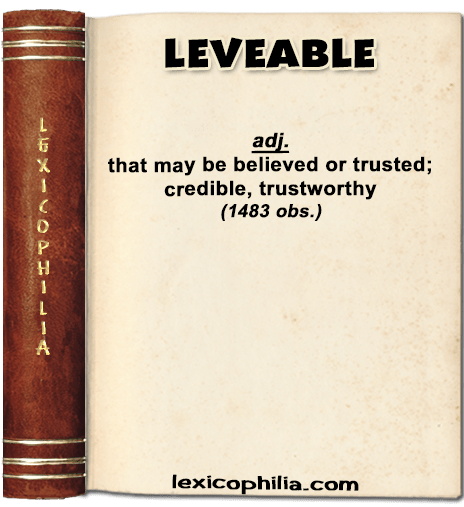
Word of the Day: LEVEABLE

ETYMOLOGY
from leve (to believe, give credence to) + -able

EXAMPLE
“… Fower yomen leveable and discrete, prooved in that facultie of choosing, buyinge, and keepinge of all country wynes; thus everyche of them to pourvey by the Kinge’s commission, to be had by the Thesaurer of housholde’s record and seale, directed to the clerke of the crowne, to make suche commission for suche pourveyours, according to the statutes; …”

From: A Collection of Ordnances and Regulations 
for the Government of the Royal Household
From King Edward III to King William and Queen Mary
Also Receipts in Ancient Cookery
Printed 1790
Liber Niger Domus Regis Edw. IV., a1483

Word of the Day: OFFENCEFUL

ETYMOLOGY
from offence (n.) + -ful

EXAMPLE
” …Now will I let the little squire shift and cleanse himselfe without me, that he may be longer about fetching the Prouost, and in the meane time will I take my Masters sute (of which the little squire tooke note) and put it on my sweet heart Francischina, who shall presently come and sup ply my Masters place, with his Mistris; for the little squire amaz’d with his late affrights and this suddaine offencefull spectacle of his daughter, tooke no certaine note who it was that accosted her; for if he had, he would haue blam’d me for my Master, only the colour of his garment sticks in his fancie, which when he shall still see where he left it, he will still imagine the same person weares it, and thus shall his daughters honour and my Masters be preseru’d with the finest sugar of inuention. …”

From: May-Day A VVitty Comedie
By George Chapman, 1611